

In This Record.
- 01Did South Florida have "condos" before Florida had a condominium law?
Yes, in everything but name. Historians Matthew Gordon Lasner and Deborah Dash Moore trace the region's first co-owned apartment buildings to the years just after World War II, when small groups of buyers developed complexes for themselves.
- 02Stop 1: What made Sea Tower a first in 1957?
Sea Tower, on Fort Lauderdale's north beach, was announced in 1956 and completed in November 1957, according to local historian Jane Feehan, who works from the newspapers of the day.
- 03Stop 2: Why is Crystal House protected as history?
Crystal House stands at 5055 Collins Avenue in Miami Beach. The City of Miami Beach credits it to Morris Lapidus, the architect of the Fontainebleau and Eden Roc, and dates it to 1960.
- 04Stop 3: What did Coral Ridge Towers prove in 1963?
Developers James Hunt and Stephen Calder built Coral Ridge Towers across from Fort Lauderdale's Galt Ocean Mile as a cooperative, just before the Condominium Act passed.
Direct answer: South Florida's oldest shared-ownership towers are older than Florida's condominium law. Cooperatives such as Sea Tower in Fort Lauderdale opened in 1957. The state adopted its Condominium Act on May 13, 1963, and the first true condominiums followed soon after. Five of those early buildings show how the region's shared-ownership towers began.
This is a history tour built from public sources: local historians, a city historic designation and the buildings' own published histories. Nothing here describes the present condition of any building named, and none is identified as a Fortis BuildSafe Solutions client.
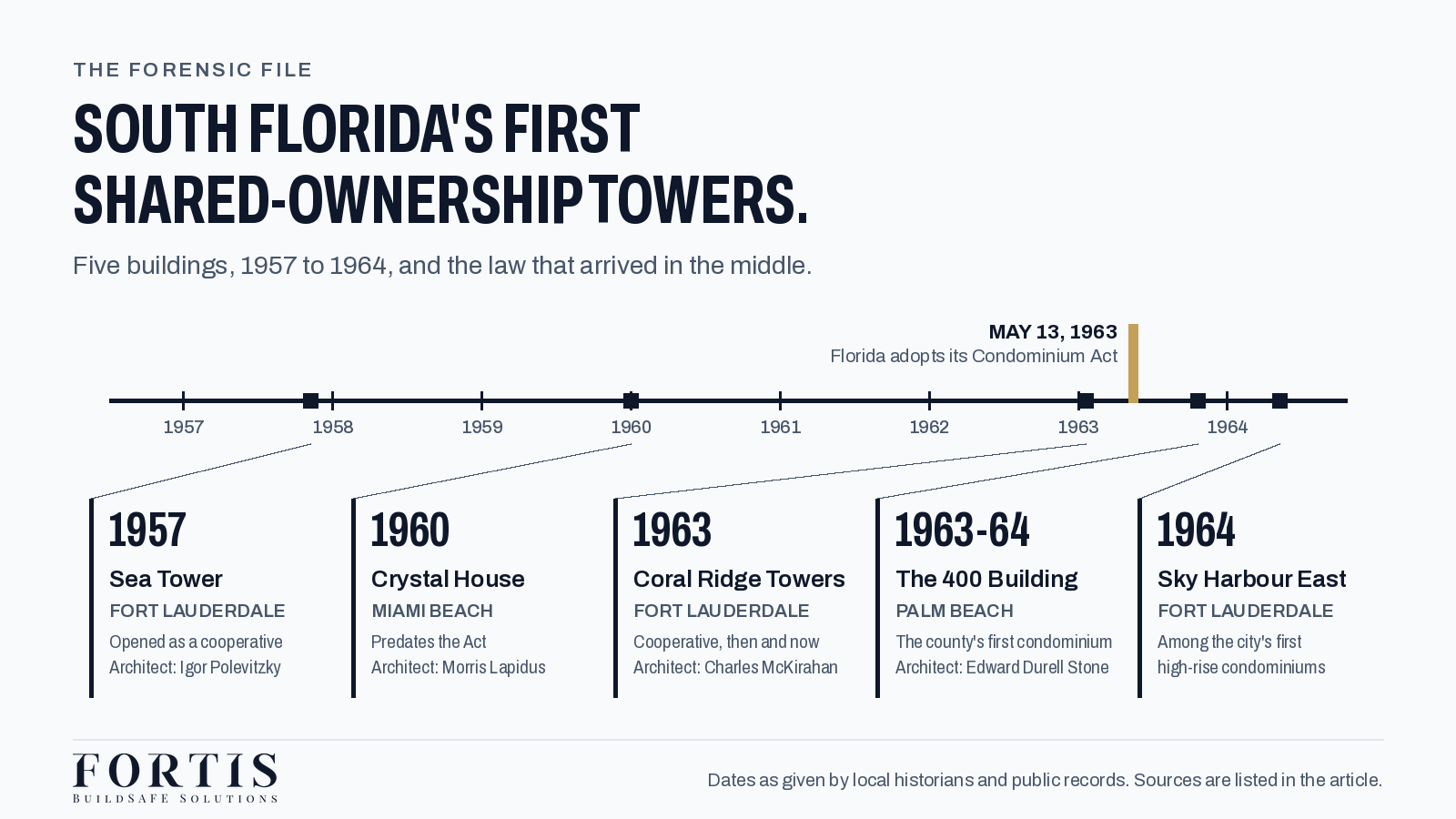
Did South Florida have "condos" before Florida had a condominium law?
Yes, in everything but name. Historians Matthew Gordon Lasner and Deborah Dash Moore trace the region's first co-owned apartment buildings to the years just after World War II, when small groups of buyers developed complexes for themselves. Those were cooperatives: one corporation owns the whole building, and each resident owns shares and a lease.
The condominium, where each owner holds title to a unit, came later. The Florida Law Review recorded the date the following year: Florida adopted a statute recognizing condominium ownership on May 13, 1963. By then the shoreline already had a row of towers.
That is why "oldest condo" is a harder question than it sounds. The oldest buildings are cooperatives. The oldest condominiums are a few years younger. Both are now past sixty.
Stop 1: What made Sea Tower a first in 1957?
Sea Tower, on Fort Lauderdale's north beach, was announced in 1956 and completed in November 1957, according to local historian Jane Feehan, who works from the newspapers of the day. Miami architect Igor Polevitzky designed it. At eleven stories, it was reported that year as the tallest cooperative in Fort Lauderdale.
The building is a favorite of architecture fans for its curved, boomerang-shaped plan. One survey of Florida's mid-century buildings describes half a mile of cantilevered balconies overlaid with concrete screen block. Lasner and Moore list it among the first high-rises of the co-ownership boom, alongside Coral Sea Towers in Bay Harbor Islands, which they date to the same year.
Stop 2: Why is Crystal House protected as history?
Crystal House stands at 5055 Collins Avenue in Miami Beach. The City of Miami Beach credits it to Morris Lapidus, the architect of the Fontainebleau and Eden Roc, and dates it to 1960. Real estate listings commonly give 1961.
It sits inside the Morris Lapidus / Mid-20th Century Historic District, which the city adopted on October 14, 2009. The district recognizes the mid-century oceanfront buildings along that stretch of Collins Avenue.
It also opened before Florida had a condominium statute, so whatever its first owners held on opening day, it was not a condominium as the law now defines one.
Stop 3: What did Coral Ridge Towers prove in 1963?
Developers James Hunt and Stephen Calder built Coral Ridge Towers across from Fort Lauderdale's Galt Ocean Mile as a cooperative, just before the Condominium Act passed. The first tower opened in 1963 with 330 apartments, by Feehan's account. The architect was Charles McKirahan, who also designed the Mai-Kai restaurant.
It remains a cooperative today. Its own published history says it is believed to be the first high-rise cooperative financed through the Federal Housing Administration to include a swimming pool, and says General Electric, which supplied the kitchens, featured the building at the 1964 New York World's Fair.
What it proved was scale: hundreds of households sharing one building and governing it together. Every large association in the region inherited that arrangement.
Stop 4: How did the 400 Building become Palm Beach County's first condominium?
By a change of plan. The Historical Society of Palm Beach County records that a group of local businessmen hired Edward Durell Stone, an architect of the Kennedy Center, to design a six-story, 64-unit rental building with hotel services at 400 South Ocean Boulevard in Palm Beach. It was meant to open for the 1963 to 1964 season.
The economy turned, and the investors converted the project to condominium ownership. The Historical Society calls it the first condominium in Palm Beach County.
Stop 5: Which Fort Lauderdale tower was sold as a condominium from the start?
Sky Harbour East, in Fort Lauderdale, was announced in 1963, the year of the Act, and completed in 1964. Feehan gives it sixteen floors and about 186 apartments, though unit counts for buildings of this age vary by source. She describes it as among the first high-rise condominiums in the city. She also adds a caution worth repeating: "first" depends on whether you count the announcement, the completion or the newspaper story.
What do five sixty-year-old buildings have in common?
Here is the observation we would add as a forensic engineering firm, and it comes straight from the tour. A building's legal age and its physical age are two different numbers. At least three of these five began as something other than a condominium: two opened as cooperatives, and one was designed as a rental. The form of ownership can change while the structure stays the same age. Boards meet this when they learn that the milestone inspection and the structural integrity reserve study are not counted from the same starting point, which we explain in when your condo's SIRS clock starts.
The physical story is a general one, and it is about the era, not about any building on this tour. Mid-century coastal design favored slender slab edges, deep cantilevered balconies, exposed concrete and decorative block, all within reach of salt spray. Those are the places an engineer looks first on a building of that generation, for the reasons we explain in why concrete spalls in South Florida and what your board should watch for on balconies and railings.
They are also not rare. The University of Florida's Warrington College of Business reported that, as of 2022, Florida had 912,000 condominiums aged thirty years or more. Its Bergstrom Real Estate Center, analyzing state Department of Revenue data, found that 74 percent of the condominiums in Miami-Dade, Broward and Palm Beach counties were built in or before 1993. The pioneers on this tour simply got there first.
Why do these buildings still stand out?
Because they are still here, six decades on, cared for by the people who live in them. Age alone tells you very little about a building. Its record of inspection, repair and funding tells you a great deal. That is the reasoning behind Florida's inspection rules for older buildings, which we trace in why Florida inspects older condominiums at all.
Every building tells its story in its structure. If your board wants help reading yours, Fortis is glad to talk.
Sources
- Matthew Gordon Lasner and Deborah Dash Moore, "The Social Origins of the Miami Condo," PLATFORM, July 26, 2021. https://www.platformspace.net/home/the-social-origins-of-the-miami-condo (accessed November 13, 2026)
- "The Florida Condominium Act Applied," Florida Law Review, vol. 17, no. 1, June 1964. https://www.floridalawreview.com/article/78806-the-florida-condominium-act-applied.pdf (accessed November 13, 2026)
- Jane Feehan, "Mid-century modern masterpiece: Sea Tower," Jane's History Nook, September 1, 2023. https://janeshistorynook.blogspot.com/2023/09/mid-century-modern-masterpiece-sea.html (accessed November 13, 2026)
- Jane Feehan, "Fort Lauderdale rises: first high-rise buildings," Jane's History Nook, July 2020. https://janeshistorynook.blogspot.com/2020/07/fort-lauderdale-rises-first-high-rise.html (accessed November 13, 2026)
- RoadsideArchitecture.com, Florida mid-century modern residential buildings (Sea Tower entry). https://www.roadarch.com/modarch/flresi.html (accessed November 13, 2026)
- City of Miami Beach, "This Month in Miami Beach History: Celebrating Morris Lapidus." https://www.miamibeachfl.gov/this-month-in-miami-beach-history-morris-lapidus/ (accessed November 13, 2026)
- Miami Design Preservation League, "Morris Lapidus / Mid-20th Century Historic District," and the City of Miami Beach Planning Department designation report, adopted October 14, 2009. https://mdpl.org/?p=27186 (accessed November 13, 2026)
- Coral Ridge Towers East, "How Coral Ridge Towers East Came About." https://websites.vertilinc.com/Crte/Coral-Ridge/About-Us (accessed November 13, 2026)
- Historical Society of Palm Beach County, "Condominiums," Palm Beach County History Online. https://education.pbchistory.org/expansion/condominiums/ (accessed November 13, 2026)
- University of Florida Warrington College of Business, "Cause and effect of Florida's new condo law," March 5, 2024. https://warrington.ufl.edu/due-diligence/2024/03/05/cause-and-effect-of-floridas-new-condo-law/ (accessed November 13, 2026)
KEEP THE FACTS CURRENT.
Florida's building-safety requirements change by county and by year. The Fortis Brief is a short note from Fortis BuildSafe Solutions, a few times a quarter, on what the rules say now and what a board should do about them.
Milestone Inspections: What Your Board Must Do
A plain-language board guide covering what triggers your Milestone Inspection, which deadline actually applies to your building, the Phase 1 and Phase 2 process, and what the statute requires your board to do next.
Record Appendix.
Related record
Continue Reading

How do you read your Florida condo's structural engineering report?
November 12, 2026
What happens when a Florida condo "fails" its milestone inspection?
November 1, 2026
Is your Florida condo's milestone inspection due at 25 years or 30? The answer depends on your city hall, not your coastline
October 22, 2026
Related Services
Reader questions
Have a question about this?
Every inquiry is reviewed by a Fortis engineer.