
In This Record
- 01What happened in 1974, and why does it still matter?
On August 5, 1974, a federal office building in downtown Miami that housed the Drug Enforcement Administration's field office collapsed, killing seven people.
- 02Where did the "40-year" inspection come from?
Consultants to the Dade County Board of Rules and Appeals recommended inspecting buildings older than 25 years.
- 03When did Broward adopt its program?
Broward County created its Building Safety Inspection Program under Section 110.15 of its administrative amendments to the Florida Building Code, with ten-year re-inspections effective January 1, 2006 and a phased schedule that brought 40-year-old buildings into compliance between 2006 and 2011 (Broward County, Section 110.15).
- 04What changed after 2021?
On June 24, 2021, a portion of Champlain Towers South in Surfside collapsed and 98 people died.
Why does Florida inspect older condominiums at all? A short history of the rules your board lives under
Published: October 16, 2026 · Last reviewed: October 16, 2026
Reviewed by Gabor I. Nagy, PE — Founder
Direct answer: Florida's building inspection rules did not arrive all at once. Miami-Dade began recertifying older buildings in the 1970s after a downtown collapse; Broward followed in 2006; the state added milestone inspections in 2022 and rewrote the trigger in 2023. Your building sits under up to three of those rules at once: the state statute, a county or city recertification program if one exists where you are, and the building department that administers both. Knowing which ones apply explains why two boards a few miles apart can be on different clocks.
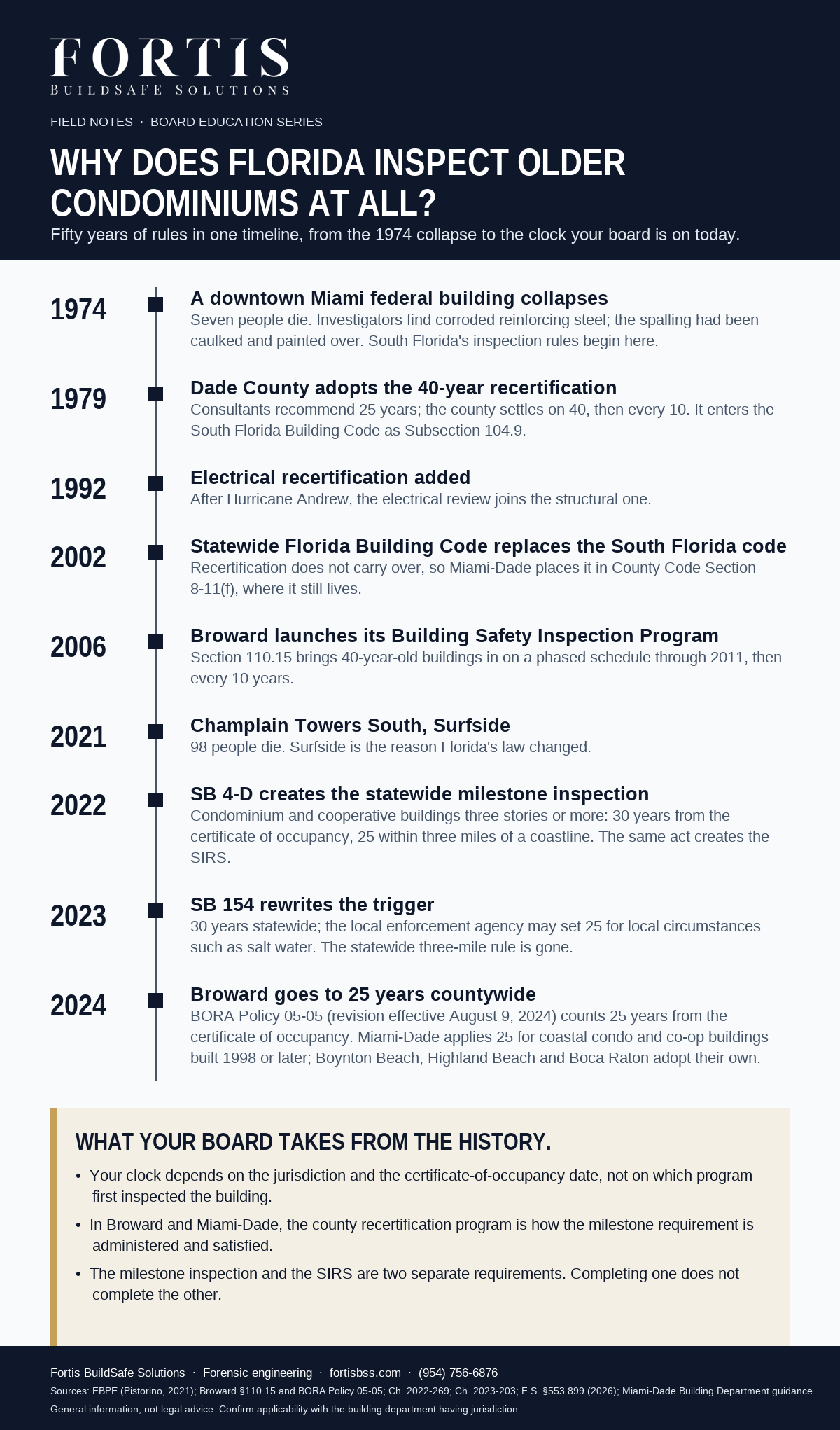
What happened in 1974, and why does it still matter?
On August 5, 1974, a federal office building in downtown Miami that housed the Drug Enforcement Administration's field office collapsed, killing seven people. The investigation found that corroded reinforcing steel inside the concrete had lost its ability to carry the building's own weight. The spalling that would have shown the problem had been caulked and painted over rather than repaired (FBPE, Pistorino 2021).
That finding is the whole story of South Florida building safety in one sentence. Salt air, embedded steel and deferred maintenance produce a failure mode that is hard to see from the lobby and that a trained inspection, with sounding, records review and testing where needed, is designed to find. The policy answer was to require a qualified professional to look on a schedule. The engineer who helped write that program has said the schedule was never meant to replace ongoing maintenance in between (FBPE, Pistorino 2021).
Where did the "40-year" inspection come from?
Consultants to the Dade County Board of Rules and Appeals recommended inspecting buildings older than 25 years. The county settled on 40 years, with a re-inspection every ten years after that. The requirement entered the South Florida Building Code as Subsection 104.9, Recertification, in the 1979 edition. When the statewide Florida Building Code replaced the South Florida code in 2002, the recertification program did not carry over, so Miami-Dade placed it in its own county code at Section 8-11(f), where it still lives. An electrical recertification was added after Hurricane Andrew in 1992 (FBPE, Pistorino 2021).
That is why boards still say "the 40-year." For roughly half a century it was the number. It is history now, not the current trigger, although buildings that went through the 40-year program keep their ten-year cycle.
When did Broward adopt its program?
Broward County created its Building Safety Inspection Program under Section 110.15 of its administrative amendments to the Florida Building Code, with ten-year re-inspections effective January 1, 2006 and a phased schedule that brought 40-year-old buildings into compliance between 2006 and 2011 (Broward County, Section 110.15). The Board of Rules and Appeals administers it under Board Policy 05-05.
So by 2006 South Florida had two county programs, both built on the same 1974 lesson, both at 40 years. The rest of the state had nothing comparable.
What changed after 2021?
On June 24, 2021, a portion of Champlain Towers South in Surfside collapsed and 98 people died. Surfside is the reason Florida's law changed. It is not why Fortis does this work; the profession was inspecting aging concrete under the county programs for decades before 2021.
The Legislature answered in a special session. Senate Bill 4-D, Chapter 2022-269, was approved on May 26, 2022 and took effect the same day. It created the statewide milestone inspection for condominium and cooperative buildings "three stories or more in height" and authorized local enforcement agencies to set timelines and penalties (Florida Senate, SB 4-D). The same act restricted the waiver of reserves for structural components, which is the origin of the Structural Integrity Reserve Study (SIRS) that now lives in Florida Statutes §718.112(2)(g).
As first written, SB 4-D set the milestone at 30 years, or 25 years for buildings within three miles of a coastline. That coastal rule had a short life.
What did 2023 change?
Senate Bill 154, Chapter 2023-203, approved June 9, 2023, rewrote the trigger and changed "three stories" to "three habitable stories" (Florida Senate, SB 154). The statute now says a building must have its milestone inspection by December 31 of the year it reaches 30 years from its certificate of occupancy, and every ten years after. It then lets the local enforcement agency determine that local circumstances, including proximity to salt water, justify 25 years instead (F.S. §553.899(3)). The words "three miles" no longer appear in §553.899. A three-mile rule can still be real where a county or city adopted one locally, as Miami-Dade and Boca Raton did; what no longer exists is a statewide three-mile rule.
The same subsection carried transition deadlines for buildings that were already past the trigger age when the law arrived: December 31, 2024 for buildings that reached the age before July 1, 2022, and December 31, 2025 for buildings that reached it between July 1, 2022 and December 31, 2024. It also lets the local enforcement agency accept a substantially similar inspection performed before July 1, 2022, which is how some earlier county recertifications were credited (F.S. §553.899(3)). The inspection itself is performed by a Florida-licensed engineer or architect in two phases: a visual Phase One, and a Phase Two only if Phase One finds substantial structural deterioration.
The practical effect was to put the 25-versus-30 decision in local hands, which is why the answer is now local.
How did the counties respond?
Broward acted early. Its Section 110.15 amendment effective September 19, 2022 set 30 years with 25 for coastal condominiums and cooperatives; the current revision of Board Policy 05-05, effective August 9, 2024, applies 25 years countywide, counted from the certificate of occupancy, with the former 40-year buildings continuing on their ten-year schedule (BORA Policy 05-05).
Miami-Dade kept its program in Section 8-11(f) and, through the Building Department's published recertification guidance, applies 25 years to condominium and cooperative buildings three stories or taller, built in 1998 or later and located within three miles of the coastline, and 30 years otherwise (Miami-Dade Building Recertification). Palm Beach County has no countywide recertification program of the Broward or Miami-Dade kind, so the milestone is administered by each city's building department, and by the county's Building Division in unincorporated areas. Boynton Beach adopted 25 years in 2022 for condominium and cooperative buildings of three or more stories and threshold buildings; Highland Beach adopted 25; Boca Raton applies 25 within three miles of the coast and 30 elsewhere. For every other Palm Beach jurisdiction, the working assumption is the state's 30 years, confirmed with that building department before anyone relies on it.
In Broward and Miami-Dade, the county recertification program is how the milestone requirement is administered and satisfied. In Boynton Beach, the city's recertification program is how the milestone requirement is administered and satisfied for the buildings it covers. The report forms, the structural and electrical components and the filing steps are set by each program, so the paperwork is not identical from one county to the next even though the obligation is one obligation.
What should a board take from the history?
Three things.
First, the clock you are on depends on which jurisdiction the building is in and when it received its certificate of occupancy, not on which program it was first inspected under. A building that completed a 40-year recertification in 2016 is on a ten-year cycle and is due again in 2026; the 2016 report does not cover the 2026 cycle.
Second, the milestone inspection and the SIRS are two separate requirements with two separate origins inside the same 2022 act. The milestone examines the structure; the SIRS examines the condition and remaining life of the structural and major building components in order to fund their replacement. Completing one does not complete the other.
Third, the whole structure rests on the 1974 finding: concrete problems hide, and the fix is a scheduled look by someone qualified to see them. Everything since has adjusted the schedule, the scope and the reporting duties. Nothing has changed the reason.
From the field: on the buildings we recertified this year, the boards that knew their program's history asked the right first question, which is the certificate-of-occupancy date, and the ones that did not asked about the 40-year inspection.
If your board is unsure which program and which year apply to your building, the milestone deadline calculator gives a first answer in a minute, and a Fortis PE can confirm it against the building department's records. Your assessment will be performed and sealed by a Fortis PE working to the Fortis Standard.
Related: Milestone Inspection vs. Building Recertification in Florida · Broward or Miami-Dade: which recertification clock is your building on? · Milestone Inspections vs. SIRS in Florida
This article is general information about the history of Florida's inspection programs. It is not legal advice and not a determination about any specific building. Applicability, deadlines, extensions and current revisions must be confirmed with the building department having jurisdiction.
Sources
- John C. Pistorino, PE, SI, "A look at building recertification in South Florida," Florida Board of Professional Engineers, October 1, 2021. https://fbpe.org/a-look-at-building-recertification-in-south-florida/ (accessed October 16, 2026)
- Broward County, Chapter 1, Section 110.15, Building Safety Inspection Program (effective September 19, 2022). https://www.broward.org/CodeAppeals/Documents/Chapter%201%2c%20Section%20110.15%20%28Effective%20September%2019%2c%202022%29.pdf (accessed October 16, 2026)
- Broward County Board of Rules and Appeals, Board Policy 05-05, Building Safety Inspection Program, revision effective August 9, 2024. https://www.broward.org/CodeAppeals/Documents/BORA%20Policy%2005-05.pdf (accessed October 16, 2026); revision date verified against the copy posted by the City of Pompano Beach, https://cdn.pompanobeachfl.gov/city/pages/building_inspections/Board-Policy-05-05_Amendments-08092024.pdf (accessed October 10, 2026)
- Florida Senate, SB 4-D (2022D), Chapter 2022-269, enrolled text. https://www.flsenate.gov/Session/Bill/2022D/4D (accessed October 16, 2026)
- Florida Senate, CS/CS/SB 154 (2023), Chapter 2023-203. https://www.flsenate.gov/Session/Bill/2023/154 (accessed October 16, 2026)
- Florida Statutes §553.899 (2026). https://www.flsenate.gov/Laws/Statutes/2026/553.899 (accessed October 16, 2026)
- Miami-Dade County, Building Recertification (Building Department guidance applying County Code §8-11(f)). https://www.miamidade.gov/global/economy/building/recertification.page (accessed October 16, 2026)
- City of Boynton Beach, Ordinance 22-025 (adopted November 14, 2022) and Building Recertification Submittal Instructions. https://www.boynton-beach.org/490/Building-Recertification-Submittal-Instr (accessed October 16, 2026)
- City of Boca Raton, Building Recertification Inspection Program (Ordinance 5589). https://www.myboca.us/2091/Building-Recertification-Inspection-Prog (accessed October 16, 2026)
- Palm Beach County Building Division, Mandatory Milestone Inspections (unincorporated county). https://discover.pbc.gov/pzb/building/Pages/Mandatory-Milestone-Inspections.aspx (accessed October 16, 2026)
KEEP THE FACTS CURRENT.
Florida's building-safety requirements change by county and by year. The Fortis Brief is a short note from Fortis BuildSafe Solutions, a few times a quarter, on what the rules say now and what a board should do about them.
Milestone Inspections: What Your Board Must Do
A plain-language board guide covering what triggers your Milestone Inspection, which deadline actually applies to your building, the Phase 1 and Phase 2 process, and what the statute requires your board to do next.
Record Appendix
Sources
Sources
- Florida Senate, SB 4-D
- Florida Senate, SB 154
- F.S. §553.899(3)
- Miami-Dade Building Recertification
- https://cdn.pompanobeachfl.gov/city/pages/building_inspections/Board-Policy-05-05_Amendments-08092024.pdf
- https://discover.pbc.gov/pzb/building/Pages/Mandatory-Milestone-Inspections.aspx
- Florida Statute §718.112(2)(g)
- Florida Statute §553.899
Related record
Continue Reading


How much does a milestone inspection cost in Florida, and what drives the price?
October 16, 2026
Broward or Miami-Dade: which recertification clock is your building on?
October 10, 2026

What does a Fortis engineer photograph on your balcony, and why?
October 9, 2026
Related Services
Reader questions
Have a question about this?
Every inquiry is reviewed by a Fortis engineer.