

In This Record
- 01When is the inspection due, and who pays?
Under §553.899 a milestone inspection is required for a residential condominium or cooperative building three habitable stories or more.
- 02What are you actually paying for?
The statute defines two phases.
- 03What drives the Phase 1 number?
The statute sets the scope.
- 04When does Phase 2 add to the cost?
Phase 2 is triggered by substantial structural deterioration, which the statute defines as substantial structural distress or weakness that negatively affects the building's general structural condition and integrity (§553.899(2)(b)).
How much does a milestone inspection cost in Florida, and what drives the price?
Published: October 16, 2026 · Last reviewed: October 16, 2026
Reviewed by Gabor I. Nagy, PE — Founder
Direct answer: There is no single price for a Florida milestone inspection, and this article does not quote one. It explains what sets the number: the building (stories, footprint, balconies), access, whether a Phase 2 inspection is triggered, and the building department's fee. Florida Statutes §553.899(4) places the cost on the association for the parts of the building it maintains.
When is the inspection due, and who pays?
Under §553.899 a milestone inspection is required for a residential condominium or cooperative building three habitable stories or more. The statewide default is 30 years after the certificate of occupancy, then every ten years. A local enforcement agency may adopt 25 years instead under §553.899(3)(b); Broward County, the City of Boynton Beach and Boca Raton (for buildings within three miles of the coast) have done so, and Miami-Dade applies 25 years to coastal condominium and cooperative buildings of three or more stories built in 1998 or later. Confirm the trigger with the building department that has jurisdiction, because that date is where the budget starts.
Once the building department sends written notice, Phase 1 must be completed within 180 days (§553.899(6)). In Broward and Miami-Dade, where the county recertification program is how the milestone requirement is administered and satisfied, the county's own notice sets the response window (Miami-Dade's current notice gives 90 days from the notice date).
Section 553.899(4) is the sentence boards should read first: the association "is responsible for all costs associated with the milestone inspection attributable to the portions of a building which the association is responsible to maintain under the governing documents of the association." For a building that is entirely a condominium, that means the association pays. For a mixed-use building, the same subsection makes the owner of the non-condominium portion jointly responsible for arranging the inspection, and the cost follows the maintenance responsibility. Either way, the inspection is a known, dated obligation, which is an argument for carrying it in the annual budget rather than meeting it with a special assessment.
Related: What happens during a Florida milestone inspection, from the first call to the Phase 1 report?
What are you actually paying for?
The statute defines two phases.
Phase 1 is a visual examination of the habitable and nonhabitable areas of the building, including its major structural components, and a qualitative assessment of its structural condition (§553.899(7)(a)). "Qualitative" means the engineer describes what the structure is doing and how serious it looks; Phase 1 does not involve testing. The statute also says what a milestone inspection is not: it is not an inspection for compliance with the building code or the fire safety code.
Phase 2 is required only if Phase 1 identifies substantial structural deterioration. The statute says a Phase 2 inspection "may involve destructive or nondestructive testing at the inspector's direction" (§553.899(7)(b)). That is where the cost can change materially.
Both phases end in a report signed and sealed by the engineer or architect in responsible charge and submitted to the building department (§553.899(8)).
What drives the Phase 1 number?
The statute sets the scope. The price is set by how much building there is to examine and how hard it is to reach. In Fortis BuildSafe Solutions' experience, four things matter most, in roughly this order.
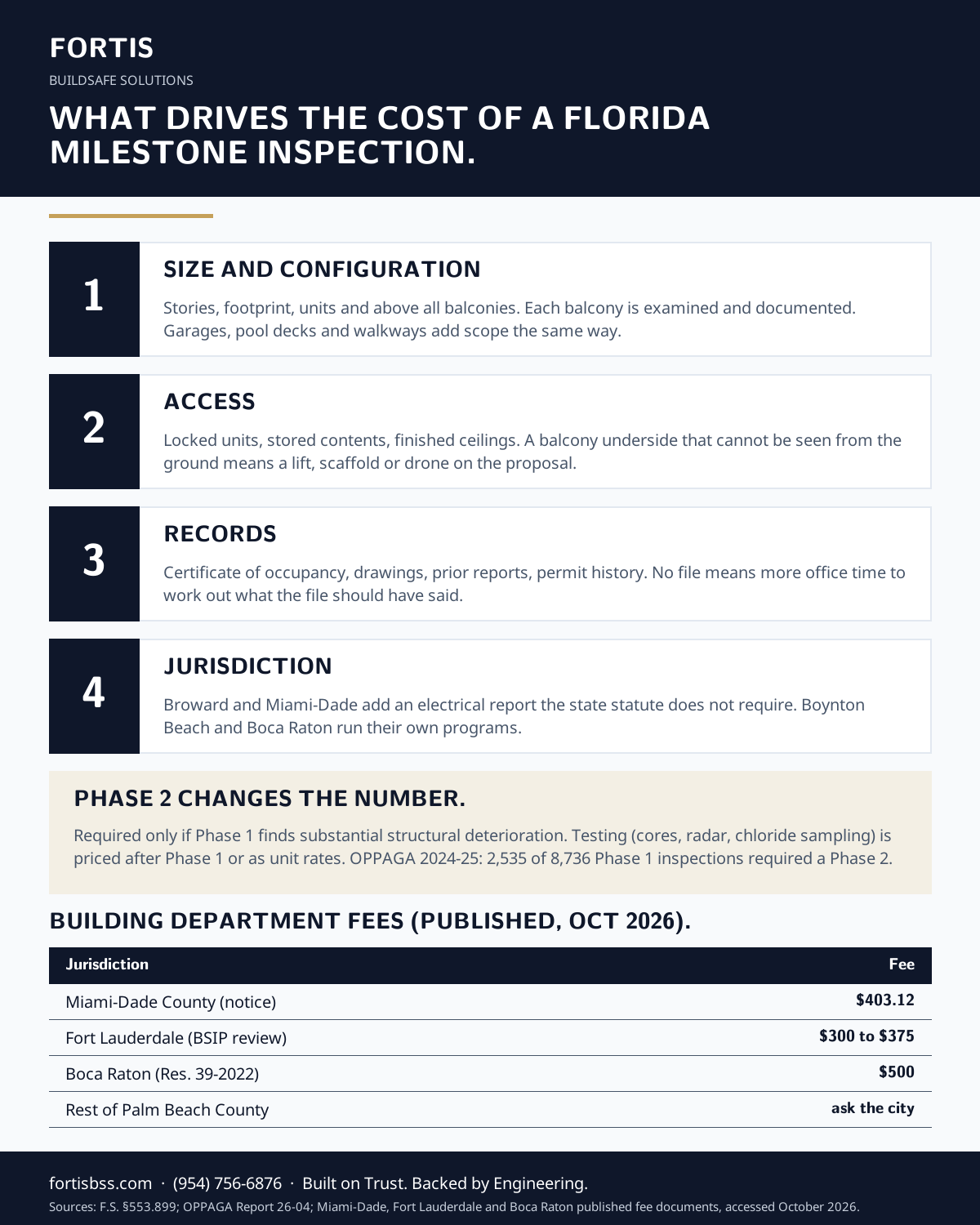
1. Size and configuration. Stories, footprint, number of units and the number of balconies. A balcony is a cantilevered or supported slab with its own edge, guard connection, drainage path and underside, and a documented examination of each one takes time. A six-story building with 40 balconies is a different job from a six-story building with none. Parking garages, pool decks over occupied space and elevated walkways add scope the same way.
2. Access. The engineer has to see the structure. Finished ceilings, stored contents, locked units and landscaping against a foundation line all cost time. Where a balcony underside or a high elevation cannot be examined from the ground or from inside the building, the proposal will usually include a lift, scaffold or drone, and that is a line item whether the engineer provides it or the association does. Buildings where the manager has keys ready, residents notified and balconies cleared take less time to inspect than buildings where the engineer spends the first hour knocking on doors.
3. Records. Most engineers will ask for the certificate of occupancy, the original drawings if they exist, prior inspection and repair reports and permit history. A building with that file in order is faster to assess. A building with no drawings and no record of its last balcony restoration takes longer, because the engineer has to work out from the structure what the file should have said. The site time may be the same; the office time is not.
4. Jurisdiction. In Broward and Miami-Dade the county recertification program adds an electrical report that the state statute does not require, prepared by a professional qualified in that field. Whether that is a second firm or the same firm depends on who the engineer has on staff, and it is part of the price in those two counties. Boynton Beach and Boca Raton run their own city programs with their own scope and fees. In the rest of Palm Beach County the state statute is administered by the city or county building department with jurisdiction.
Age by itself is not a cost driver. A 30-year-old building in good condition can be a short job; a 25-year-old building with chronic water intrusion is not.
When does Phase 2 add to the cost?
Phase 2 is triggered by substantial structural deterioration, which the statute defines as substantial structural distress or weakness that negatively affects the building's general structural condition and integrity (§553.899(2)(b)). The definition specifically excludes ordinary surface imperfections (cracks, distortion, sagging, deflections, misalignment, signs of leakage, peeling finishes) unless the engineer determines they are a sign of something substantial underneath.
If Phase 2 is required, the engineer has 180 days after submitting the Phase 1 report to file a progress report with a timeline for completing it (§553.899(7)(b)). Where Phase 2 identifies deterioration requiring repair, the owner must commence repairs within 365 days of receiving the Phase 2 report (§553.899(11)).
Phase 2 costs more because it is different work. Phase 1 is observation. Phase 2 can involve testing: taking a concrete core, opening a finish to expose reinforcing steel, ground-penetrating radar to locate steel without opening anything, chloride sampling to measure salt in the concrete, or a load evaluation. The scope follows what Phase 1 found, so a Phase 2 price is normally quoted after Phase 1, or as unit rates (per core, per test, per day) rather than a lump sum.
How often does it happen? The state's first milestone data report, published by OPPAGA in July 2026, counted 8,736 completed Phase 1 inspections for 2024 and 2025 and 2,535 inspections for which a Phase 2 was required (1,899 in 2024 and 636 in 2025). Of those, 1,575 Phase 2 inspections had been completed. The report cautions that Broward, Miami-Dade and Palm Beach jurisdictions with combined-phase programs were directed to report a required Phase 2 only where repairs were needed, so the statewide share is a rough planning figure, not a prediction for any one building. The same report counted 1,587 extensions, citing difficulty finding engineers and engineer workloads, which is its own reason to start early.
Related: What happens after a Phase 2 milestone inspection report in Florida?
What does the building department charge?
The engineer's fee is the larger number. The department's fee is smaller, but it is real and it is often left out of the budget. Published figures as of October 16, 2026:
- Miami-Dade County (unincorporated): the current Notice of Required Recertification states a fee of $403.12, which is the county fee schedule's $375.00 recertification application fee with the 7.5 percent surcharge applied. The schedule also lists $106.59 per trade to re-review a resubmitted report, $62.50 for an extension request and $157.25 per trade for a quality-control inspection, before surcharge.
- City of Fort Lauderdale (Broward's Building Safety Inspection Program): $300 to $375 for report review, depending on which of the city's two published documents governs (the fee schedule revised September 17, 2026 lists $300; the program page states $375). Budget the higher figure.
- City of Boca Raton: $500 per recertification under Resolution 39-2022.
- Elsewhere in Palm Beach County: no countywide fee. Ask the building department with jurisdiction.
Cities inside Broward and Miami-Dade run their own permit counters and may publish their own schedules, so confirm the number with the department that will actually receive the report.
Why is the lowest bid not always the lowest cost?
Three reasons, none of them about the engineer's hourly rate.
Phase 1 documentation sets up Phase 2. Phase 2 is triggered by what the structure shows, not by how thin the report is. But the Phase 2 engineer works from the Phase 1 record. A Phase 1 report that locates and photographs each condition lets Phase 2 go straight to the question; one that does not means re-establishing the baseline first, which is paid time.
A report the department sends back costs more and takes longer. Miami-Dade charges per trade to re-review a resubmitted report, and the submission deadline does not pause while the report is out. A report written to the department's form, with the photographs the form asks for, has the best chance of clearing review the first time.
The report is the baseline for the next ten years. The next milestone inspection, the Structural Integrity Reserve Study and any future buyer's or insurer's due diligence can all refer back to it. A report that says "balconies: fair" tells the next engineer very little. A report that says which balconies showed what, with photographs, is the comparison point.
One more thing to check when comparing proposals: under §553.899 an engineer or architect who intends to bid on the repair work their own inspection recommends must disclose that in writing. Ask.
Six questions to ask every proposer: How many hours on site, and by whom? How many balconies and other elements are included? What is photographed, and to what standard? Is the electrical report included where the county requires it? Is the department's fee in or out? And what happens to the price if Phase 2 is triggered?
Related: What your board should ask before hiring an engineer
From the field: the single thing that most often adds half a day to a South Florida Phase 1 is not the structure, it is the balcony that cannot be reached. One locked unit, or a balcony stacked with furniture and planters, means a return visit or a lift that was not in the proposal. A manager who walks the building with the notice in hand two weeks before the inspection removes that cost entirely.
What should a board do with this?
Confirm the trigger date with the building department. Carry the inspection and the department's fee in the budget for the year it is due. Clear access before the engineer arrives. Put the drawings and prior reports in one folder. Ask every proposer the same six questions. And read the Phase 1 report when it comes, because that document, more than the invoice, is what the association bought.
If your board is planning its first milestone inspection or comparing proposals, Fortis BuildSafe Solutions is glad to walk through the scope questions with you. Every Fortis assessment is performed to one documented standard and sealed by a licensed Florida PE who exercised direct responsible charge.
Sources
- Fla. Stat. §553.899 (2026), Mandatory structural inspections for condominium and cooperative buildings, subsections (2)(a), (2)(b), (3)(a)–(b), (4), (6), (7)(a), (7)(b), (8), (11). http://www.leg.state.fl.us/statutes/index.cfm?App_mode=Display_Statute&URL=0500-0599/0553/Sections/0553.899.html. Accessed October 16, 2026.
- OPPAGA, Milestone Inspection Reporting Data 2024 and 2025, Report 26-04 (July 2026), pp. 2, 8–11, 13. https://oppaga.fl.gov/Documents/Reports/26-04.pdf. Accessed October 16, 2026.
- Miami-Dade County, Notice of Required Recertification (fee $403.12; 90-day response). https://www.miamidade.gov/permits/library/recertification-building.pdf. Accessed October 16, 2026.
- Miami-Dade County, Building Department Fee Schedule, Implementing Order 4-63, Section I, Sub-section I (recertification application $375.00; re-review $106.59 per trade; extension $62.50; QC inspection $157.25 per trade; 7.5 percent surcharge). https://www.miamidade.gov/permits/library/fees/building-fee-schedule.pdf. Accessed October 16, 2026.
- City of Fort Lauderdale, Building Safety Inspection Program ($375 review fee). https://www.fortlauderdale.gov/Government/Departments/Development-Services/Permitting-Services/Building-Safety-Inspection-Program. Accessed October 16, 2026.
- City of Fort Lauderdale, Building Fees, Rev. 10, revision date 9/17/2026 ("Forty-Year Building Safety Inspection" $300). https://www.fortlauderdale.gov/files/assets/public/v/1/development-services/documents/building-fees.pdf. Accessed October 16, 2026.
- City of Boca Raton, Building Recertification Inspection Program (Ord. 5589; Resolution 39-2022, $500). https://myboca.us/2091/Building-Recertification-Inspection-Prog. Accessed October 16, 2026.
This article is general information for condominium and cooperative boards, not legal, financial or engineering advice for a specific building. Fee amounts are those published by the named jurisdictions on the access date and change; confirm with the building department having jurisdiction.
KEEP THE FACTS CURRENT.
Florida's building-safety requirements change by county and by year. The Fortis Brief is a short note from Fortis BuildSafe Solutions, a few times a quarter, on what the rules say now and what a board should do about them.
Milestone Inspections: What Your Board Must Do
A plain-language board guide covering what triggers your Milestone Inspection, which deadline actually applies to your building, the Phase 1 and Phase 2 process, and what the statute requires your board to do next.
Record Appendix
Sources
Sources
- http://www.leg.state.fl.us/statutes/index.cfm?App_mode=Display_Statute&URL=0500-0599/0553/Sections/0553.899.html
- https://oppaga.fl.gov/Documents/Reports/26-04.pdf
- https://www.miamidade.gov/permits/library/recertification-building.pdf
- https://www.miamidade.gov/permits/library/fees/building-fee-schedule.pdf
- https://www.fortlauderdale.gov/Government/Departments/Development-Services/Permitting-Services/Building-Safety-Inspection-Program
- https://www.fortlauderdale.gov/files/assets/public/v/1/development-services/documents/building-fees.pdf
- Florida Statute §553.899
Related record
Continue Reading

Why does Florida inspect older condominiums at all? A short history of the rules your board lives under
October 17, 2026
Broward or Miami-Dade: which recertification clock is your building on?
October 10, 2026

What does a Fortis engineer photograph on your balcony, and why?
October 9, 2026
Related Services
Reader questions
Have a question about this?
Every inquiry is reviewed by a Fortis engineer.