
In This Record
- 01
- 02What happens when the building department's notice arrives?
The local building department sends the association a written notice.
- 03What does the engineer review before arriving?
A good inspection starts at a desk, not on a balcony.
- 04Who shows up on inspection day, and what do they do?
The statute requires a licensed architect or engineer to perform the visual examination, and allows milestone services to be delivered by a team with an architect or engineer acting as the registered design professional in responsible charge.
What happens during a Florida milestone inspection, from the first call to the Phase 1 report?
Published: October 4, 2026 · Last reviewed: October 4, 2026
Reviewed by Gabor I. Nagy, PE — Founder
Direct answer: A Phase 1 milestone inspection is a visual examination of a building's habitable and nonhabitable areas, including its major structural components, performed by a Florida-licensed architect or engineer. Phase 1 is complete when that professional submits the report to the local building department. If the inspection identifies substantial structural deterioration, a Phase 2 inspection must follow. (F.S. §553.899)
Most boards meet the milestone inspection the same way: a letter from the building department, a deadline, and very little sense of what will actually happen at the building. This post walks through a Phase 1 inspection in order, from the notice to the report, so your board knows what to expect and what to have ready.
Which buildings need a milestone inspection, and when?
F.S. §553.899 applies to buildings that are three habitable stories or more and subject, in whole or in part, to residential condominium ownership under chapter 718 or residential cooperative ownership under chapter 719. It does not apply to one- to four-family dwellings of three or fewer habitable stories.
The first inspection is due by December 31 of the year the building reaches 30 years from the date its certificate of occupancy was issued, and every 10 years after that. A local enforcement agency may move the first inspection to 25 years if it determines that local circumstances, such as proximity to salt water, require it. Several South Florida jurisdictions have done so, so confirm your building's trigger with the building department that has jurisdiction.
In Broward and Miami-Dade, the county recertification program is how the milestone requirement is administered and satisfied. Broward's Building Safety Inspection Program, for example, starts at 25 years, repeats every 10 years, and requires a report confirming the building's structural and electrical safety. The structural walkthrough below is the core of it; recertification adds its own report forms, the electrical report, and filing with the building department that has jurisdiction (in many Miami-Dade cities, the city's own). See Milestone Inspection vs. Building Recertification in Florida.
What happens when the building department's notice arrives?
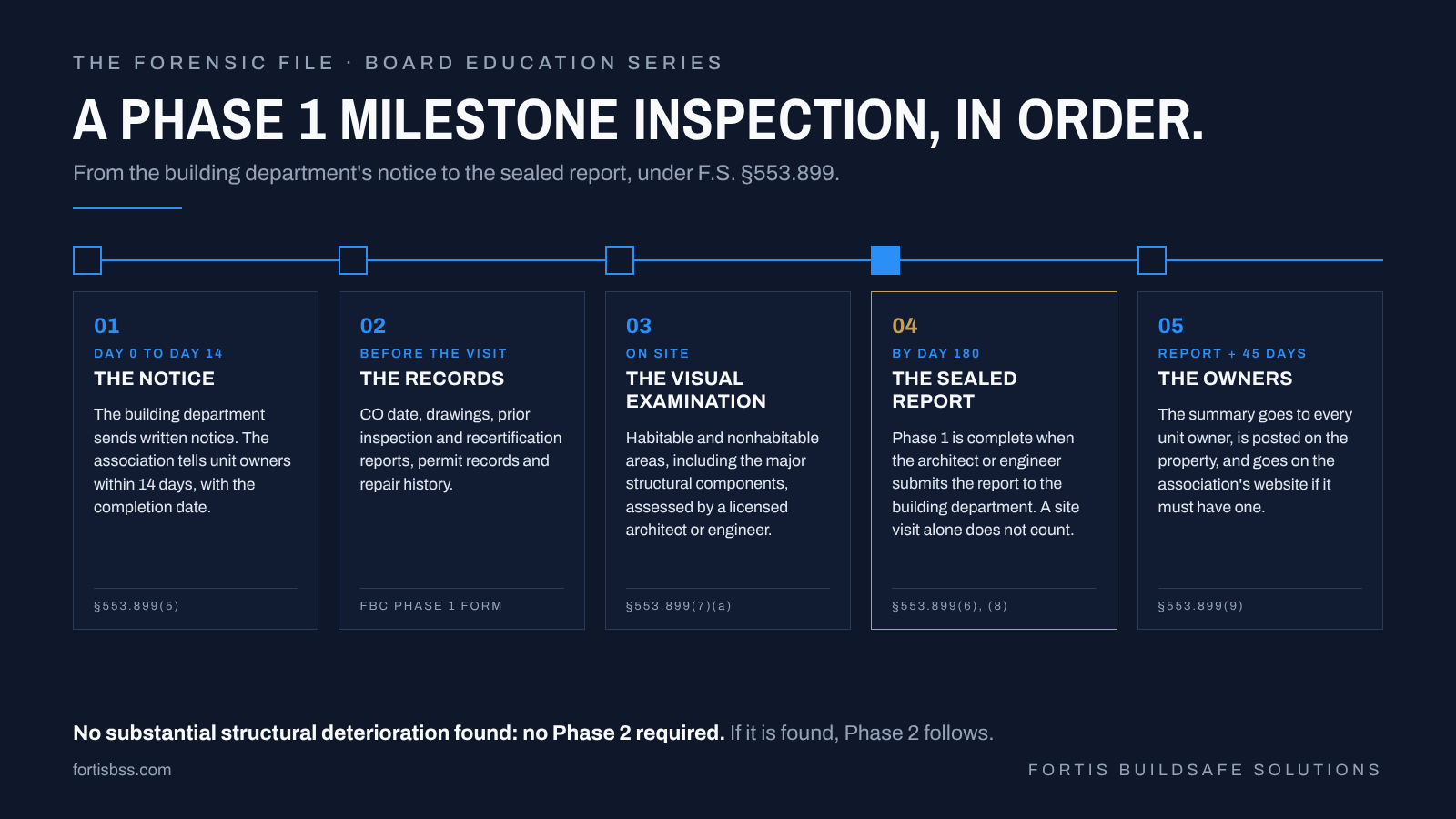
The local building department sends the association a written notice. Two clocks start when it arrives:
- 14 days: the association must notify unit owners that a milestone inspection is required and give the date by which it must be completed.
- 180 days: Phase 1 must be completed. "Completed" has a specific meaning: the architect or engineer has submitted the Phase 1 report to the local enforcement agency by email, U.S. mail or commercial delivery. A site visit alone does not meet the deadline.
For an initial inspection, the building department may extend the deadline for good cause, such as an engineer already under contract who cannot reasonably finish in time. Plan as if no extension is coming.
When comparing proposals, expect a written disclosure: an architect or engineer bidding on the milestone inspection must state whether it intends to bid on any repair or replacement work the inspection may recommend. See What Your Board Should Ask Before Hiring an Engineer.
What does the engineer review before arriving?
A good inspection starts at a desk, not on a balcony. Before the site visit, the inspecting engineer typically asks for:
- The building's certificate of occupancy date and the notice from the building department
- Original drawings and any later structural or restoration drawings, if the association has them
- Prior inspection and recertification reports, and any engineering letters written since
- Permit records and any open code-enforcement or unsafe-structure cases
- A list of past repairs and alterations: concrete restoration, waterproofing, balcony or railing work, with dates and contractors, including any work done without a permit
- Known problem areas: leaks, cracks residents have reported, areas already under watch
The statute does not make any single document a precondition to starting, but the standard Phase 1 report form includes a review of existing documents and permit records. Each one sharpens the findings, because the engineer can compare what the building is doing now with what it was designed and repaired to do.
Who shows up on inspection day, and what do they do?
The statute requires a licensed architect or engineer to perform the visual examination, and allows milestone services to be delivered by a team with an architect or engineer acting as the registered design professional in responsible charge. At Fortis, a Fortis PE and Inspector work as a team on site, to one documented standard, and the assessment is sealed by a licensed Florida PE who exercised direct responsible charge. See Who Can Sign and Seal a Florida Milestone Inspection?
The visit itself is methodical. The team works through the building area by area, observing and documenting conditions with photographs and notes. Each finding is recorded with enough context to locate it again: a wide shot to show where it is, and a close shot to show what it is.
How long it takes depends on the building's size, layout and condition, and on how quickly the team can reach each area.
What gets inspected?
The statute defines Phase 1 as "a visual examination of habitable and nonhabitable areas of a building, including the major structural components of a building," with "a qualitative assessment of the structural conditions." The exact scope follows the building's structural system, but it typically covers:
- Parking garages and slabs, where concrete and reinforcing steel are most exposed
- Columns, beams, load-bearing walls and floor systems, wherever they can be seen
- Balconies, walkways, stairs and railings
- Exterior walls and facades, including windows and doors where they affect structural safety
- Roofs and roof structures
- Foundations, where visible
- Stairwells, corridors and other common areas, and structural elements in mechanical and service spaces
Because Phase 1 covers habitable as well as nonhabitable areas, the engineer may need to enter some units, for example to see a balcony that is only reachable from inside or distress a resident has reported.
Phase 1 is primarily visual and qualitative. Where the engineer needs to understand what the eye shows, limited hands-on checks are part of the work: the standard Phase 1 report form asks, for example, whether samples were chipped out for examination in spalled areas. Formal destructive or nondestructive testing is what Phase 2 is for.
What is the engineer actually looking for?
The legal threshold is "substantial structural deterioration," which the statute defines as "substantial structural distress or substantial structural weakness that negatively affects a building's general structural condition and integrity." The statute lists surface imperfections that do not meet that bar on their own: cracks, distortion, sagging, deflections, misalignment, signs of leakage and peeling of finishes. Any of them can still qualify if the engineer determines it is a sign of substantial structural deterioration.
So the engineer is reading the building, not just cataloguing blemishes. Rust staining at a crack, displacement, or a pattern repeating across several floors may point to corrosion or movement behind the surface, and a hollow sound when a surface is tapped adds evidence of delamination. None of these settles the cause on its own. A crack in one place may be cosmetic; the same crack in a structurally sensitive location may not be. Deciding which, and whether it needs further inspection, is the engineer's judgment, and it is why the inspection is performed by a licensed professional. See Why does concrete spall in South Florida?
What does the Phase 1 report contain?
At the end of each phase, the statute requires the report to:
- Bear the seal and signature, or electronic signature, of the licensed architect or engineer who performed the inspection
- Indicate the manner and type of inspection behind the report
- Identify any substantial structural deterioration, within a reasonable professional probability based on the scope of the inspection, describe its extent, and identify recommended repairs
- State whether unsafe or dangerous conditions, as the Florida Building Code defines them, were observed
- Recommend remedial or preventive repairs for items that are damaged but are not substantial structural deterioration
- Identify and describe any items requiring further inspection
The architect or engineer also prepares a separate summary of, at minimum, the material findings and recommendations. The sealed report and summary go to the association, to the local building official, and to any owner of a part of the building that is not under condominium or cooperative ownership.
What happens after the report?
If no substantial structural deterioration is found, Phase 2 is not required. Damaged items below that threshold still get recommended remedial or preventive repairs in the report. Those do not trigger Phase 2, but they belong in the board's plan and budget, and some may still need permits or action under local code.
If substantial structural deterioration is found, a Phase 2 inspection is required. Phase 2 may involve destructive or nondestructive testing at the inspector's direction, and the architect or engineer performing it must submit a progress report, with a timeline for completing Phase 2, to the local enforcement agency within 180 days of submitting the Phase 1 report. Repairs identified in the Phase 2 report must then be commenced within 365 days of the report being received, under a local ordinance that may set an earlier date. See What happens after a Phase 2 milestone inspection report in Florida?
Either way, the association has duties of its own. Within 45 days of receiving a report, whatever it finds, the association must distribute a copy of the inspector-prepared summary to each unit owner (by mail or personal delivery, and by electronic transmission to owners who have consented to it), post it in a conspicuous place on the property, and publish the full report and summary on the association's website if it is required to have one. Your association's attorney and the building department can confirm exactly what applies to your building.
What should your board have ready?
A smooth Phase 1 comes down to four things:
- One point of contact who can answer questions and coordinate access, usually the property manager.
- Documents gathered in one place: the CO date, the building department notice, drawings, prior reports, permit records and a repair history.
- Access arranged in advance: keys to roofs, mechanical rooms and garages, and resident notices for any balconies or units that need to be entered.
- The deadlines in view. Owners notified within 14 days of the notice; the Phase 1 report submitted within 180 days. Starting early leaves room for a Phase 2 if one is needed.
The bottom line
A milestone inspection is a structured, documented look at how your building is actually performing. Knowing the sequence (notice, records, site visit, sealed report, summary to owners) lets a board plan the work instead of reacting to it.
If your board has received a notice, or expects one, Fortis can walk through your building's timeline with you. Your assessment will be performed and sealed by a Fortis PE working to the Fortis Standard. Learn more about milestone inspections and building recertification, or contact Fortis.
This article is general information about Florida law as of the date above. It is not legal advice. Requirements can vary by jurisdiction; confirm your building's specific obligations with your local building department and association counsel.
Sources
- Florida Statutes §553.899, Mandatory structural inspections for condominium and cooperative buildings (2026 Florida Statutes), subsections (2)(a)–(b), (3)(a)–(c), (4), (5), (6), (7), (8), (9), (11), (12). The Florida Senate. https://www.flsenate.gov/Laws/Statutes/2026/553.899 (accessed 2026-10-04)
- Florida Building Commission, Phase 1 Milestone Inspection Report Form (based on Florida Building Code, Existing Building, Chapter 18). https://www.floridabuilding.org/fbc/thecode/2023_Code_Development/2023_Code_Resources/Phase-1-Milestone_Inspection_Report_Form-B.pdf (accessed 2026-10-04)
- City of Fort Lauderdale, Building Safety Inspection Program (Broward County BORA Policy 05-05). https://www.fortlauderdale.gov/Government/Departments/Development-Services/Permitting-Services/Building-Safety-Inspection-Program (accessed 2026-10-01)
- Miami-Dade County, Building Recertification. https://www.miamidade.gov/global/economy/building/recertification.page (accessed 2026-10-04)
KEEP THE FACTS CURRENT.
Florida's building-safety requirements change by county and by year. The Fortis Brief is a short note from Fortis BuildSafe Solutions, a few times a quarter, on what the rules say now and what a board should do about them.
Milestone Inspections: What Your Board Must Do
A plain-language board guide covering what triggers your Milestone Inspection, which deadline actually applies to your building, the Phase 1 and Phase 2 process, and what the statute requires your board to do next.
Record Appendix
Sources
Sources
- https://www.flsenate.gov/Laws/Statutes/2026/553.899
- https://www.floridabuilding.org/fbc/thecode/2023_Code_Development/2023_Code_Resources/Phase-1-Milestone_Inspection_Report_Form-B.pdf
- https://www.fortlauderdale.gov/Government/Departments/Development-Services/Permitting-Services/Building-Safety-Inspection-Program
- https://www.miamidade.gov/global/economy/building/recertification.page
- Florida Statute §553.899
Related record
Continue Reading
Why does Florida inspect older condominiums at all? A short history of the rules your board lives under
October 17, 2026


How much does a milestone inspection cost in Florida, and what drives the price?
October 16, 2026
Broward or Miami-Dade: which recertification clock is your building on?
October 10, 2026
Related Services
Reader questions
Have a question about this?
Every inquiry is reviewed by a Fortis engineer.