

In This Record
- 01Are these two different programs, or one program run twice?
One program, run twice with different dials.
- 02Which date does each county count from?
This is the larger trap, and it is invisible on the notice.
- 03How long do you have once the notice arrives?
Sixty days is a ceiling, not an entitlement.
- 04Can you file before the notice arrives?
In Miami-Dade, yes, explicitly.
Broward or Miami-Dade: which recertification clock is your building on?
Published: October 10, 2026 · Last reviewed: October 10, 2026
Reviewed by Gabor I. Nagy, PE — Founder
Direct answer: For covered condominium and cooperative buildings, both counties run one inspection that satisfies the state milestone requirement. Broward's report is due 180 days from receiving the notice; Miami-Dade's is due 90 days from the notice date. Broward counts age from the certificate of occupancy and starts at 25 years; Miami-Dade counts the Property Appraiser's year built and starts at 30.
If you manage buildings on both sides of that line, the response window is the difference you notice first. It is not the one most likely to catch you out.
One qualification before any of the numbers below are useful. These are the county programs. Municipalities in both counties administer them locally and may add their own requirements, forms and timelines. Confirm the building department with jurisdiction before you put a date in a tracker.
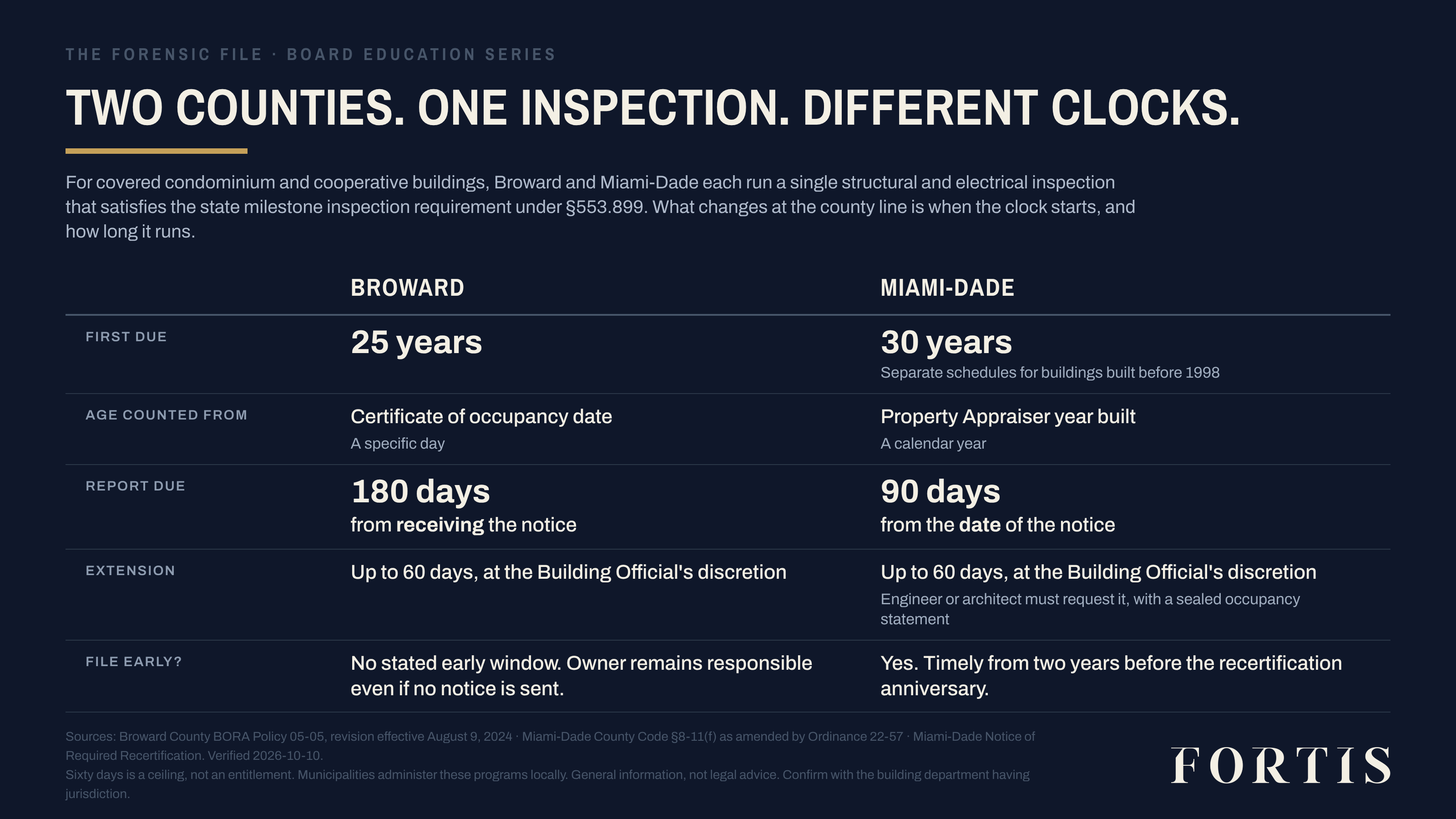
Are these two different programs, or one program run twice?
One program, run twice with different dials.
Broward — Building Safety Inspection Program (BSIP). Established by the Florida Building Code Broward County Amendments §110.15 and implemented through Board of Rules and Appeals Policy 05-05, currently in its August 9, 2024 revision.
Miami-Dade — Building Recertification. Governed by §8-11(f) of the Miami-Dade County Code as amended by Ordinance 22-57, applied through the Building Department's published recertification guidance.
Both programs require inspection of structure and electrical systems and a signed and sealed report filed with the building official. Both repeat on a ten-year cycle.
Neither program covers every building. Broward's policy excludes specified government buildings, certain small residential dwellings, fee-simple townhouses and qualifying minor structures. Miami-Dade excludes single-family residences, duplexes and defined minor structures. Both county programs also reach a wider set of buildings than the state milestone statute does: §553.899 applies to qualifying residential condominium and cooperative buildings of three or more habitable stories, while county recertification picks up commercial and other building types that have no milestone obligation at all.
A Florida licence is necessary but not always sufficient. Both counties impose additional qualification requirements for threshold buildings, and the electrical portion must be prepared by a professional qualified in that discipline. One licensed professional does not automatically cover both disciplines on every building.
Both programs do satisfy the state milestone inspection for the buildings they cover. Broward's policy says the program "shall serve as compliance for both phase one and phase two milestone inspection requirements" under §553.899. Miami-Dade's code says recertification "shall serve as compliance with any 'milestone inspection' requirements under section 553.899, Florida Statutes," and the county's guidelines call its program "synonymous with the State of Florida Milestone Inspection Program."
In Broward and Miami-Dade, the county recertification program is how the milestone requirement is administered and satisfied. It is one inspection process, not two stacked obligations.
That sentence is about the inspection, not about everything the statute asks of you. §553.899 also carries obligations that a county filing does not discharge on its own: what the report must contain, the separate summary, distribution to owners, and the Phase Two sequence where substantial structural deterioration is identified. Satisfying the inspection requirement is not the same as satisfying every statutory duty attached to it.
Two things it does not mean
An older recertification does not automatically cover the current cycle. The question is rarely whether a building has ever been recertified. It is whether it has been recertified for the cycle it is in now. Broward does expressly treat buildings that completed the prior 40-Year Building Safety Inspection Program as compliant for that cycle, and §553.899(3)(d) allows certain earlier structural inspections to be accepted where the statutory criteria are met. Neither of those removes the next recurring inspection.
It does not discharge the Structural Integrity Reserve Study. The SIRS under §718.112(2)(g) is a separate requirement on its own ten-year cycle, triggered by the condominium's creation, and a county recertification does not satisfy it. The statute does, however, allow two specific efficiencies: a qualifying inspection performed within the previous five years may be used in place of the visual inspection portion of the SIRS, and an association may delay a required SIRS for up to the two consecutive budget years immediately following a milestone inspection. Reusing an inspection component is not the same as the obligation going away.
Related reading: Milestone Inspection vs. Building Recertification in Florida: What's the Difference?
Which date does each county count from?
This is the larger trap, and it is invisible on the notice.
The entry ages differ by five years. Broward starts at 25. Miami-Dade's general trigger is 30. A manager who carries Broward's instinct across the line mis-dates a Miami-Dade building by half a decade.
The counting methods differ too. Broward measures from the date the certificate of occupancy was issued. Miami-Dade defines Building Age as the difference between the present year and the year-built information recorded with the County Property Appraiser, and the code is explicit that renovations do not reset it. Renovation history still matters to the engineering assessment; it just does not move the age calculation.
And state law uses a third reference. §553.899(3)(a) sets milestone age from the certificate of occupancy date. Where a Miami-Dade building's Property Appraiser year built does not line up with its certificate of occupancy, those two records can point at different years. Reconcile them with the building department having jurisdiction before you commit to a schedule rather than picking the later one.
Miami-Dade also has cohorts that do not follow the plain 30-year rule:
- Built 1993 or later: 30 years, then every ten years.
- Built 1983 through 1992: initial recertification was due no later than December 31, 2024, then every ten years.
- Certain 1993 through 1997 buildings, including coastal condominium and cooperative buildings of three or more stories within three miles of the coast, were also caught by the December 31, 2024 transitional deadline rather than an ordinary 30-year anniversary.
- Built 1982 or earlier: the cycle runs from a Building Age of 40 years.
- Coastal condominium and cooperative buildings of three or more stories, built 1998 or later and within the county's three-mile coastal zone: 25 years, then every ten years.
If your Miami-Dade building predates 1998, do not reason from the 30-year number. Confirm its cohort against the Property Appraiser's year built and the building department.
How long do you have once the notice arrives?
| Broward (BSIP) | Miami-Dade (Recertification) | |
|---|---|---|
| Report due | 180 days from receiving the notice | 90 days from the date of the notice |
| Extension | Up to 60 days, at the Building Official's discretion | Up to 60 days, at the Building Official's discretion, on written request from the engineer or architect with a signed and sealed statement that the building may continue to be occupied |
| Latest deadline if the full extension is granted | 240 days from receipt | 150 days from the notice date |
| First due | 25 years | 30 years, with separate schedules for older cohorts |
| Then | Every ten years from the year the previous inspection was required | Every ten years from the recertification anniversary |
Sixty days is a ceiling, not an entitlement. Neither extension is automatic, a shorter one may be granted, and neither belongs in a schedule as available time.
The anchors are different. Broward's period runs from receipt of the notice; Miami-Dade's published deadline runs from the date printed on it. Ten days in the mail therefore consumes part of a Miami-Dade owner's window and does not consume a Broward owner's. That is a difference in the response period only. In both counties the underlying age-based obligation exists whether or not a notice ever arrives.
Miami-Dade's extension needs lead time. The request has to come from the engineer or architect and carry a signed and sealed statement that the building may continue to be occupied. Whether an extension is more or less likely to be granted in one county than the other is not something the ordinances tell you. What they do tell you is that the Miami-Dade request depends on a professional who has already inspected the building, so it is not something an owner can assemble alone at the end of the window.
Filing late does not move your next due date in Broward. Subsequent inspections are due every ten years from the year the initial inspection was required, regardless of when the previous report was finalized or filed. Applied to an example: a building that files three years after its required year would generally have seven years, not ten, until the next cycle.
What you file is a package, not a letter. Broward requires the applicable BORA structural and electrical forms, a supporting narrative and colour photographs of adequate resolution. Miami-Dade has its own report criteria and forms and, where applicable, additional certifications including parking lot illumination and waterway guardrails. A generic engineering letter is not a submission in either county.
Can you file before the notice arrives?
In Miami-Dade, yes, explicitly. A recertification report is timely if submitted any time between two years prior to the building's applicable recertification anniversary and 90 days after the Notice of Required Inspection, including any extension granted.
Read that as a scheduling instruction. The planning horizon is two years, and the 90-day notice is the end of the runway rather than the start of it. Starting early is not the same as being finished early: the report still has to meet the inspection criteria and clear the jurisdiction's review, and findings can add work. But a manager who schedules from the anniversary is rarely the one negotiating with the 90-day window.
In Broward the mirror question comes up constantly: the building passed 25 and no notice has arrived. The absence of a notice is not a defence. Broward's materials state that owners remain responsible for timely inspections and repairs even if the building official does not send the Notice of Required Inspection. The 180-day response period runs from receipt, so it has not started, but the underlying obligation has. That is not a licence to wait indefinitely. Contact the building department, confirm the required year for that building, and engage a professional without waiting for paper.
What are the repair clocks, and how do they differ?
A report with findings starts a different clock from the one above, and the two counties diverge here as well.
Broward generally allows 180 days from the inspection report date to complete required repairs, subject to the policy's qualifications and to the building official specifying otherwise. Miami-Dade works from a 150-day period running from the date of the Notice of Required Inspection for completing indicated repairs that do not require permits and for obtaining any necessary permits, with permitted work then following the permit timeline.
Note the anchors again. Broward's repair period starts when the report is issued. Miami-Dade's starts back at the notice, which means time spent producing the report is time already spent against it.
What happens if the deadline passes?
The controllable version of this question is the one worth answering first: file within the window, or have your engineer request the extension before the window closes. Both counties give you a path that does not involve enforcement, and most buildings take it.
For the ones that do not, both counties act on their own initiative, and the mechanisms differ.
Broward. Where an owner or association fails to submit the report on time or to seek an extension in accordance with the policy, the Building Official shall elect either a Special Magistrate or a Code Enforcement Board to conduct a hearing addressing the failure. That is mandatory language about selecting the forum. The Building Official may also file a complaint with the Department of Business and Professional Regulation, and a building that is not repaired may be deemed unsafe and unfit for occupation. Florida's code enforcement framework under §162.09 permits daily fines where the statutory procedures and findings are met; it is not an automatic meter that starts the day a report is late.
Miami-Dade. The county's notice form states that failure to submit results in a Civil Violation Notice or ticket without further notice. Separate mechanisms exist for civil penalties, liens and unsafe structures proceedings, and they are not interchangeable: which applies depends on the nature of the violation. Miami-Dade also has a tool Broward's policy does not name. Where an owner has neither filed nor requested an extension and the Building Official is uncertain whether the building may continue to be safely occupied, the official may order electrical utilities disconnected. That order carries safeguards: certified mail and posting, a minimum posting period of five business days, a bar on proceeding where a health or medical issue has been reported and not yet addressed, and a stop if an engineer or architect provides a signed and sealed safe-occupancy statement.
One duty sits above all of this. If the inspecting professional finds an actual or immediate danger of failure or collapse, or a health, windstorm or fire hazard, that goes to the building official within 24 hours of discovery, and in Broward to the owner or association immediately. Other findings that would endanger life or property if left unaddressed carry a ten-day reporting deadline, which runs from notifying the owner or other required parties rather than from the moment of discovery. Those duties do not wait for the report, the deadline, or the next board meeting.
What about Palm Beach County?
Different structure entirely. Palm Beach has no countywide recertification program comparable to Broward's or Miami-Dade's, so §553.899 governs directly. The enforcement authority is the municipal building department, or the county building department for unincorporated areas.
The statewide default is 30 years, then every ten. The 25-year trigger applies only where a local enforcement agency has adopted it. Boynton Beach and Highland Beach have; Boca Raton runs its own three-mile ordinance. For any other municipality, confirm the applicable program, threshold age and reporting requirements with the authority having jurisdiction before assigning a due date. Do not assume the state default applies simply because a city is not named here.
What should a portfolio manager do with this?
1. Identify the jurisdiction before the rule. County first, then municipality. Broward's policy expressly allows a local enforcement agency to prescribe its own timelines and penalties, and municipalities in both counties administer these programs locally.
2. Pull the right date field for each county. Certificate of occupancy for Broward. Property Appraiser year built for Miami-Dade, reconciled against the certificate of occupancy where the two disagree. If one column in your tracker feeds both counties, it is wrong for one of them.
3. Work from the anniversary, not the notice. Miami-Dade will accept a report two years early. Broward's cycle is anchored to the year the inspection was required and does not slip when you do.
4. Engage the engineer before you need the extension. In Miami-Dade the request must come from the engineer or architect with a sealed occupancy statement. An unengaged professional cannot file it for you.
5. Re-verify the current revision before relying on any of this. Broward's Policy 05-05 was amended August 9, 2024, and older copies with different numbers are still posted on several municipal websites. Miami-Dade's §8-11(f) was substantially amended by Ordinance 22-57. Fees change. Confirm against each county's current document and the building department having jurisdiction.
In our experience the Miami-Dade extension is rarely refused. It is simply requested too late to matter, because the request has to come from an engineer and the owner has not retained one yet. The buildings that miss the 90-day window are almost never the buildings with a problem. They are the buildings that treated the notice as the start of the process.
Fortis BuildSafe Solutions is a forensic engineering firm working across Broward, Miami-Dade and Palm Beach. Every assessment is performed to one documented standard and sealed by a licensed Florida PE who exercised direct responsible charge.
If you are holding a notice and are not certain which clock the building is on, the jurisdiction, the age source and whether it has been recertified for its current cycle settle it quickly. We are glad to tell you where a building stands before it goes to the board.
Building Recertification · Contact us
This article is general information about county inspection programs. It is not legal advice and not a determination about any specific building. Program applicability, exemptions, current revisions and fees must be confirmed with the building department having jurisdiction.
Sources
- Broward County Board of Rules and Appeals, Policy 05-05, Building Safety Inspection Program, revision effective August 9, 2024 — §I.C (exclusions), §I.D (prior 40-Year program), §I.E (compliance for phase one and phase two milestone inspections), §I.F (DBPR complaint), §III.B.1 (25 years, certificate of occupancy date), §III.B.2 (ten-year cycle from the year the initial inspection was required), §III.C.3 (failure to notice does not relieve the owner), §III.D (qualification requirements), §III.E.1 (180 days from receiving the notice), §III.E.2 (extension of not more than 60 days), §III.E.3 (required forms and photographs), §III.E.5 (local enforcement agency may prescribe timelines and penalties), §III.F (24-hour and ten-day reporting duties), §III.G (repair period), §III.H.2 (Special Magistrate or Code Enforcement Board). County program home: https://www.broward.org/CodeAppeals/ (accessed 2026-10-10). August 9, 2024 revision text verified against the copy posted by the City of Pompano Beach, which matches: https://cdn.pompanobeachfl.gov/city/pages/building_inspections/Board-Policy-05-05_Amendments-08092024.pdf (accessed 2026-10-10)
- Broward County BORA, Building Safety Inspection Program brochure (2024) — program overview; owner responsibility persists even if the notice is not sent. https://www.broward.org/codeappeals/documents/2024%20Bora%20BSIP%20Brochure.pdf (accessed 2026-10-10)
- Miami-Dade County Code §8-11, as amended by Ordinance 22-57 — §8-11(e) (24-hour and ten-day duty to report), §8-11(f)(1)(D) (Building Age from the Property Appraiser's year-built record), (f)(2)(A) (30-year general trigger; 1983–1992 and pre-1982 cohorts; compliance with §553.899; exclusions), (f)(2)(E) (90 days from the Notice of Required Inspection), (f)(2)(E)(vi) (timely from two years prior to the recertification anniversary), (f)(2)(F) (150-day repair and permit period), (f)(2)(I) (60-day extension on written request of an engineer or architect with a signed and sealed occupancy statement), (f)(2)(J) (electrical utility disconnection and safeguards). https://www.miamidade.gov/building/library/amended-miami-dade-ordinance.pdf (accessed 2026-10-10)
- Miami-Dade County, Notice of Required Recertification (official notice form) — 90 days from the date of the notice; Civil Violation Notice or ticket without further notice. https://www.miamidade.gov/permits/library/recertification-building.pdf (accessed 2026-10-10)
- Miami-Dade County, Recertification program page — submittal requirements, age cohorts, extension, penalties. https://www.miamidade.gov/global/economy/building/recertification.page (accessed 2026-10-10)
- Miami-Dade County, Recertification General Considerations and Guidelines (2025) — program "synonymous with the State of Florida Milestone Inspection Program"; additional required certifications. https://www.miamidade.gov/resources/economy/building/documents/general-consideration-guidelines-2025.pdf (accessed 2026-10-10)
- Florida Statutes §553.899, milestone inspection, 2026 edition — (3)(a) age from certificate of occupancy; (3)(d) acceptance of certain earlier inspections. https://www.flsenate.gov/Laws/Statutes/2026/553.899 (accessed 2026-10-10)
- Florida Statutes §718.112(2)(g), structural integrity reserve study, 2026 edition — subparagraph 8 (a qualifying inspection within the previous five years may be used in place of the visual inspection portion) and subparagraph 9 (delay of up to two consecutive budget years following a milestone inspection). https://www.flsenate.gov/Laws/Statutes/2026/718.112 (accessed 2026-10-10)
- Florida Statutes §162.09, code enforcement penalties, 2026 edition. https://www.flsenate.gov/Laws/Statutes/2026/162.09 (accessed 2026-10-10)
KEEP THE FACTS CURRENT.
Florida's building-safety requirements change by county and by year. The Fortis Brief is a short note from Fortis BuildSafe Solutions, a few times a quarter, on what the rules say now and what a board should do about them.
Building Recertification in Broward & Miami-Dade: What Boards Must Do
Covers county-specific recertification timelines, what the engineer's report must include, and how to avoid city-imposed fines.
Record Appendix
Sources
Sources
- https://cdn.pompanobeachfl.gov/city/pages/building_inspections/Board-Policy-05-05_Amendments-08092024.pdf
- https://www.miamidade.gov/building/library/amended-miami-dade-ordinance.pdf
- https://www.miamidade.gov/permits/library/recertification-building.pdf
- https://www.miamidade.gov/global/economy/building/recertification.page
- https://www.miamidade.gov/resources/economy/building/documents/general-consideration-guidelines-2025.pdf
- https://www.flsenate.gov/Laws/Statutes/2026/553.899
- https://www.flsenate.gov/Laws/Statutes/2026/718.112
- https://www.flsenate.gov/Laws/Statutes/2026/162.09
- Florida Statute §553.899
- Florida Statute §718.112(2)(g)
Related record
Continue Reading

Why does Florida inspect older condominiums at all? A short history of the rules your board lives under
October 17, 2026
How much does a milestone inspection cost in Florida, and what drives the price?
October 16, 2026

What does a Fortis engineer photograph on your balcony, and why?
October 9, 2026
Related Services
Reader questions
Have a question about this?
Every inquiry is reviewed by a Fortis engineer.