
In This Record
- 01What is a milestone inspection?
The milestone inspection is Florida's statewide baseline, created after the 2021 Surfside collapse under Florida Statutes §553.899.
- 02What is building recertification?
Building recertification is the older, more developed inspection program run by the building departments in Broward and Miami-Dade counties — the same authorities that administer the milestone requirement there.
- 03Do we need both a milestone inspection and a recertification?
For qualifying condo and co-op buildings in Broward and Miami-Dade: no.
- 04What are the current trigger ages?
Each county runs its own schedule, and they don't use the same numbers.
The short answer: A milestone inspection is Florida's statewide structural inspection requirement for qualifying aging condominium and cooperative buildings. Building recertification is the local inspection program in Broward and Miami-Dade counties, covering both structural and electrical systems. For qualifying condo and co-op buildings in those counties, the recertification process incorporates the applicable structural inspection requirement — so boards complete one inspection process, not both.
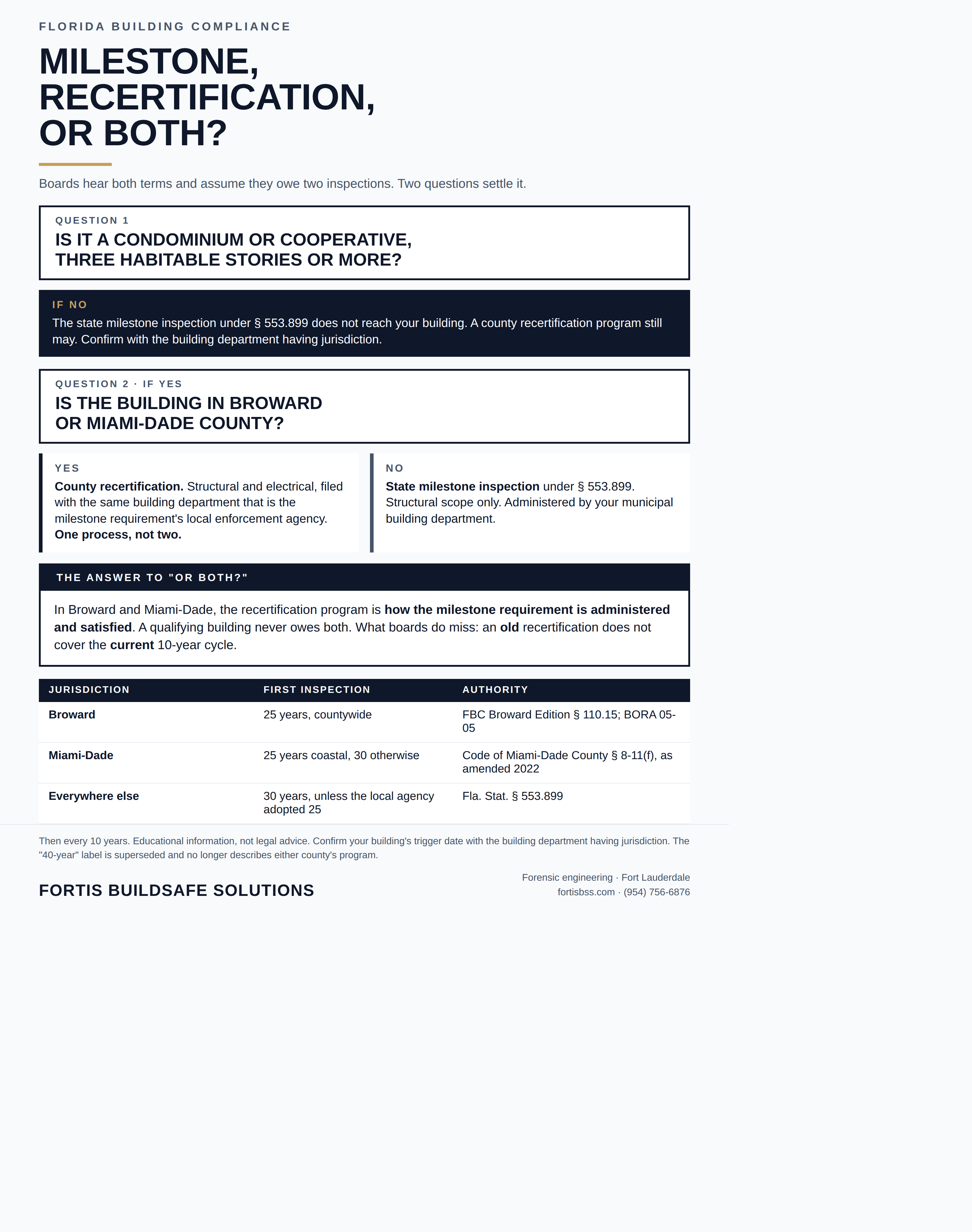
Boards hear both terms — "milestone inspection" and "recertification" — and reasonably assume they owe two separate inspections. For qualifying buildings in Broward and Miami-Dade, they are not. The program is not a second requirement stacked on top of the milestone inspection. It's the evolved version of the milestone program — recertification.
The difference at a glance
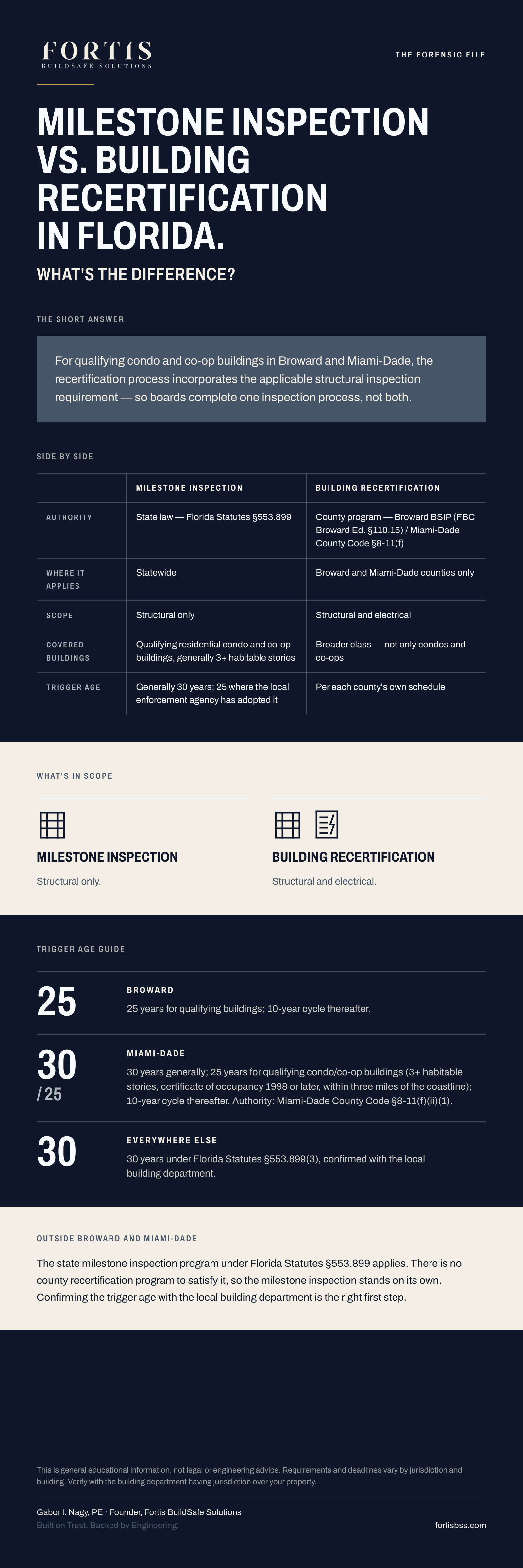
| Milestone Inspection | Building Recertification | |
|---|---|---|
| Authority | State law — Florida Statutes §553.899, Florida Building Code | County program — Broward Building Safety Inspection Program; Miami-Dade County Code §8-11(f) |
| Where it applies | Statewide, for qualifying condo and co-op buildings | Broward and Miami-Dade counties |
| Scope | Structural | Structural and electrical |
| Covered buildings | Residential condominium and cooperative buildings, generally three habitable stories or more, subject to statutory exceptions | A broader class of buildings meeting each county's criteria — not only condos and co-ops |
| Typical initial cycle | Generally 30 years; 25 where the local enforcement agency requires it | Per the county's own schedule (see trigger ages below) |
What is a milestone inspection?
The milestone inspection is Florida's statewide baseline, created after the 2021 Surfside collapse under Florida Statutes §553.899. It generally applies to residential condominium and cooperative buildings three habitable stories or more in height, subject to statutory exceptions. The trigger is the building's age: generally 30 years, although a local enforcement agency may require the initial inspection at 25 years based on qualifying local circumstances such as proximity to salt water, followed by inspections every 10 years.
The milestone inspection is structural in scope. A licensed engineer or architect evaluates the building's major structural components and general structural condition; if signs of substantial structural deterioration are found, a deeper Phase 2 inspection follows. It is not an electrical inspection.
Milestone inspections are administered and enforced locally: §553.899 assigns the notice, compliance, and enforcement functions to the local enforcement agency — in practice, the building department with jurisdiction over your property. That detail matters, because it's exactly how recertification fits in.
What is building recertification?
Building recertification is the older, more developed inspection program run by the building departments in Broward and Miami-Dade counties — the same authorities that administer the milestone requirement there. Miami-Dade pioneered it decades before the statewide milestone law existed; Broward runs its version as the Building Safety Inspection Program under the Florida Building Code, Broward Edition, Section 110.15.
One major difference: recertification includes an electrical inspection in addition to the structural inspection. That isn't bureaucratic padding — an improperly grounded pool is as much a life-safety issue as a deteriorating balcony, and a structural-only inspection would never catch it.
Another difference boards often miss: unlike the state milestone law, which specifically addresses qualifying condominium and cooperative buildings, the county recertification programs apply to a broader class of buildings.
Do we need both a milestone inspection and a recertification?
For qualifying condo and co-op buildings in Broward and Miami-Dade: no.
In those counties, the recertification program is how the applicable inspection requirement is administered and satisfied. The county building department is the milestone requirement's local enforcement agency — and rather than run two overlapping inspection regimes, these counties administer one process. The recertification incorporates the structural inspection requirements applicable to the milestone program and adds the electrical inspection. Miami-Dade says this expressly: the county describes its recertification requirements as more stringent than the state milestone requirements, and its guidance provides that the structural and electrical recertification reports are what qualifying buildings file for compliance.
The practical result: a board in Fort Lauderdale or Miami that completes its recertification does not ordinarily commission a second, duplicative milestone inspection. One program, one building department, one engineering process. (The inspection is only part of a board's duties under §553.899 — notice, distribution, and any follow-up repairs identified in the report still apply.)
What are the current trigger ages?
Each county runs its own schedule, and they don't use the same numbers.
Broward County: the Building Safety Inspection Program covers qualifying buildings 25 years of age or older, with subsequent inspections every 10 years. Confirm your building's specific inspection year with the municipal building department having jurisdiction — Broward's own guidance directs owners of properties 25 years or older who haven't received notice to do exactly that.
Miami-Dade County: under the county's 2022 ordinance update, recertification applies to buildings of three or more habitable stories: three-story-or-higher condominiums and cooperatives with a Certificate of Occupancy of 1998 or later within Miami-Dade's 3-mile coastal zone trigger recertification at 25 years; all other qualifying buildings trigger at 30 years (Miami-Dade County Code §8-11(f)). Boards should verify the applicable cycle directly with the building department rather than assuming the old "40-year" figure still applies. Every cycle, once triggered, repeats at 10 years.
What if our building is outside Broward and Miami-Dade?
Then your building follows the state milestone inspection under §553.899, administered by your local enforcement agency: structural inspection generally at 30 years (25 where your local agency requires it), then every 10 years. Local requirements vary, so the building department with jurisdiction is the authority on your building's trigger.
One observation from filing these inspections across South Florida's building departments: inspection standards in this state tend to start in Miami-Dade and move north. Miami-Dade built recertification; Broward adopted and refined it — Broward's program even uses forms modeled on Miami-Dade's. Nothing beyond those two counties is adopted today, and no board should act on a requirement that doesn't exist. But the direction of travel is worth knowing.
What should our board do next?
Three things, in order.
First, confirm which process your building answers to. That depends on your jurisdiction, building type and height, age, location, and any applicable transition provisions — not on what a neighboring building did or what an old committee memo says.
Second, confirm your trigger date with the building department having jurisdiction. In Broward, the program begins at 25 years for covered buildings. In Miami-Dade, the answer depends on the building's construction era and coastal location.
Third, understand the scope of the inspection and any findings, recommendations, follow-up testing, or repairs identified in the engineer's report. The filing satisfies the county; the report itself is the board's working picture of the building's condition.
This article is general educational information, not legal advice. Statutes and ordinances change; confirm your building's specific requirements and trigger dates with the applicable building department before your board acts.
If you're not certain which inspection process applies to your building — or when it triggers — Fortis BuildSafe Solutions can review your building's information and help identify the applicable requirement and the next engineering step.
Reviewed by Gabor I. Nagy, PE — Founder, Fortis BuildSafe Solutions
Sources: Fla. Stat. §553.899, current operative version (2025 published edition; flsenate.gov, accessed Sept. 2, 2026) · Code of Miami-Dade County §8-11(f), as amended 2022, and Miami-Dade County Building Recertification guidance (miamidade.gov, accessed Sept. 2, 2026) · Broward County Building Safety Inspection Program — Florida Building Code (Broward Edition) §110.15, BORA Policy 05-05, and program guidance (broward.org, accessed Sept. 2, 2026) · Palm Beach County Building Division, Mandatory Milestone Inspections (discover.pbc.gov, accessed Sept. 2, 2026)
KEEP THE FACTS CURRENT.
Florida's building-safety requirements change by county and by year. The Fortis Brief is a short note from Fortis BuildSafe Solutions, a few times a quarter, on what the rules say now and what a board should do about them.
The Board President's Guide to Florida's Building Safety Laws
A plain-language walkthrough of milestone inspections, SIRS, county recertification, and your board's personal exposure — what triggers each requirement and what your board must do next.
Record Appendix
Sources
Sources
Related record
Continue Reading


Is your Florida condo's milestone inspection due at 25 years or 30? The answer depends on your city hall, not your coastline
October 22, 2026

Why does Florida inspect older condominiums at all? A short history of the rules your board lives under
October 17, 2026
How much does a milestone inspection cost in Florida, and what drives the price?
October 16, 2026
Related Services
Reader questions
Have a question about this?
Every inquiry is reviewed by a Fortis engineer.