
In This Record
- 01Why do the signature and seal matter?
The report documents the inspection performed, observed conditions, findings and recommendations, including testing when applicable.
- 02Can a team perform the inspection, or does one licensee have to do it all?
A professional team may provide Milestone Inspection services.
- 03Does the license belong to the firm or to the individual?
Both matter, and they answer different questions.
- 04Does the same person have to sign Phase 1 and Phase 2?
Nothing in §553.899 requires the identical individual to sign both phases.
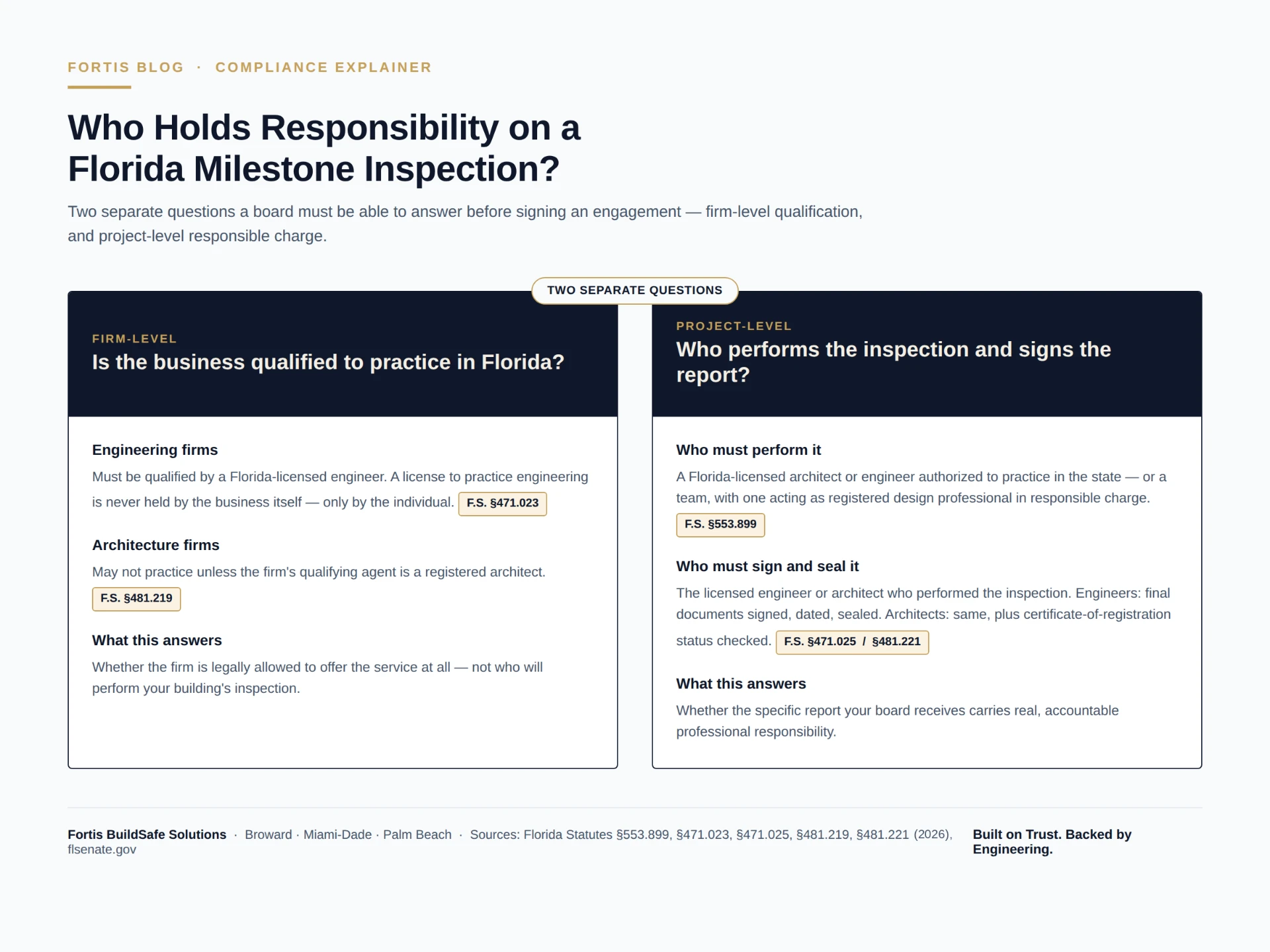
A Florida Milestone Inspection must be performed by a Florida-licensed architect or engineer authorized to practice in the state, with the final report bearing that professional's signature and seal under §553.899. The statute also allows the work to be delivered by a team of professionals, provided a licensed architect or engineer serves as the registered design professional in responsible charge. For a board, the key questions are which licensed architect or engineer is performing the inspection, who holds responsible charge if a team is involved, and whose signature and seal appear on the final report.
Why do the signature and seal matter?
The report documents the inspection performed, observed conditions, findings and recommendations, including testing when applicable. The signature and seal identify the licensed professional taking responsibility for the report's conclusions.
Under §553.899, the applicable Phase 1 or Phase 2 inspection must be performed by "a licensed architect or engineer authorized to practice in this state," and the report must "bear the seal and signature, or the electronic signature, of the licensed engineer or architect who performed the inspection." Without that signature and seal, the report does not satisfy §553.899(8)(a) — a statutory completeness requirement, not a judgment on how thorough the underlying inspection was.
Can a team perform the inspection, or does one licensee have to do it all?
A professional team may provide Milestone Inspection services. §553.899 expressly allows that structure: "The milestone inspection services may be provided by a team of professionals with an architect or engineer acting as a registered design professional in responsible charge with all work and reports signed and sealed by the appropriate qualified team member." For engineering work, responsible charge can include engineering decisions made by others under the PE's supervisory direction and control.
That doesn't make the "who performed it" question irrelevant — the statute is specific that a licensed architect or engineer performs the inspection itself. The board doesn't need one professional to have personally handled every supporting task. It does need to know which licensed architect or engineer is performing the statutory inspection, and how responsible charge is maintained when a team is involved.
Does the license belong to the firm or to the individual?
Both matter, and they answer different questions. Professional licensure is held by individuals: §471.023 states that "[n]othing in this section shall be construed to mean that a license to practice engineering shall be held by a business organization." Architecture registration is likewise held by individuals, while architecture businesses must separately qualify under §481.219.
Separately, the firm itself must be qualified to offer these services in Florida. An engineering business organization may practice "only if the business organization is qualified by an engineer licensed under this chapter" (§471.023). An architecture business organization "may not engage in the practice of architecture unless its qualifying agent is a registered architect" (§481.219).
Firm qualification and responsibility for a particular Milestone Inspection are separate questions. A board evaluating a bid should ask both: is the firm properly qualified to offer engineering or architectural services in Florida, and separately, which licensed professional is performing this inspection and signing the report?
Does the same person have to sign Phase 1 and Phase 2?
Nothing in §553.899 requires the identical individual to sign both phases. The report for each phase must carry the signature and seal required by §553.899 from the licensed architect or engineer who performed that inspection — the statute sets requirements per phase, not a same-signer rule across phases. Boards should still ask how observations and findings are carried forward if different professionals participate in Phase 1 and Phase 2, since continuity of information matters even where the statute doesn't require continuity of the individual signer.
What should a board check before hiring?
- Is the firm properly qualified to offer engineering or architectural services in Florida? Engineering businesses need a qualifying licensed engineer under §471.023; architecture businesses need a qualifying registered architect under §481.219.
- Which licensed professional is performing the inspection, and who holds responsible charge? Verify the individual's license directly through the Florida Board of Professional Engineers or the Florida Board of Architecture and Interior Design, not just the firm's marketing materials.
- Is the seal on the final report, not a draft? A preliminary or "draft findings" version circulated before sealing does not satisfy §553.899(8)(a). For engineers, §471.025 additionally requires final documents — whether filed for public record or provided directly to the owner — to be signed, dated and sealed; for architects, §481.221 requires the same for final construction documents and instruments of service filed for public record, and prohibits signing or sealing after a registration has expired, been suspended, or been revoked.
Every Fortis Milestone Inspection is performed to the Fortis Standard and sealed by the licensed Florida PE who exercises direct responsible charge for the work. Contact Fortis to confirm the next engineering step for your building.
Sources
- Florida Statutes §553.899 (2026) — Mandatory structural inspections for condominium and cooperative buildings. flsenate.gov
- Florida Statutes §471.023 (2026) — Qualification of business organizations. flsenate.gov
- Florida Statutes §471.025 (2026) — Seals. flsenate.gov
- Florida Statutes §481.219 (2026) — Qualification of business organizations. flsenate.gov
- Florida Statutes §481.221 (2026) — Seals; display of certificate number. flsenate.gov
- Milestone Inspections vs. SIRS in Florida
This article is general educational information, not legal advice. Florida statutes, licensure requirements, and local enforcement procedures should be confirmed with association counsel and the relevant state licensing board for the specific property and professional before the association acts.
KEEP THE FACTS CURRENT.
Florida's building-safety requirements change by county and by year. The Fortis Brief is a short note from Fortis BuildSafe Solutions, a few times a quarter, on what the rules say now and what a board should do about them.
Milestone Inspections: What Your Board Must Do
A plain-language board guide covering what triggers your Milestone Inspection, which deadline actually applies to your building, the Phase 1 and Phase 2 process, and what the statute requires your board to do next.
Record Appendix
Related record
Continue Reading


Is your Florida condo's milestone inspection due at 25 years or 30? The answer depends on your city hall, not your coastline
October 22, 2026

Why does Florida inspect older condominiums at all? A short history of the rules your board lives under
October 17, 2026
How much does a milestone inspection cost in Florida, and what drives the price?
October 16, 2026
Related Services
Reader questions
Have a question about this?
Every inquiry is reviewed by a Fortis engineer.