

Florida's condominium-safety framework did not stop changing after SB 4-D. In 2025, the Legislature passed HB 913, a broad revision of the condominium and cooperative statutes that took effect July 1, 2025. It adjusted milestone inspection timing, moved the SIRS deadline, changed how associations may fund reserves, added conflict-of-interest disclosure rules for the professionals boards hire, and modernized meeting and voting procedures.
Given how much the bill touches, many boards are still working through what it means for their specific building — and a board acting on the old rules can miss obligations that are already in effect. As a forensic engineering firm, Fortis's job is to make those obligations concrete for the building in front of us. Every Fortis assessment is performed and sealed by a Fortis PE working to the Fortis Standard, then explained to the board in plain terms. Here is what a board needs to know.
The short answer
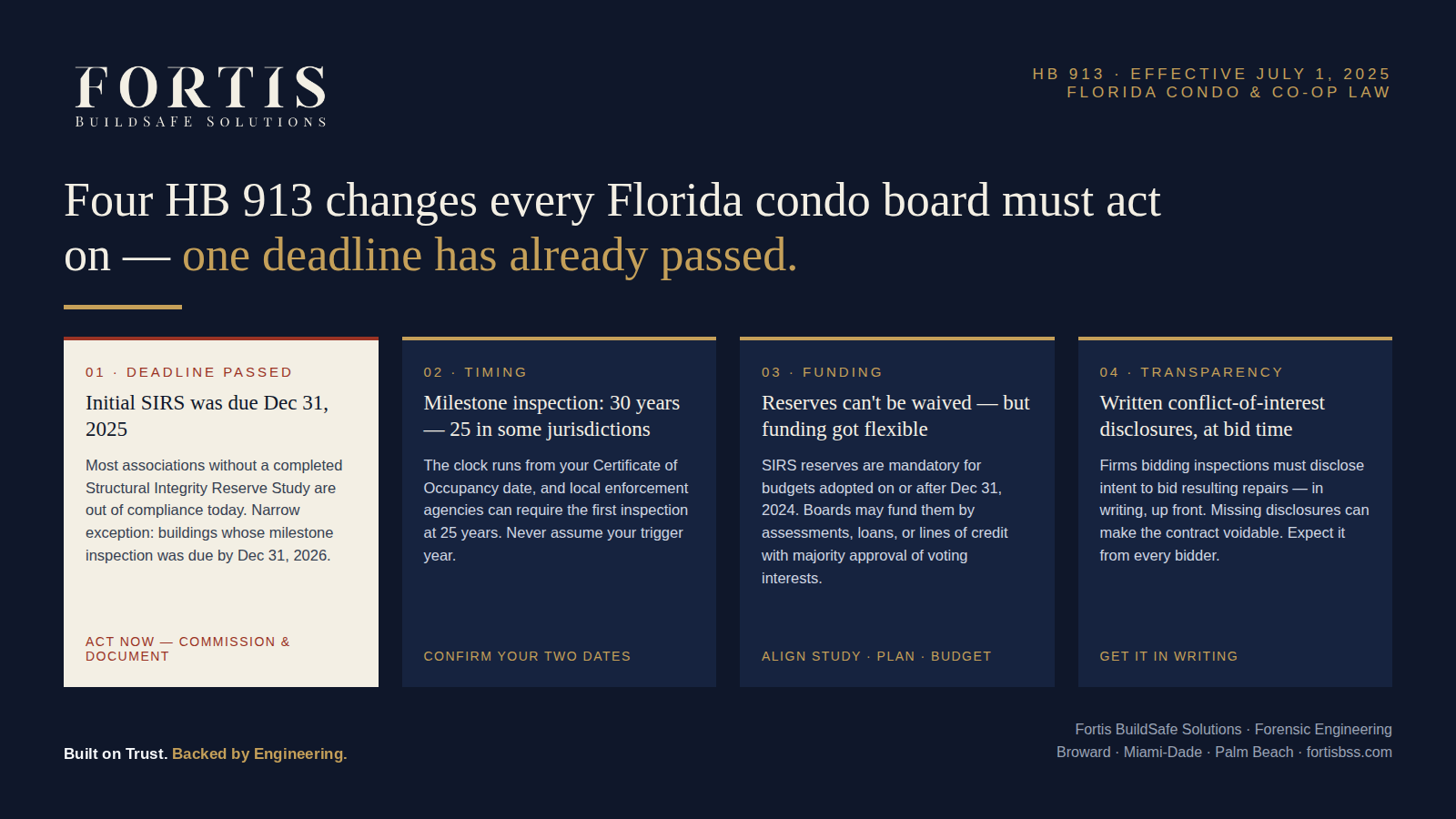
HB 913 did four things that matter most to a condominium or cooperative board:
- It confirmed and refined the milestone inspection framework — including the three-habitable-stories scope: statewide at 30 years from the Certificate of Occupancy for qualifying buildings, with local enforcement agencies able to require the first inspection as early as 25 years.
- It moved the one-time initial SIRS deadline to December 31, 2025 — a date that has now passed. An association that missed it is out of compliance today, not someday.
- It gave boards new flexibility in funding reserves, including loans, lines of credit, and special assessments, subject to owner approval requirements.
- It created written conflict-of-interest disclosure requirements for the engineers and contractors associations hire around milestone inspections and repair work.
None of this reduced the underlying obligations. The inspections are still required. The reserves are still required. What changed is timing, funding mechanics, and transparency.
Milestone inspection timing: 30 years, sometimes 25
The statewide default under Florida Statutes §553.899 is an initial milestone inspection by the end of the year a qualifying building reaches 30 years from the Certificate of Occupancy date, then every 10 years after. Local enforcement agencies may require the first inspection as early as 25 years — and some jurisdictions in South Florida apply the earlier threshold broadly.
The practical rule for a board has not changed: never assume your trigger year. Confirm the Certificate of Occupancy date, then confirm what your specific city or county enforcement agency requires. Two buildings a mile apart can be on different clocks.
One more county-specific note: in Broward and Miami-Dade, the county recertification program is how the milestone inspection requirement is administered and satisfied — one inspection process, not two separate obligations. Palm Beach has no countywide recertification program, so milestone timing there is confirmed independently, city by city, with the local enforcement agency.
One definitional note worth raising with counsel: HB 913 frames the requirement around buildings "three habitable stories or more," and how habitable stories are counted for a particular building — lobbies, parking levels, mezzanines — is a question that has generated genuine interpretive debate. If your building sits anywhere near that line, confirm its status with your local enforcement agency and association counsel rather than assuming an exemption.
The repair deadline attached to the inspection has teeth. When a Phase 2 inspection identifies substantial structural deterioration, repairs must commence no later than 365 days after the local enforcement agency receives the Phase 2 report — and HB 913 directs local governments to adopt ordinances enforcing that deadline. Enforcement that used to be theoretical is becoming procedural.
The SIRS deadline has passed
A Structural Integrity Reserve Study — the reserve study, prepared by a qualified professional such as an engineer or reserve specialist, that tells an association what its major structural components will cost to maintain and replace, and how to fund that — got the bill's most consequential date change. HB 913 extended the one-time deadline for the initial SIRS to December 31, 2025 for qualifying condominium and cooperative buildings three habitable stories or higher. That extension was real relief when it passed. It is now history: an association that has not completed its initial SIRS is not "running late" — it is out of compliance with §718.112, unless it qualifies for the milestone-pairing accommodation described next.
One timing accommodation is worth knowing about: the law allowed an association whose milestone inspection was due by December 31, 2026 to complete its initial SIRS together with that inspection — but not later than the end of 2026. If your association's milestone inspection falls in that window, your SIRS timing may look different from your neighbor's, and the two engagements can often be scoped together efficiently. Confirm which case applies to your building before relying on either date.
One more reason the deadline has weight now: HB 913 required local enforcement agencies to report milestone-inspection program data to the state's Division of Business and Professional Regulation — how many buildings require inspections, which phases are complete, extensions granted, and buildings identified as unsafe. A building's milestone-inspection status is increasingly a matter of public record.
For associations past their deadline with no study underway, the answer is not panic, and it is not paralysis. It is commissioning the study now. Documenting that the board acted promptly once it understood the obligation is part of responsible governance — and it is the record a future board, buyer, or insurer will look for.
Two separate provisions can affect SIRS and reserve timing after a milestone inspection, and boards often blur them together:
- Deferring the study itself. An association that completes its milestone inspection may delay a required SIRS for no more than the two consecutive budget years immediately following that inspection, so the board can focus on the repairs the inspection identified.
- Pausing reserve contributions. Separately, for a budget adopted on or before December 31, 2028, an association that completed a milestone inspection within the previous two calendar years may — with the approval of a majority of the total voting interests — temporarily pause or reduce reserve contributions for up to two consecutive annual budgets, specifically to fund repairs the milestone inspection recommended.
Both are time-limited tools tied to a completed milestone inspection, not permanent exemptions. Which one applies, and on exactly what conditions, should be confirmed against the statutory language before a board relies on either.
Reserve funding: more flexibility, same obligation
Since the budget cycle beginning December 31, 2024, qualifying associations generally cannot waive or underfund reserves for the structural items a SIRS covers. HB 913 did not undo that. What it did is widen the set of tools a board may use to meet the obligation.
Boards may now fund reserve obligations through regular assessments, special assessments, lines of credit, or loans, subject to the statute's approval requirements — for most unit-owner-controlled associations, that means majority approval of the total voting interests for borrowing-based approaches. The SIRS itself must include a baseline funding plan that keeps the reserve balance above zero throughout the funding period.
Two related financial changes are easy to miss. The threshold for items that must be included in reserve calculations rose from $10,000 to $25,000, indexed to inflation — the state publishes the adjusted figure, so confirm the current number before relying on it. And associations must maintain a replacement-cost insurance appraisal updated at least every three years — a longstanding requirement under §718.111(11), which the statute allows to be satisfied by an update of a previous appraisal, not a repeated appraisal from scratch.
What this means in practice: the reserve conversation has moved from "whether" to "how." That "how" is a decision the board makes with its financial and legal advisors — the engineering study supplies the component facts the plan is built on.
The disclosure rules protect your board — use them
HB 913 strengthened conflict-of-interest disclosure requirements in §553.899(12). A firm bidding to perform a milestone inspection must disclose in writing, at the time of its bid, whether it intends to bid on maintenance, repair, or replacement work the inspection may recommend. A design professional or contractor bidding on that recommended work must disclose, in writing, any direct or indirect interest in the firm that performed the inspection — or any family relationship to it within the third degree of consanguinity by blood or marriage. Similar disclosure rules reach the professionals who prepare a SIRS. A contract entered without the required disclosure is voidable and terminates when the association files written notice of termination, and the nondisclosure can expose the licensee to discipline.
This works in a board's favor: you are entitled to know, in writing and up front, how the professionals you hire are positioned. When you solicit milestone or SIRS bids, expect the disclosure — and be wary of any bidder who treats the question as an imposition.
Good vetting goes a step beyond the statute. Before engaging any inspection or repair professional, a board is well served by three habits: get the disclosure in writing with the bid, not after; keep every bid and disclosure in the association's records, where a future board can find them; and ask directly how the firm separates its inspection findings from any repair work it might later propose. A firm that inspects buildings and also performs restoration engineering can serve an association well — but the relationship should be on paper from the first bid. That is how Fortis handles it on every proposal.
The governance details boards get cited for
Beyond the engineering requirements, HB 913 also modernized meeting and voting mechanics — and these are the provisions boards most often stumble on in practice. Board, member, and committee meetings conducted by video conference must be recorded; where the association posts approved minutes of the meeting, the recording is retained at least a year after posting, and larger associations must post recordings or links within set windows. Notices for these meetings must include the video link, dial-in number, and physical location. And if members holding at least 25 percent of the total voting interests petition for electronic voting, the association must implement it for the next scheduled election, with the board acting on the request within 21 days.
None of these is an engineering issue. All of them are the kind of procedural details that generate owner complaints and legal exposure when missed — worth ten minutes with your association counsel or manager to confirm your practices match the current statute.
What to do this quarter
Three checks, in order:
- Confirm your two dates. Certificate of Occupancy date for the milestone clock; Declaration recording date and prior-study history for the SIRS clock. Then confirm what your local enforcement agency requires — including whether your jurisdiction uses the 25-year trigger.
- Confirm your SIRS status. If the initial study wasn't completed by December 31, 2025, commissioning it is the board's most urgent compliance item. If your association used the post-milestone deferral provision, or paused reserve contributions to fund milestone repairs, confirm the exact terms and time limits that apply.
- Confirm your funding plan holds up. The reserve study, the baseline funding plan, the budget, and the insurance appraisal should tell one consistent story. Where they don't, that gap is the agenda for your next board meeting.
Frequently asked questions
Has the Florida SIRS deadline passed?
Yes. HB 913 extended the one-time deadline for the initial SIRS to December 31, 2025 for qualifying condominium and cooperative buildings three habitable stories or higher. An association that has not completed its initial SIRS is not "running late" — it is out of compliance with §718.112, unless it qualifies for the milestone-pairing accommodation.
When is a milestone inspection due — 30 years or 25?
The statewide default under §553.899 is an initial milestone inspection by the end of the year a qualifying building reaches 30 years from the Certificate of Occupancy date, then every 10 years after. Local enforcement agencies may require the first inspection as early as 25 years, and some South Florida jurisdictions apply the earlier threshold broadly.
Can an association pause reserve contributions after a milestone inspection?
For a budget adopted on or before December 31, 2028, an association that completed a milestone inspection within the previous two calendar years may — with the approval of a majority of the total voting interests — temporarily pause or reduce reserve contributions for up to two consecutive annual budgets, specifically to fund repairs the milestone inspection recommended.
Must a firm bidding on a milestone inspection disclose whether it will also bid on repairs?
Yes. Under §553.899(12), a firm bidding to perform a milestone inspection must disclose in writing, at the time of its bid, whether it intends to bid on maintenance, repair, or replacement work the inspection may recommend. A contract entered without the required disclosure is voidable.
A clear path forward
HB 913 didn't make Florida's building-safety framework easier — it made it more specific. Boards that know their dates, their study status, and their funding plan can meet it in an orderly, budgeted way. Boards that don't will meet it later, on the enforcement agency's schedule rather than their own.
For boards working through HB 913, Fortis performs Milestone Inspections (Phase 1 and Phase 2), Structural Integrity Reserve Study, and Building Recertification — with the written conflict-of-interest disclosures the law requires included on every bid, and every assessment performed and sealed by a Fortis PE working to the Fortis Standard.
This article is general educational information, not legal advice. HB 913's provisions, later legislative amendments, and local enforcement procedures should be confirmed with association counsel for the specific property and jurisdiction before the association acts.
KEEP THE FACTS CURRENT.
Florida's building-safety requirements change by county and by year. The Fortis Brief is a short note from Fortis BuildSafe Solutions, a few times a quarter, on what the rules say now and what a board should do about them.
Understanding Your SIRS Report: A Board Member’s Guide
Covers what a Structural Integrity Reserve Study is, how the 10-year cycle works under §718.112(2)(g)1, and how the HB 913 reserve funding changes affect your association.
Record Appendix
Sources
Sources
Related record
Continue Reading
Is your Florida condo's milestone inspection due at 25 years or 30? The answer depends on your city hall, not your coastline
October 22, 2026

Why does Florida inspect older condominiums at all? A short history of the rules your board lives under
October 17, 2026
How much does a milestone inspection cost in Florida, and what drives the price?
October 16, 2026
Related Services
Reader questions
Have a question about this?
Every inquiry is reviewed by a Fortis engineer.