
In This Record
- 01What triggers a Milestone Inspection?
For qualifying condominium and cooperative buildings that are three habitable stories or more, the statewide default is an initial Milestone Inspection by December 31 of the year the building reaches 30 years of age, measured from the building's Certificate of Occupancy date.
- 02What happens in Phase 1 and Phase 2?
In practice, the first hour on site often tells an engineer where to focus.
- 03What triggers a SIRS?
A SIRS follows a different timeline.
- 04What does a SIRS cover?
A SIRS looks at major building components related to structural integrity and safety that the association is responsible for maintaining.
A Milestone Inspection and a Structural Integrity Reserve Study, or SIRS, are not the same requirement. One looks at the building's structural condition now. The other helps the association plan and fund major building components over time. Many Florida condominium associations need both, but they run on different clocks and lead to different board decisions.
Boards mix them up constantly, and it's not their fault. The two reports often arrive in the same meeting, in the same year, from firms with similar names. Still, they are not interchangeable.
The short answer
A Milestone Inspection is a structural inspection performed by a Florida-licensed engineer or architect. It evaluates the building's general structural condition and looks for signs of substantial structural deterioration. Under Florida Statutes §553.899, its purpose is life safety and structural condition. It is not a full review for compliance with every part of the current Florida Building Code or fire code.
A Structural Integrity Reserve Study, or SIRS, is a reserve-planning study. It evaluates the components the association is responsible for, estimates their remaining useful life and replacement cost, and informs required reserve funding under Florida Statutes §718.112(2)(g).
Put simply:
- A Milestone Inspection asks: what is the condition of the structure today, and does it require further investigation or repair?
- A SIRS asks: what major components will the association need to fund over time, and how should it plan for them?
Both matter. Neither is paperwork.
The difference at a glance
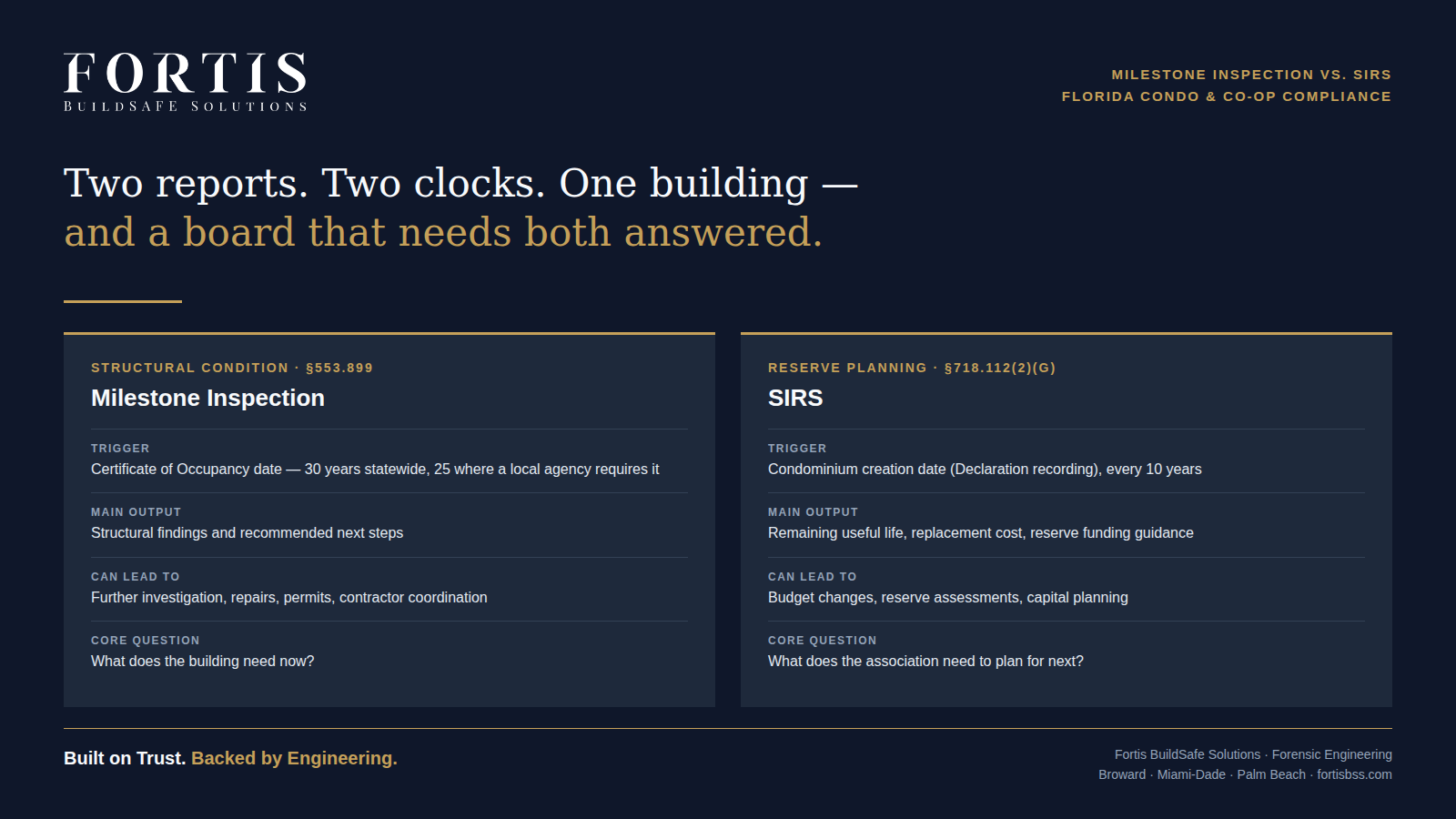
| Question | Milestone Inspection | SIRS |
|---|---|---|
| Main purpose | Evaluates structural condition and potential life-safety concerns | Supports long-term reserve planning for required components |
| Main trigger | Building age based on the Certificate of Occupancy date, plus applicable local requirements | Condominium creation date, based on the Declaration recording date, and the recurring statutory cycle |
| Main output | Structural findings, observations, and recommended next steps | Remaining useful life estimates, replacement cost estimates, and reserve funding guidance |
| What it can lead to | Further investigation, repairs, permits, contractor coordination, and owner communication | Budget changes, reserve assessments, special assessment planning, financing discussions, and capital planning |
| Core board question | What does the building need now? | What does the association need to plan for next? |
Same building. Same board. Different legal trigger.
What triggers a Milestone Inspection?
For qualifying condominium and cooperative buildings that are three habitable stories or more, the statewide default is an initial Milestone Inspection by December 31 of the year the building reaches 30 years of age, measured from the building's Certificate of Occupancy date. After that, the building must be inspected every 10 years.
A local enforcement agency may require the first inspection at 25 years based on local circumstances, including proximity to salt water. That earlier threshold is a local-agency option, not an automatic statewide rule for every coastal building.
The practical starting point is simple: confirm the Certificate of Occupancy date, then confirm the local enforcement process that applies to the property. Do not assume the answer based on a nearby building, the neighborhood, or a building's distance from the water.
Once a local enforcement agency gives written notice that a building requires a Milestone Inspection, the owner has 180 days to complete Phase 1. If Phase 2 is required, a progress report is due within 180 days after the Phase 1 report is submitted. If the Phase 2 inspection identifies substantial structural deterioration, repairs must commence within 365 days after the Phase 2 report is received by the local enforcement agency.
What happens in Phase 1 and Phase 2?
Phase 1 is the visual inspection. The engineer or architect examines habitable and nonhabitable areas and evaluates the building's general structural condition. If the inspection does not identify signs of substantial structural deterioration in the areas examined, Phase 2 is not required.
In practice, the first hour on site often tells an engineer where to focus. Garage slab soffits, balcony edges, exposed concrete, water paths, and prior repair areas usually provide more useful information than a finished lobby ever will. The work is not checking a box. The work is understanding how the building is performing.
Phase 2 follows only if Phase 1 identifies substantial structural deterioration. It is a more focused investigation directed by the engineer or architect and may include destructive or nondestructive testing to define the extent of the concern and support repair recommendations.
A Phase 2 requirement does not mean a building is about to fail. It means the conditions found in Phase 1 require a more precise engineering answer.
What triggers a SIRS?
A SIRS follows a different timeline. For qualifying residential condominium associations, the study is tied to the condominium's creation date, which is generally the date the Declaration of Condominium was recorded, not the building's Certificate of Occupancy date. The statute requires a SIRS at least every 10 years for each qualifying building that is three habitable stories or higher.
That distinction is where many associations get turned around. A building may be current on one requirement and due for the other. A Milestone Inspection could be based on the age of the building, while the SIRS timing depends on the condominium's creation and prior SIRS cycle.
The 2025 condominium-law changes under HB 913 took effect July 1, 2025. The law changed several SIRS and reserve-funding provisions, including the initial SIRS deadline for many existing associations and the ways associations may fund required reserve obligations.
The details matter property by property. Boards should have their specific SIRS timing, prior study status, and reserve obligations confirmed before relying on a general deadline summary.
What does a SIRS cover?
A SIRS looks at major building components related to structural integrity and safety that the association is responsible for maintaining. The statute identifies components including the roof, structure, fireproofing and fire-protection systems, plumbing, electrical systems, waterproofing and exterior painting, windows, and exterior doors, as applicable to the building and the association's responsibility.
For each applicable component, the study addresses the estimated remaining useful life, estimated replacement cost or deferred-maintenance expense, and reserve funding needed under the statute.
This does not mean every component must be replaced immediately. It means the association needs a documented basis for planning. A SIRS gives the board a clearer answer to questions it is already being asked:
- What is likely to need work first?
- What can be planned over time?
- What funding needs to be included in the budget?
- What happens if a known repair need advances faster than expected?
Those are board decisions. The engineering study provides the facts needed to make them responsibly.
Can boards waive SIRS reserves?
For the structural-integrity items covered by the SIRS, qualifying associations generally cannot vote to provide no reserves or less than the required reserves in a budget adopted on or after December 31, 2024, subject to limited statutory exceptions.
That is why the SIRS conversation cannot stop at "we got the report." The board needs to understand what the study says, how it affects the budget, and what funding approach is available under the current statute.
HB 913 added flexibility in certain funding methods, including the use of regular assessments, special assessments, lines of credit, or loans for SIRS-related reserves and certain capital expenses, subject to the requirements in the statute.
This is where engineering, financial planning, association counsel, and property management need to work from the same facts. The engineer explains the condition and scope. The association's financial and legal advisors help the board determine how to implement the required funding and governance decisions.
Why the two reports work together
A Milestone Inspection looks at present condition. A SIRS helps the association prepare for future funding needs.
If a Milestone Inspection identifies deterioration, the association may need to move into repair planning sooner than expected. That finding can also change what the board needs to consider in its reserve strategy. If the SIRS shows a major component approaching the end of its useful life, the board has more time to communicate with owners, build a budget, and make decisions before the project becomes urgent.
The reports are connected tools. They are not substitutes for each other.
What to do this quarter
Start with the two dates that govern the conversation: the building's Certificate of Occupancy date and the condominium Declaration recording date.
Then assemble the records the board already has: prior engineering reports, reserve studies, repair history, budgets, meeting minutes, and known project information. A complete file set prevents the board from having to recreate the building's history in the middle of a deadline.
Finally, confirm which requirements apply to the specific property and what needs to happen next. A board should know whether it needs an inspection, a SIRS, a repair-planning discussion, a reserve-funding conversation, or all four.
A clear path forward
Two reports. Two clocks. One building — and a board that needs both answered before budget season.
Fortis BuildSafe Solutions serves condominium associations, HOA boards, and property managers across Broward, Miami-Dade, and Palm Beach. Every Fortis assessment is performed to one documented standard and sealed by a licensed Florida PE who exercised direct responsible charge, with findings explained plainly for the boards that have to act on them.
If you don't know which dates apply to your property, that's a short conversation, not a research project. Contact Fortis BuildSafe Solutions to confirm the next engineering step for your building.
This article is general educational information, not legal advice. Florida statutes, association obligations, and local enforcement procedures should be confirmed for the specific property and jurisdiction before the association acts.
KEEP THE FACTS CURRENT.
Florida's building-safety requirements change by county and by year. The Fortis Brief is a short note from Fortis BuildSafe Solutions, a few times a quarter, on what the rules say now and what a board should do about them.
Milestone Inspections: What Your Board Must Do
A plain-language board guide covering what triggers your Milestone Inspection, which deadline actually applies to your building, the Phase 1 and Phase 2 process, and what the statute requires your board to do next.
Record Appendix
Sources
Sources
Related record
Continue Reading


Is your Florida condo's milestone inspection due at 25 years or 30? The answer depends on your city hall, not your coastline
October 22, 2026
Why does Florida inspect older condominiums at all? A short history of the rules your board lives under
October 17, 2026
How much does a milestone inspection cost in Florida, and what drives the price?
October 16, 2026
Related Services
Reader questions
Have a question about this?
Every inquiry is reviewed by a Fortis engineer.