

In This Record
- 01Is there a pass or fail grade?
Not under the state statute.
- 02What counts as substantial structural deterioration?
The statute defines it as substantial structural distress or substantial structural weakness that negatively affects the building's general structural condition and integrity (§553.899(2)(b)).
- 03What does the Phase 1 report actually tell the board?
The sealed report must cover several separate points (§553.899(8)).
- 04What happens next if Phase 1 finds substantial structural deterioration?
Two separate 180-day clocks apply, so keep them apart.
What happens when a Florida condo "fails" its milestone inspection?
Published: November 1, 2026 · Last reviewed: November 1, 2026
Reviewed by Gabor I. Nagy, PE — Founder
Direct answer: Florida's milestone statute gives the inspection no pass or fail grade. If the Phase 1 visual inspection finds substantial structural deterioration, a Phase 2 inspection is required, a progress report is due to the building department within 180 days, and the local ordinance sets when repairs must be scheduled or begun, no later than 365 days after the Phase 2 report (F.S. §553.899).
"Did we fail?" is usually the first question a board asks when a Phase 1 report recommends further inspection. It is a fair question. It is also the wrong frame, and the statute shows why.
Is there a pass or fail grade?
Not under the state statute. Section 553.899 describes two phases, a report and a set of deadlines. It does not grade the building. The statute also says the purpose of the inspection is not to determine whether the building complies with the Florida Building Code or the firesafety code (§553.899(2)(a)). Some local programs use their own terms or classifications, so read your building department's paperwork with that in mind.
What the law does treat as a problem is not acting. Owners who fail to show the building department that repairs have been scheduled or started on time face a review of whether the building is unsafe (§553.899(11)). For condominiums, Chapter 718 adds that the association must have the milestone inspection performed, and directors who willfully and knowingly fail to do so breach their fiduciary duty (§718.112(2)(h)).
What counts as substantial structural deterioration?
The statute defines it as substantial structural distress or substantial structural weakness that negatively affects the building's general structural condition and integrity (§553.899(2)(b)). Surface imperfections such as cracks, distortion, sagging, deflections, misalignment, signs of leakage and peeling finishes do not meet that bar on their own, unless the engineer or architect determines they are a sign of substantial structural deterioration.
That determination is professional judgment applied to what the inspector saw. Two buildings with similar-looking cracks can end up with different findings. What happens during a Florida milestone inspection?
What does the Phase 1 report actually tell the board?
The sealed report must cover several separate points (§553.899(8)). Among them, it must:
- State the manner and type of inspection it is based on
- Identify any substantial structural deterioration within a reasonable professional probability based on the scope of the inspection, describe its extent and list the recommended repairs
- State whether unsafe or dangerous conditions were observed, as the Florida Building Code defines those terms
- Recommend remedial or preventive repairs for items that are damaged but are not substantial structural deterioration
- Identify and describe items that need further inspection
Read those as different questions. A finding of substantial structural deterioration sends the building to Phase 2. A statement that unsafe or dangerous conditions were observed is a separate finding. A report can contain the first without the second. Ask your engineer to walk the board through which statements the report makes and which it does not.
In the Phase 1 reports we prepare, the findings that send a building to Phase 2 are most often concentrated in a few locations, typically balconies, parking levels and exposed slab edges, rather than spread across the whole structure.
What happens next if Phase 1 finds substantial structural deterioration?
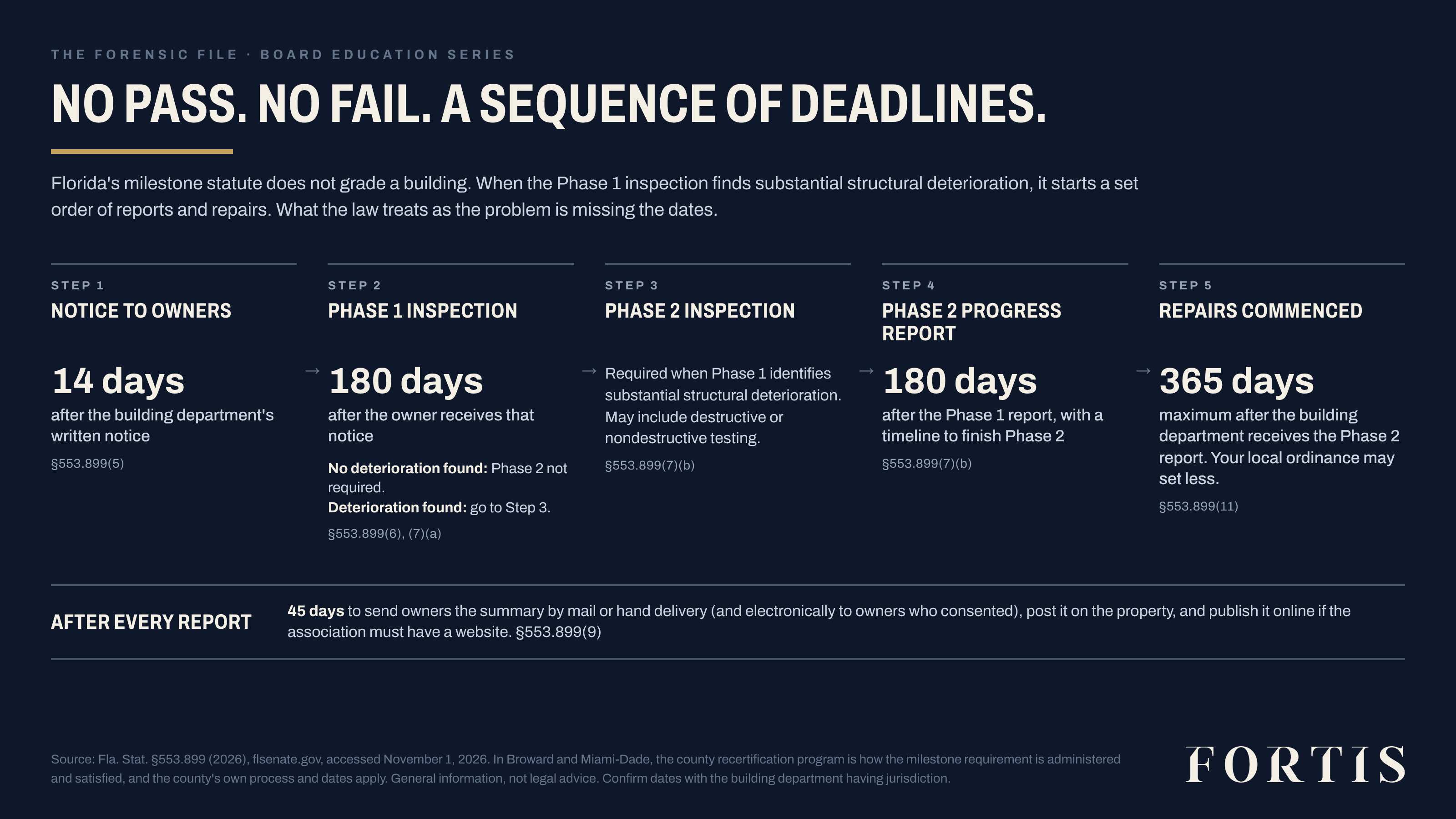
Two separate 180-day clocks apply, so keep them apart. The first is for Phase 1 itself: it must be completed within 180 days after the owner receives the building department's written notice (§553.899(6)). The second starts once Phase 1 finds substantial structural deterioration:
- Phase 2 inspection. It is required whenever Phase 1 identifies substantial structural deterioration, and it may include destructive or nondestructive testing at the inspector's direction (§553.899(7)(b)).
- Progress report within 180 days. Within 180 days after submitting the Phase 1 report, the engineer or architect must file a Phase 2 progress report with the local enforcement agency, with a timeline for completing Phase 2 (§553.899(7)(b)). The deadline attaches to the progress report, not to finishing Phase 2.
- Repairs on a local deadline. Each county or city must adopt an ordinance requiring owners to schedule or begin repairs for substantial structural deterioration within a set time after the building department receives the Phase 2 report. The statute requires those repairs to be commenced within 365 days after the report is received (§553.899(11)). Your local deadline may be shorter. Commencing repairs is not the same as completing them; ask the building department what it requires to show progress.
Local agencies may also set their own timelines and penalties (§553.899(10)). In Broward and Miami-Dade, the county recertification program is how the milestone requirement is administered and satisfied, and the county's own process and dates apply. Confirm your building's dates with the building department having jurisdiction. Milestone inspection vs. building recertification in Florida
What does the board have to tell owners?
Two notices matter.
- Before the inspection. A condominium association must notify unit owners within 14 days after it receives the building department's written notice that a milestone inspection is required (§553.899(5); §718.112(2)(h)).
- After each report. Within 45 days after receiving an inspection report, whether Phase 1 or Phase 2, the association must (§553.899(9)):
- Send a copy of the inspector's summary to each unit owner by mail or personal delivery, and by electronic transmission to owners who have consented to receive notices that way
- Post the summary in a conspicuous place on the property
- Publish the full report and summary on the association's website, if it is required to have one
Can the building be declared unsafe?
Two paths lead there, and neither is automatic.
- If the report states that unsafe or dangerous conditions were observed. The statute requires the report to say so. What action follows is up to the local building official under its own authority.
- If an owner fails to submit proof that repairs were scheduled or started within the required time after the Phase 2 report, the local enforcement agency must review the building and determine whether it is unsafe for human occupancy (§553.899(11)).
A Phase 2 referral starts a repair process. It is not, by itself, a declaration that the building is unsafe.
How do repairs get scoped and funded?
The Phase 2 report identifies the recommended repairs. Turning them into a permitted repair project usually takes engineered repair documents, contractor bids and permits from the building department. Two statutory points help boards plan:
- Disclosure if the inspector may bid on the repairs. An engineer or architect who bids to perform a milestone inspection must disclose in writing to the association any intent to bid on the maintenance, repair or replacement work the inspection may recommend, and the statute adds disclosure rules for certain relationships with firms bidding on that work (§553.899(12)). Ask for these disclosures in writing before you engage.
- The SIRS can be delayed for repairs. An association that must have a milestone inspection may delay its required structural integrity reserve study for no more than the two consecutive budget years immediately following the milestone inspection, so it can focus its funds on the repairs the milestone inspection recommends (§718.112(2)(g)9). How that interacts with the study deadlines elsewhere in §718.112(2)(g) depends on your building's dates, so confirm it with counsel. This delay is separate from the other reserve provisions in Chapter 718. The milestone inspection and the SIRS remain two separate requirements. Milestone inspections vs. SIRS in Florida
How the repairs are paid for, whether from reserves, a special assessment or a loan, depends on the association's governing documents and Chapter 718. That is a question for the board's counsel and manager. What happens after a Phase 2 milestone inspection report?
What should the board do first?
- Read the summary and the full report, and ask the engineer to explain each statement the report makes.
- Put the 180-day progress-report date on the board calendar now, and ask the building department what repair deadline its ordinance sets.
- Send owners the summary, post it and publish it within 45 days of each report.
- Ask counsel how repairs will be funded and approved under your documents, and whether a SIRS delay applies.
If your board has a Phase 1 report that recommends Phase 2 and wants help reading what it says and planning what comes next, we are glad to walk through it. Every Fortis assessment is performed to one documented standard and sealed by a licensed Florida PE who exercised direct responsible charge. Milestone Inspections
Sources
- Fla. Stat. §553.899(2), (5), (6), (7), (8), (9), (10), (11), (12) (2026). https://www.flsenate.gov/Laws/Statutes/2026/553.899. Accessed November 1, 2026.
- Fla. Stat. §718.112(2)(g)9 and (2)(h) (2026). https://www.flsenate.gov/Laws/Statutes/2026/718.112. Accessed November 1, 2026.
This article is general information for condominium and cooperative boards, not legal advice for a specific association. Local enforcement agencies may set their own timelines and penalties. Confirm dates with the building department having jurisdiction and the association's counsel before relying on them.
KEEP THE FACTS CURRENT.
Florida's building-safety requirements change by county and by year. The Fortis Brief is a short note from Fortis BuildSafe Solutions, a few times a quarter, on what the rules say now and what a board should do about them.
Milestone Inspections: What Your Board Must Do
A plain-language board guide covering what triggers your Milestone Inspection, which deadline actually applies to your building, the Phase 1 and Phase 2 process, and what the statute requires your board to do next.
Record Appendix
Related record
Continue Reading
When does your condo's SIRS clock start: when the building was finished, or when the condominium was created?
October 30, 2026
Does HB 913 change anything for a Broward or Miami-Dade building that already does a county recertification?
October 27, 2026
Is your Florida condo's milestone inspection due at 25 years or 30? The answer depends on your city hall, not your coastline
October 22, 2026
Related Services
Reader questions
Have a question about this?
Every inquiry is reviewed by a Fortis engineer.