

In This Record
- 01Where did the "three miles from the coast" rule come from?
From the original 2022 law.
- 02What does F.S. §553.899(3) say about the 25-year and 30-year triggers?
Two paragraphs do the work, and two more qualify them.
- 03Which South Florida jurisdictions require the inspection at 25 years?
Here is the tri-county picture as of the review date, each line checked against the jurisdiction's own published material.
- 04What about the rest of Palm Beach County?
This is where the coastal assumption causes the most confusion.
Is your Florida condo's milestone inspection due at 25 years or 30? The answer depends on your city hall, not your coastline
Published: October 22, 2026 · Last reviewed: October 22, 2026
Reviewed by Gabor I. Nagy, PE — Founder
Direct answer: Under F.S. §553.899(3)(a), a Florida condominium or cooperative building three habitable stories or taller is due for its first milestone inspection by December 31 of the year it turns 30, counted from the certificate of occupancy, then every 10 years. It is due at 25 only where the local enforcement agency has determined that local conditions require it under §553.899(3)(b). The automatic "within three miles of the coast" rule was repealed in 2023. Transition deadlines, accepted prior inspections and good-cause extensions can move an individual building's date.
If you have been told your building is on a 25-year clock because it is near the water, that may be true. But it is not true because it is near the water. It is true only if the city or county building department with jurisdiction over your building said so. This piece lays out which South Florida jurisdictions have, which we have not found, and how a board confirms its own date in writing.
Where did the "three miles from the coast" rule come from?
From the original 2022 law. SB 4-D (Ch. 2022-269) created the milestone inspection in F.S. §553.899 and set two triggers: 30 years for most buildings, and 25 years for buildings within three miles of a coastline. That coastal rule was automatic. No local action was needed.
It lasted about a year. In 2023 the Legislature passed SB 154 (Ch. 2023-203), and the Senate's own bill summary describes the change plainly: the bill would "delete the 25-year milestone inspection requirements for buildings that are within three miles of the coastline." In its place, local building departments received "the option to set a 25-year inspection requirement if justified by local environmental conditions."
That is the shift. Coastal proximity stopped creating an automatic statewide 25-year deadline. It is still a reason a local enforcement agency may give for adopting one; the statute names proximity to salt water as an example. The difference is that someone local now has to decide it.
What does F.S. §553.899(3) say about the 25-year and 30-year triggers?
Two paragraphs do the work, and two more qualify them.
§553.899(3)(a) sets the default. The owner of a building three habitable stories or more in height must have a milestone inspection performed by December 31 of the year the building reaches 30 years of age, and every 10 years after that. Age runs from the certificate of occupancy; if that date is not available, from the date of occupancy evidenced in any record of the local building official. The paragraph also carries the transition deadlines for buildings that were already past 30 when the law took effect.
§553.899(3)(b) is the local option. The local enforcement agency may determine that local circumstances, including environmental conditions such as proximity to salt water, require a milestone inspection by December 31 of the year the building reaches 25 years of age.
§553.899(3)(c) lets the local enforcement agency extend the initial deadline on a showing of good cause, for example when an engineer or architect is under contract but cannot finish in time. §553.899(3)(d) lets it accept a substantially compliant inspection performed before July 1, 2022.
Three things follow from that wording.
First, 30 is the statewide default. A building is on a 25-year clock only if a local enforcement agency with authority over it put it there.
Second, the authority is the local enforcement agency: the city or county building department that enforces the Florida Building Code where your building sits today. Not the county commission in the abstract, not the state, not your management company, and not an engineer.
Third, the statute speaks of a determination, not an ordinance. Some jurisdictions made theirs by ordinance. Some did it inside an existing recertification program. Some have published guidance and nothing else. There is no state registry you can search, and the absence of an ordinance does not prove the absence of a determination. That is why the only reliable method is to ask each jurisdiction, in writing.
Which South Florida jurisdictions require the inspection at 25 years?
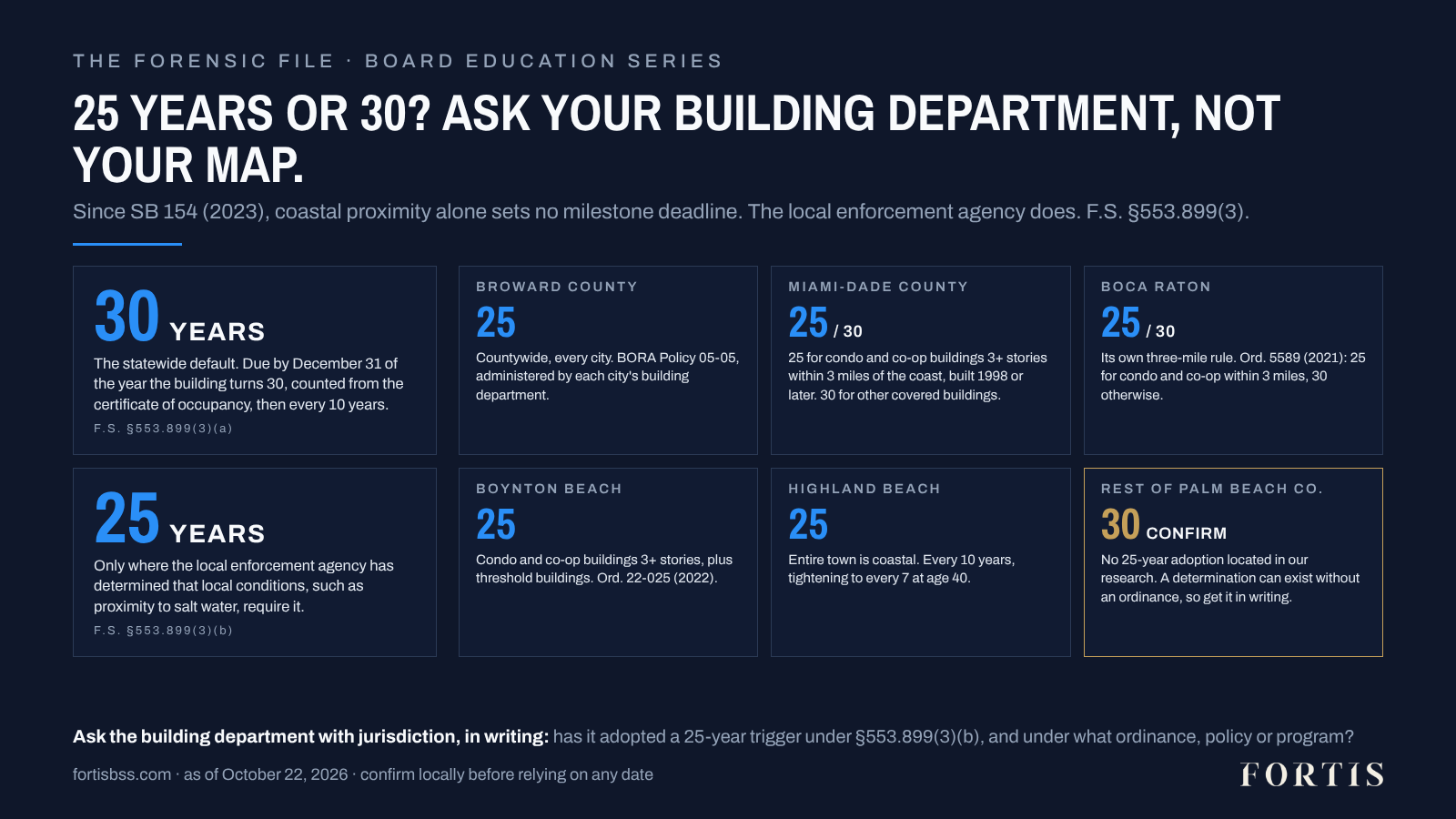
Here is the tri-county picture as of the review date, each line checked against the jurisdiction's own published material. Local recertification programs often cover more buildings than §553.899 does (threshold buildings, for instance) and add their own forms and electrical requirements; the table describes the age trigger, not the whole program.
| Jurisdiction | First inspection | How it was adopted | Source |
|---|---|---|---|
| Broward County (all municipalities) | 25 years, then every 10 | Building Safety Inspection Program, Board of Rules and Appeals Policy 05-05 (Aug. 9, 2024 revision), administered by each city's building department | BORA Policy 05-05; City of Fort Lauderdale BSIP page |
| Miami-Dade County | 25 years for condominium and cooperative buildings three stories or taller, within three miles of the coastline, built 1998 or later; 30 years for other covered buildings, with separate transition schedules for buildings built before 1998 | Building Recertification program under County Code §8-11(f), as applied in the Building Department's published guidance | Miami-Dade County Recertification page |
| Boynton Beach | 25 years, then every 10, for condominium and cooperative buildings three or more stories and for threshold buildings | Building Recertification Program, Ord. 22-025 (adopted late 2022), with the city's own structural and electrical report requirements | City of Boynton Beach Building Recertification page |
| Highland Beach | 25 years, then every 10; every 7 once a building is 40 or older | Building recertification ordinance (Ord. 2021-011, as amended); the entire town is coastal | Town of Highland Beach Milestone Inspection Program Summary |
| Boca Raton | 25 years for condominium and cooperative buildings within three miles of a coastline; 30 years for other covered buildings, including threshold buildings | Ord. 5589 (adopted August 24, 2021), Code §19-162; coverage also reaches buildings 50 feet or taller | City of Boca Raton Building Recertification page |
| Other Palm Beach County cities, and unincorporated Palm Beach County | 30 years (statewide default) unless the building department confirms otherwise | No 25-year adoption located in our research as of the review date; see the next section | Confirm with the building department, in writing |
A note on the first two rows. In Broward and Miami-Dade, the county recertification program is how the milestone requirement is administered and satisfied for the buildings those programs cover, on the program's own forms and with its electrical component. A covered building in either county does not owe a county recertification and a separate state milestone inspection. Boynton Beach's program works the same way for the buildings it covers. Broward or Miami-Dade: which recertification clock is your building on? Boynton Beach's recertification program and the state milestone inspection: one process or two?
A note on Boca Raton. Its ordinance predates SB 4-D and uses the three-mile line the state later abandoned. That is not a contradiction. Boca Raton's three-mile rule is a local adoption, which is exactly what §553.899(3)(b) permits. The coastline matters there because Boca Raton's city commission decided it does.
What about the rest of Palm Beach County?
This is where the coastal assumption causes the most confusion.
Palm Beach County has no countywide recertification ordinance. Every incorporated city is its own local enforcement agency, and unincorporated parcels answer to the county. Our research across the county's municipalities, last refreshed on the review date, located no 25-year adoption in Riviera Beach, Lake Worth Beach or Jupiter, and none in Delray Beach, West Palm Beach, the Town of Palm Beach, North Palm Beach, Ocean Ridge, Lantana, Palm Beach Gardens, Juno Beach or unincorporated Palm Beach County.
Read that carefully. "Not located" is not "does not exist." A building department can make a §553.899(3)(b) determination without passing an ordinance, and a city can adopt one next month. For a building in any of those places, the defensible statement today is: 30 years, confirmed in writing with the building department. Not "25 because we're coastal."
Why does the difference between 25 and 30 years matter to a condo board?
Because it moves a statutory deadline by five years, and the work behind that deadline is funded through budgets and reserves that are set a year or more ahead.
An illustration. A building with a 2001 certificate of occupancy on a 30-year clock is due by December 31, 2031. On a 25-year clock it is due by December 31, 2026. Whether a particular building is on time or late also depends on the local program's notices, any good-cause extension under §553.899(3)(c) and any prior inspection accepted under §553.899(3)(d), so the example illustrates the arithmetic, not any building's status.
The clocks do not stop at the age trigger. Under §553.899(5) the association must notify unit owners within 14 days of receiving the local enforcement agency's written notice, and under §553.899(6) Phase 1 must be completed, meaning the report submitted, within 180 days of the owner receiving that notice. If Phase 1 finds substantial structural deterioration, Phase 2 follows, and its repairs can affect the operating budget, special assessments and reserve planning depending on which components are involved. What happens after a Phase 2 milestone inspection report in Florida?
It also changes what you tell owners. Under §553.899(9), within 45 days of receiving the inspection report the association must distribute the inspector-prepared summary to every unit owner, post it in a conspicuous place on the property, and, where the association is required to maintain a website under §718.111(12)(g), post the report and summary there. A board that announces a 25-year deadline that does not exist has created an obligation its own documents will not support. A board that assumes 30 in a 25-year jurisdiction has miscalculated a statutory date.
How does a board confirm which clock it is on?
Four steps, in order. None of them requires an engineer.
- Find the certificate of occupancy date. The building department's permit records carry it. If the CO date is not available, the statute uses the date of occupancy evidenced in the local building official's records. Do not substitute the Property Appraiser's "year built" unless your jurisdiction's program says to; Miami-Dade's does, the state statute does not.
- Identify the local enforcement agency that has jurisdiction today. It is the building department that issues your permits now, which after annexations and reorganizations is not always the office that issued the original CO. In Broward and Miami-Dade that is the city building department administering the county program. In Palm Beach County it is the city, or the county for unincorporated parcels.
- Ask that department one question in writing: has it adopted or determined a 25-year milestone inspection trigger under §553.899(3)(b), and if so, under what ordinance, policy or program? Keep the answer with the association's records. Under §718.111(12) the milestone inspection report is an official record of the association; the correspondence establishing its due date is worth filing beside it.
- Put the date in the reserve plan. The SIRS under §718.112(2)(g) and the milestone inspection under §553.899 are separate requirements, but a Phase 2 finding can change the repair assumptions the reserve plan rests on. Milestone Inspections vs. SIRS in Florida
If the department says 25, you have a document. If it says 30, you have a document. If it says it is not sure, that is also an answer, and it is the one that most needs to be in writing.
What should a board do with this?
State the trigger with confidence where it is published: Broward, Miami-Dade, Boynton Beach, Highland Beach and Boca Raton. Everywhere else in Palm Beach County, start from 30 and confirm. Treat any statement that your building is on a 25-year clock "because it is coastal" as a claim that needs a citation, and ask for the ordinance or the determination.
Every Fortis assessment is performed to one documented standard and sealed by a licensed Florida PE who exercised direct responsible charge. If your board is unsure which clock it is on, we are glad to walk through the building's records with you and your counsel before anything is scheduled. Milestone Inspections
Sources
- Fla. Stat. §553.899 (2026), subsections (3)(a)–(d), (5), (6), (9). History: s. 3, ch. 2022-269; s. 2, ch. 2023-203; s. 4, ch. 2024-244; s. 4, ch. 2025-175. https://www.flsenate.gov/Laws/Statutes/2026/553.899. Accessed October 22, 2026.
- The Florida Senate, Bill Summary, CS/CS/SB 154 (2023). https://flsenate.gov/Committees/BillSummaries/2023/html/154. Accessed October 22, 2026.
- Broward County Board of Rules and Appeals, Policy 05-05, Building Safety Inspection Program (August 9, 2024 revision), as administered by the City of Fort Lauderdale (first inspection at 25 years, every ten thereafter). https://www.fortlauderdale.gov/Government/Departments/Development-Services/Permitting-Services/Building-Safety-Inspection-Program. Accessed October 22, 2026.
- Miami-Dade County, Building Recertification (§8-11(f); 30 years, or 25 for coastal condominium and cooperative buildings three stories or taller built 1998 or later; every 10 years; transition schedules for earlier cohorts). https://www.miamidade.gov/global/economy/building/recertification.page. Accessed October 22, 2026.
- City of Boynton Beach, Building Recertification (25 years from CO, every 10 thereafter; city structural and electrical report requirements). https://www.boynton-beach.org/469/Building-Recertification. Accessed October 22, 2026.
- Town of Highland Beach, Milestone Recertification Information (Ordinance 2021-011, November 16, 2021). https://www.highlandbeach.us/319/Milestone-Recertification-Information. Accessed October 22, 2026. Town of Highland Beach Building Department, Milestone Inspection Program – Summary (25 years or older every 10 years; 40 years or older every 7 years; threshold and association buildings), 3 pp.
- City of Boca Raton, Building Recertification Inspection Program (Ord. 5589, adopted August 24, 2021; §19-162). https://myboca.us/2091/Building-Recertification-Inspection-Prog. Accessed October 22, 2026.
- Fla. Stat. §718.111(12) (2026), official records, including (12)(g) association websites. https://www.flsenate.gov/Laws/Statutes/2026/718.111. Accessed October 22, 2026.
- Fla. Stat. §718.112(2)(g) (2026), structural integrity reserve study. https://www.flsenate.gov/Laws/Statutes/2026/718.112. Accessed October 22, 2026.
This article is general information for condominium and cooperative boards, not legal advice for a specific building. Local adoptions and determinations change; confirm the trigger in writing with the building department having jurisdiction before relying on any date.
KEEP THE FACTS CURRENT.
Florida's building-safety requirements change by county and by year. The Fortis Brief is a short note from Fortis BuildSafe Solutions, a few times a quarter, on what the rules say now and what a board should do about them.
Milestone Inspections: What Your Board Must Do
A plain-language board guide covering what triggers your Milestone Inspection, which deadline actually applies to your building, the Phase 1 and Phase 2 process, and what the statute requires your board to do next.
Record Appendix
Sources
Sources
- https://www.flsenate.gov/Laws/Statutes/2026/553.899
- https://flsenate.gov/Committees/BillSummaries/2023/html/154
- https://www.fortlauderdale.gov/Government/Departments/Development-Services/Permitting-Services/Building-Safety-Inspection-Program
- https://www.miamidade.gov/global/economy/building/recertification.page
- https://www.flsenate.gov/Laws/Statutes/2026/718.111
- https://www.flsenate.gov/Laws/Statutes/2026/718.112
- Florida Statute §553.899
- Florida Statute §718.112(2)(g)
Related record
Continue Reading

Why does Florida inspect older condominiums at all? A short history of the rules your board lives under
October 17, 2026
How much does a milestone inspection cost in Florida, and what drives the price?
October 16, 2026
Broward or Miami-Dade: which recertification clock is your building on?
October 10, 2026
Related Services
Reader questions
Have a question about this?
Every inquiry is reviewed by a Fortis engineer.