

In This Record
- 01
- 02Why isn't that the same as the building's age?
The building is the structure.
- 03What does the Division say?
The Division of Florida Condominiums, Timeshares, and Mobile Homes publishes an FAQ that answers a related question: what it considers a condominium's "date of existence." Its answer is the date the certificate of occupancy was issued by the local building department, not the date the declaration was filed.
- 04When does the difference actually matter?
Less often than the headline suggests.
When does your condo's SIRS clock start: when the building was finished, or when the condominium was created?
Published: October 30, 2026 · Last reviewed: October 30, 2026
Reviewed by Gabor I. Nagy, PE — Founder
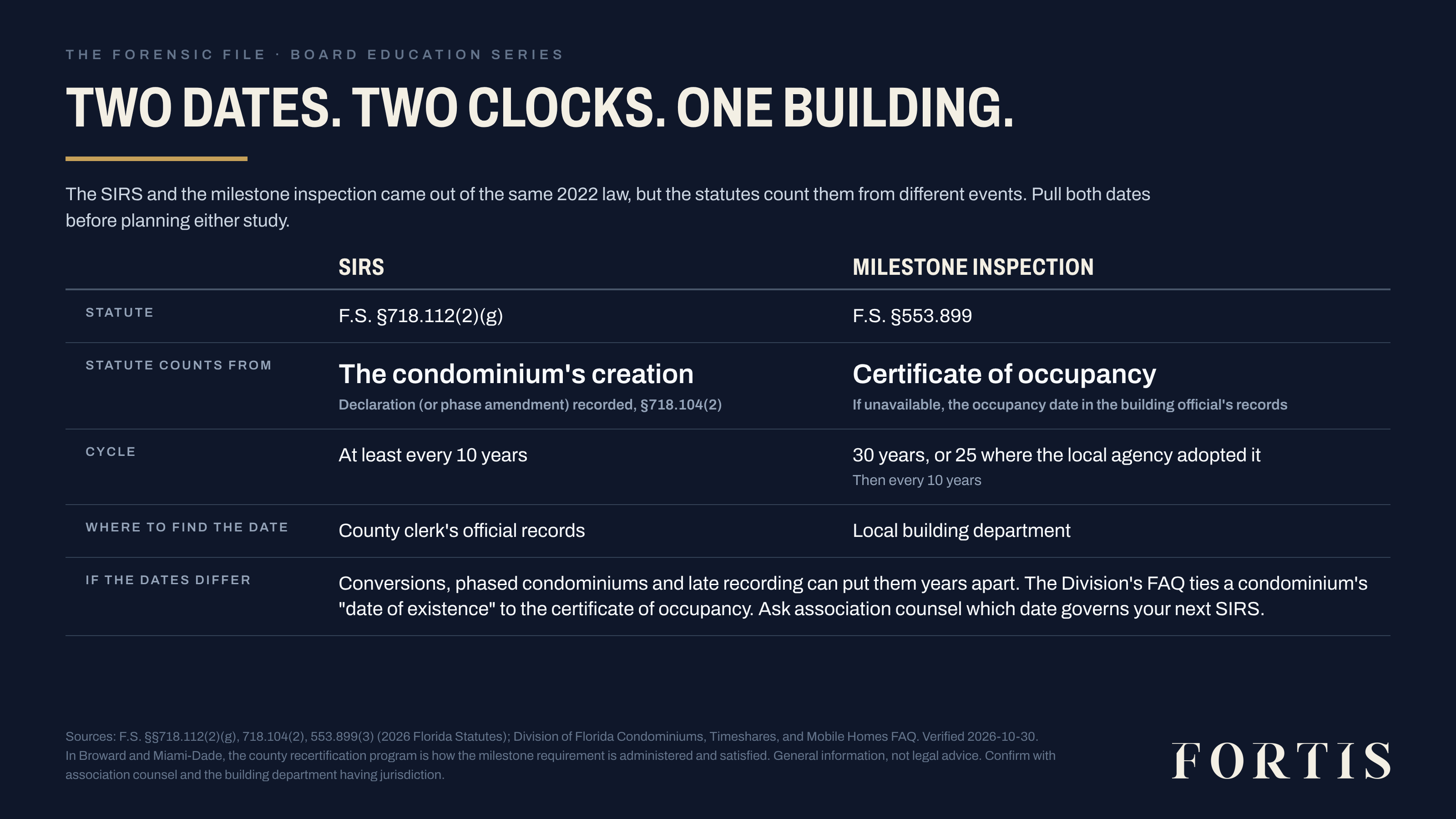
Direct answer: Florida law requires a structural integrity reserve study (SIRS) at least every 10 years "after the condominium's creation" (F.S. §718.112(2)(g)1). Chapter 718 says a condominium is created when its declaration is recorded (§718.104(2)). The milestone inspection counts from the certificate of occupancy instead. For most buildings those dates sit close together. For converted, phased or late-recorded condominiums they can be years apart, and the Division's published guidance uses the certificate of occupancy, so the start date is worth confirming with counsel.
The SIRS and the milestone inspection came out of the same 2022 law, but the statutes describe their starting points in different words. The difference is easy to miss until both dates are written side by side.
What does the statute measure the SIRS from?
F.S. §718.112(2)(g)1 requires a residential condominium association to have a SIRS completed at least every 10 years after the condominium's creation, for each building three habitable stories or more in height as determined by the Florida Building Code. Section 718.112(2)(g)5 excludes buildings under three stories, one- to four-family dwellings with three or fewer habitable stories above ground, any portion not submitted to condominium ownership, and any portion maintained by someone other than the association.
The SIRS paragraph does not define "creation." Section 718.104(2) does: a condominium is created by recording a declaration in the public records of the county where the land is located. Units in a later phase come into existence when the amendment adding that phase is recorded.
Read together, the statutory text points to a recording date in the county's official records rather than a construction date. That is a reading of two provisions side by side. No statute or rule we have found states it in one sentence.
Why isn't that the same as the building's age?
The building is the structure. The condominium is the legal form of ownership recorded on it. The two events can happen at different times, and §718.104(2) says units exist on recording regardless of how complete the improvements are.
They separate in a few situations:
- Conversions. A rental building finished in one decade and converted in a later one has a declaration newer than the structure.
- Phased condominiums. Each recorded phase amendment brings its own units into existence, so one condominium can hold buildings with different recording dates. An association that operates more than one condominium has a declaration for each.
- Late recording. A declaration recorded well after completion creates the condominium later than the certificate of occupancy.
What does the Division say?
The Division of Florida Condominiums, Timeshares, and Mobile Homes publishes an FAQ that answers a related question: what it considers a condominium's "date of existence." Its answer is the date the certificate of occupancy was issued by the local building department, not the date the declaration was filed.
The same FAQ restates the SIRS rule in the statute's own words, "after the condominium's creation." It does not say which date governs the 10-year cycle when the two differ, and it does not address conversions.
An FAQ is the Division's published guidance, not a statute or an adopted rule, and we are not aware of a published decision resolving this point. When the two dates are close, the conflict rarely changes anything. When they are years apart, it is a question for the association's counsel, best asked before the board budgets for the next study.
When does the difference actually matter?
Less often than the headline suggests.
For associations that existed on or before July 1, 2022 and are controlled by unit owners other than the developer, the first SIRS had a fixed deadline of December 31, 2025 (§718.112(2)(g)7). Where the association also has a milestone inspection due by December 31, 2026, the two may be completed together, but the SIRS may not be completed after December 31, 2026. That first deadline does not depend on either date. Can a Florida condo complete its SIRS and milestone inspection together in 2026?
The start date matters more for:
- Later studies. The statute ties the cycle to creation and requires a study at least every 10 years. Whether a later due date counts from creation or from the last completed study is not spelled out, so ask counsel how your association's schedule is set.
- Condominiums created after July 1, 2022, which fall outside the fixed first-study deadline.
- Conversions and phased condominiums, where the dates can be far apart.
Is the SIRS clock the same as the milestone clock?
No. They are two separate requirements, and neither satisfies the other outright.
The milestone inspection, F.S. §553.899(3), counts from the certificate of occupancy: 30 years for a building three habitable stories or more, or 25 where the local enforcement agency has adopted 25, then every 10 years. If the certificate's issuance date is not available, the statute uses the occupancy date shown in the local building official's records. In Broward and Miami-Dade, the county recertification program is how the milestone requirement is administered and satisfied.
They connect in two places. A milestone inspection performed within the past five years that meets the SIRS requirements may be used in place of the SIRS visual inspection (§718.112(2)(g)8). And after a milestone inspection, an association may delay a required SIRS for no more than the two consecutive budget years that follow it, so it can put its money toward the repairs the milestone inspection recommends (§718.112(2)(g)9). Milestone Inspections vs. SIRS in Florida
How do you find both dates?
- Declaration recording date: the county clerk's official records. The recording information on the declaration shows the date. Associations must keep the recorded declaration and its amendments as an official record (§718.111(12)).
- Certificate of occupancy: the local building department that issued the permits.
Keep both dates in one place in the board's records, next to the last SIRS date and the next milestone date.
What should a board do with two dates?
- Pull both records and write both dates down, including any phase amendments.
- If they fall in the same year, the start-date question is unlikely to change your schedule. Have counsel confirm how the next study date is set.
- If they are years apart, ask counsel which date governs your next study, and record the answer in the minutes.
- Keep the SIRS and the milestone inspection on separate lines of the calendar. One site visit can support both, but each requirement needs its own report.
If your board wants a second set of eyes on which dates the building is on, send us the certificate of occupancy date and the declaration recording date. Counsel answers the legal question. We can show you what the records say and how the two studies line up. Every Fortis assessment is performed to one documented standard and sealed by a licensed Florida PE who exercised direct responsible charge. Structural Integrity Reserve Study (SIRS)
Sources
- Fla. Stat. §718.112(2)(g)1, 5, 7, 8, 9 (2026). History ends s. 43, ch. 2026-14 (SB 104, reviser's bill, no substantive change to (2)(g)). https://www.flsenate.gov/Laws/Statutes/2026/718.112. Accessed October 30, 2026.
- Fla. Stat. §718.104(2) (2026), creation by recording the declaration or a phase amendment. https://www.flsenate.gov/Laws/Statutes/2026/718.104. Accessed October 30, 2026.
- Fla. Stat. §718.111(12) (2026), official records. https://www.flsenate.gov/Laws/Statutes/2026/718.111. Accessed October 30, 2026.
- Fla. Stat. §553.899(3)(a) (2026), milestone inspection trigger and the fallback when the certificate date is unavailable. https://www.flsenate.gov/Laws/Statutes/2026/553.899. Accessed October 30, 2026.
- Division of Florida Condominiums, Timeshares, and Mobile Homes, FAQs ("date of existence"; "When is the Structural Integrity Reserve study (SIRS) due"; milestone and SIRS overlap). https://condos.myfloridalicense.com/faqs/. Accessed October 30, 2026.
- Rule 61B-22.005, F.A.C. (Reserves), amended effective October 4, 2026. https://flrules.org/gateway/RuleNo.asp?id=61B-22.005. Accessed October 30, 2026.
- Hamilton, Mikes, Florida Condominium Law Changes: 2026 Session Update. https://hamiltonmikes.com/legislative-updates/florida-condominium-law-changes/. Accessed October 30, 2026. Secondary source, used only to confirm the 2026 session status.
This article is general information for condominium boards, not legal advice for a specific association. It does not cover associations still under developer control or cooperatives, which have a parallel requirement in Chapter 719. The Division's reserves rule, Rule 61B-22.005, F.A.C., was amended effective October 4, 2026. Confirm dates with association counsel and the building department having jurisdiction before relying on them.
KEEP THE FACTS CURRENT.
Florida's building-safety requirements change by county and by year. The Fortis Brief is a short note from Fortis BuildSafe Solutions, a few times a quarter, on what the rules say now and what a board should do about them.
Understanding Your SIRS Report: A Board Member’s Guide
Covers what a Structural Integrity Reserve Study is, how the 10-year cycle works under §718.112(2)(g)1, and how the HB 913 reserve funding changes affect your association.
Record Appendix
Related record
Continue Reading
Does HB 913 change anything for a Broward or Miami-Dade building that already does a county recertification?
October 27, 2026
Is your Florida condo's milestone inspection due at 25 years or 30? The answer depends on your city hall, not your coastline
October 22, 2026

Why does Florida inspect older condominiums at all? A short history of the rules your board lives under
October 17, 2026
Related Services
Reader questions
Have a question about this?
Every inquiry is reviewed by a Fortis engineer.