
In This Record
- 01Why do balconies deteriorate before the rest of the building?
Many South Florida balconies are cantilevers: a reinforced-concrete slab that reaches out from the building with no column or wall at its outer edge.
- 02What warning signs should the board look for between inspections?
Your engineer inspects on a schedule.
- 03What does the code actually require of a railing?
Railings are not decorative.
- 04Are balconies and railings covered by the milestone inspection?
For buildings that are subject to it, yes.
Balconies and railings: what should your Florida condo board watch for?
Published: September 28, 2026 · Last reviewed: September 28, 2026
Reviewed by Gabor I. Nagy, PE — Founder
Direct answer: Balconies and railings carry people, and in South Florida's salt air they are among a building's most exposed parts. In condo and co-op buildings covered by Florida's milestone inspection, and under county recertification programs, both are inspected items. Watching them between inspections lets a board catch problems while repairs are still small.
This post covers why balconies deteriorate first, the warning signs a board can spot between engineering visits, what the Florida Building Code requires of a railing, and how the milestone inspection and county recertification cover balconies and railings. It is general information, not an assessment of any building and not legal advice.
Florida does not have a standalone balcony-inspection statute for condominiums the way a few other states do. (Florida does require recurring balcony and railing inspections for qualifying hotels and other public lodging establishments under Fla. Stat. §509.2112, but that regime does not govern an ordinary residential condominium.) For condos and co-ops, balconies and railings are covered inside the inspections the building already owes and inside the building code that applied when the work was built or last altered.
Why do balconies deteriorate before the rest of the building?
Many South Florida balconies are cantilevers: a reinforced-concrete slab that reaches out from the building with no column or wall at its outer edge. In that common case, the strength comes from the steel reinforcement inside the slab working together with the concrete bonded around it. That bond is the whole point of reinforced concrete, and it is exactly what coastal exposure attacks.
The usual mechanism here is chloride-driven corrosion. Salt-laden water enters through cracks, failed waterproofing, or open joints at railing posts, reaches the reinforcing steel, and the steel corrodes. Corroding steel expands, which cracks the concrete from the inside, which lets in more water. The cycle accelerates where the concrete cover over the bar was thin to begin with. Corrosion is not the only way a balcony can fail — overload, original construction defects, connection or post-tensioning problems, and impact all happen too — but on aging coastal reinforced concrete it is the one we see most.
Railings add their own failure paths. A guard may be aluminum, steel, glass, or masonry, and it can loosen or fail at a corroded anchor, a failed weld, or a deteriorated slab edge where the post is embedded, independent of the balcony slab itself.
What warning signs should the board look for between inspections?
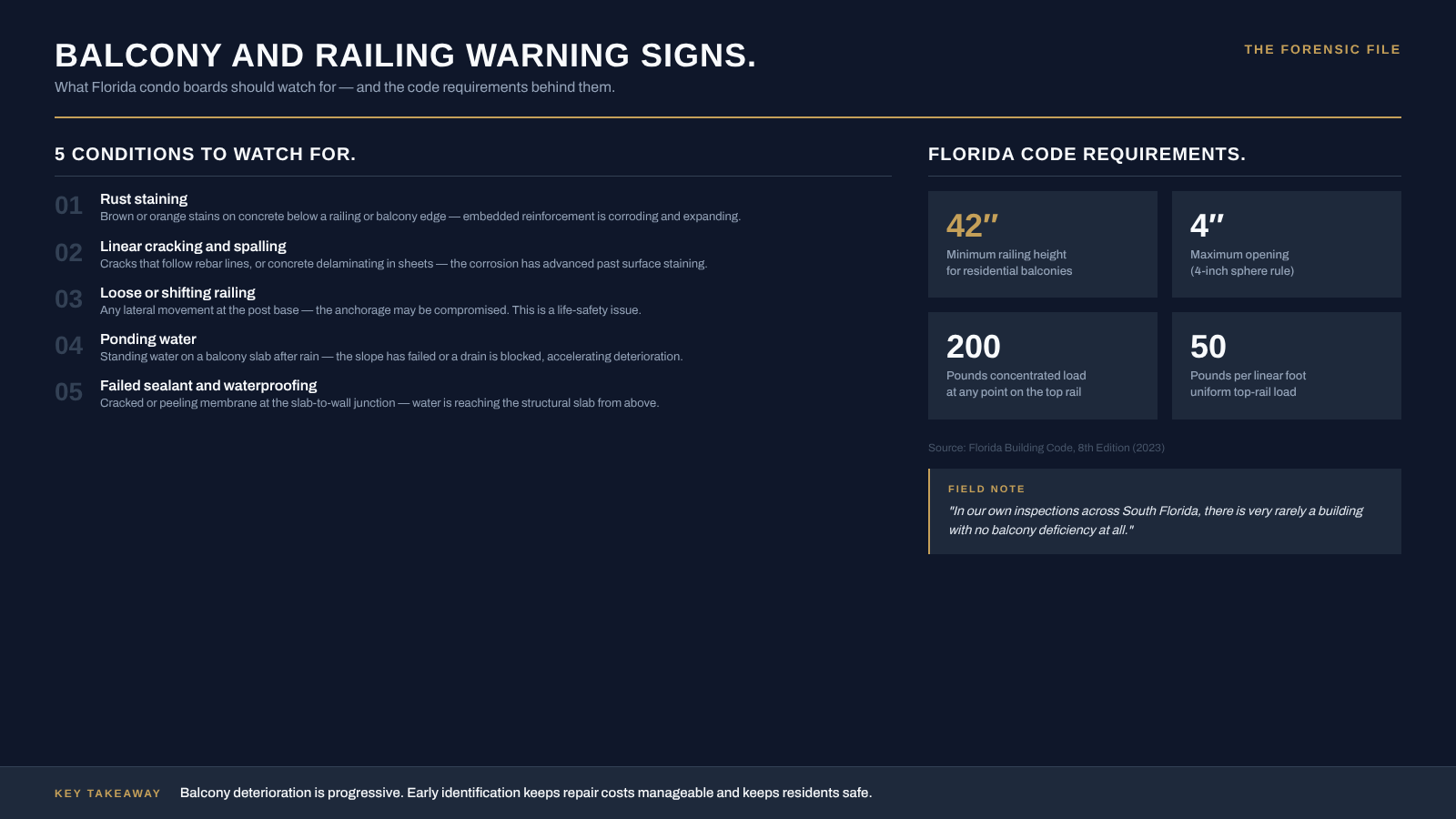
Your engineer inspects on a schedule. Your board and manager see the building every day. A few things are worth flagging the moment you notice them:
- Rust stains bleeding out of the concrete, especially along the underside edge of a balcony or around railing posts.
- Cracks that run in a line parallel to the balcony edge, or spalling — concrete that has cracked, bulged, or fallen away, sometimes exposing rust-colored steel.
- A railing that has become loose or that moves in normal use. A guard should feel solid. If one has started to shift, rotate, or flex, report it and keep people away from it. Do not deliberately push or lean on a suspect railing to test it — a compromised guard is exactly the wrong thing to load by hand.
- Ponding water that does not drain off the balcony surface after rain.
- Failed sealant or waterproofing at the floor, at the wall joint, or at the base of railing posts.
None of these means the balcony is about to fall. They mean water may be reaching steel, and the sooner an engineer sees it, the smaller the repair tends to be. A hairline crack caught early is often a sealant-and-monitoring item. The same crack left for years can become a shored balcony and an emergency assessment.
What does the code actually require of a railing?
Railings are not decorative. Under the Florida Building Code, Building (8th Edition, 2023), a guard is generally required along an open-sided walking surface located more than 30 inches above the floor or grade below, measured within 36 inches horizontally of the open edge (§1015.2). Guards must generally be at least 42 inches high (§1015.3). There is a limited exception that allows 36 inches for certain residential buildings three stories or shorter, which does not cover a typical multi-story condominium balcony, so 42 inches is the number most boards should expect. A guard generally cannot have openings that let a 4-inch sphere pass through (§1015.4), a child-safety provision that newer or replacement guards must respect even where older ones do not.
A guard also has to be strong enough. The code requires handrails and guards to resist a 200-pound concentrated load applied in any direction and a 50-pound-per-linear-foot load along the top, and it requires the infill (balusters and panels) to resist a separate 50-pound concentrated load (Florida Building Code, Building §1607.9). A railing that has started to move may no longer meet the load it was built to carry.
Two different questions matter here, and boards often blur them. What a guard must look like today, and what triggers a code upgrade when you repair one, are not the same. Inspections generally judge an existing building against the code it was built and altered under, while repair and replacement work is governed by the Florida Building Code, Existing Building, and whether new-code requirements apply depends on the scope of the work. This has a real budget consequence: if a concrete-restoration project has to fully remove older, grandfathered 36-inch railings to fix spalling at the slab edge, the building may not be allowed to reinstall the short rails and may have to upgrade to new 42-inch guards. Ask your engineer to price that possibility into a restoration scope rather than discovering it mid-project.
Are balconies and railings covered by the milestone inspection?
For buildings that are subject to it, yes. Florida's milestone inspection applies to buildings that are three habitable stories or more in height, as determined by the Florida Building Code, and under condominium or cooperative ownership, and it requires a licensed architect or engineer to perform "a visual examination of habitable and nonhabitable areas of a building, including the major structural components of a building" and give a qualitative assessment (§553.899(7)(a)). A load-bearing cantilevered balcony slab is a structural component and falls squarely within that examination. Guardrails are covered too, but by a more direct route: the statewide milestone inspection report form has its own guardrails section, so the inspector is expected to record their condition. Because a "habitable story" is counted under the Florida Building Code, a building near the three-story line — for example one with a ground-floor parking or utility level — should confirm with its building department whether it is in scope.
In Broward and Miami-Dade, the county recertification program is how the milestone requirement is administered and satisfied for qualifying buildings, so a board is not chasing two separate structural inspections. Those county forms are explicit where the statute is general. The Miami-Dade recertification structural report asks the engineer to document balconies — "indicate location, framing system, materials and condition" — and to describe the "type, material, and condition" of stairs, ramps, and guardrails and handrails. Balconies and railings are named items, not an afterthought. Which office is the local enforcement agency can vary by municipality, so confirm your building's filing path with your building department.
What should a board do with all this?
Three things, in order. First, treat balconies and railings as something you keep an eye on between engineering visits, not only every ten years. Second, when you see a warning sign, get it looked at while it is small. Third, when repair time comes, make sure the person specifying the fix is looking at why the steel corroded, not just patching the concrete that fell, because a patch over an active corrosion cell tends to fail again.
Balconies and railings are where a building's condition becomes personal, since they are the parts residents stand on and lean against. Watching them is not alarmism, and catching a problem early will not always make it cheap. It does give a board the chance to act on its own timeline instead of on an emergency's.
If your board wants a clear read on the balconies and railings in your building, contact us and we will walk you through what a building condition survey looks for. See also our work on milestone inspections and building recertification.
Sources
- Florida Statutes §553.899, Mandatory structural inspections — trigger §553.899(3)(a) ("a building that is three habitable stories or more in height as determined by the Florida Building Code"); Phase One scope §553.899(7)(a).
- Florida Statutes §509.2112, Inspection of balconies, platforms, stairways and railings at public lodging establishments.
- Florida Building Code, Building, 8th Edition (2023), §1015 (Guards) and §1607.9 (Loads on handrails and guards).
- Miami-Dade County Building Recertification Inspection Report Form — Structural (balconies; stairs, ramps, guardrails and handrails).
KEEP THE FACTS CURRENT.
Florida's building-safety requirements change by county and by year. The Fortis Brief is a short note from Fortis BuildSafe Solutions, a few times a quarter, on what the rules say now and what a board should do about them.
The Board President's Guide to Florida's Building Safety Laws
A plain-language walkthrough of milestone inspections, SIRS, county recertification, and your board's personal exposure — what triggers each requirement and what your board must do next.
Record Appendix
Sources
Sources
Related record
Continue Reading

Why does Florida inspect older condominiums at all? A short history of the rules your board lives under
October 17, 2026


How much does a milestone inspection cost in Florida, and what drives the price?
October 16, 2026
Broward or Miami-Dade: which recertification clock is your building on?
October 10, 2026
Related Services
Reader questions
Have a question about this?
Every inquiry is reviewed by a Fortis engineer.