
In This Record.
- 01What is a milestone report, and what is it not?
A milestone inspection is a structural inspection by a Florida-licensed engineer or architect "for the purposes of attesting to the life safety and adequacy of the structural components of the building" (§553.899(2)(a)).
- 02Why does every engineering report look different?
Section 553.899(8) lists what a report must contain "at a minimum." It does not lay out a page format or a statewide rating scale, so two sound reports on two similar buildings can look very different.
- 03What should your board read first?
Start with one sentence: whether the engineer observed unsafe or dangerous conditions. The report must say so either way (§553.899(8)(d)). If it says yes, that finding comes before everything else, and the board should ask the engineer at once what immediate steps it recommends.
- 04What six things must a milestone report contain?
Under §553.899(8), the report must, at a minimum: Bear the seal and signature, or the electronic signature, of the licensed engineer or architect who performed the inspection.
Reviewed by Gabor I. Nagy, PE — Founder
Direct answer: Check first whether the report states that unsafe or dangerous conditions were observed, then read the separate summary, then find the six things Florida law requires every milestone inspection report to contain (F.S. §553.899(8)). Anything the report leaves unclear goes back to the engineer as a written question.
A milestone inspection report is a signed and sealed document with several readers. The engineer delivers it to the association, to any owner of a portion of the building that is not under condominium or cooperative ownership, and to the local building official (§553.899(8)). The board is the reader that has to act on it, and often the one with the least practice reading it. This guide explains what each part of a typical Phase 1 report is for, which terms trigger next steps under the statute, and what to ask the engineer before the next board meeting.
What is a milestone report, and what is it not?
A milestone inspection is a structural inspection by a Florida-licensed engineer or architect "for the purposes of attesting to the life safety and adequacy of the structural components of the building" (§553.899(2)(a)). The statute is direct about its limits: "The purpose of such inspection is not to determine if the condition of an existing building is in compliance with the Florida Building Code or the firesafety code" (§553.899(2)(a)). A milestone report is a structural assessment, not a code-compliance certificate for the whole building.
Phase one is "a visual examination of habitable and nonhabitable areas of a building, including the major structural components of a building," with "a qualitative assessment of the structural conditions of the building" (§553.899(7)(a)). Phase two, when it is required, "may involve destructive or nondestructive testing at the inspector's direction" (§553.899(7)(b)). A Phase 1 report is a professional judgment based on what was visible and accessible. It cannot establish the condition of concealed materials from visible evidence alone.
The same section governs condominiums and cooperatives, so this guide applies to both. In Broward and Miami-Dade, the county recertification program is how the milestone requirement is administered and satisfied. Those programs also cover electrical systems, which §553.899 does not.
Why does every engineering report look different?
Section 553.899(8) lists what a report must contain "at a minimum." It does not lay out a page format or a statewide rating scale, so two sound reports on two similar buildings can look very different. One firm leads with a findings table, another with a narrative by floor.
Local programs can add their own forms, classifications and filing requirements on top of the statutory minimum. When you see a rating or a label, find out whether it comes from the engineer's own method or from a program your building is filed under.
What should your board read first?
Start with one sentence: whether the engineer observed unsafe or dangerous conditions. The report must say so either way (§553.899(8)(d)). If it says yes, that finding comes before everything else, and the board should ask the engineer at once what immediate steps it recommends.
Then read the separate summary. The engineer must deliver the sealed report with "a separate summary of, at minimum, the material findings and recommendations in the inspection report" (§553.899(8)).
That summary matters because your owners will read it too. Within 45 days after receiving the report, the association must distribute a copy of the inspector-prepared summary to each unit owner, regardless of the findings, by United States mail or personal delivery, and also by electronic transmission to owners who previously consented to receive notice that way. It must also post the summary in a conspicuous place on the property and publish the full report and summary on the association's website, if the association is required to have one (§553.899(9)). Posting and website publication do not replace the individual distribution.
The summary does not replace the full report. Locations, photos, the method behind each finding and the full list of lesser items live in the body. Read the summary for what the engineer concluded, then the body for where and why.
What six things must a milestone report contain?
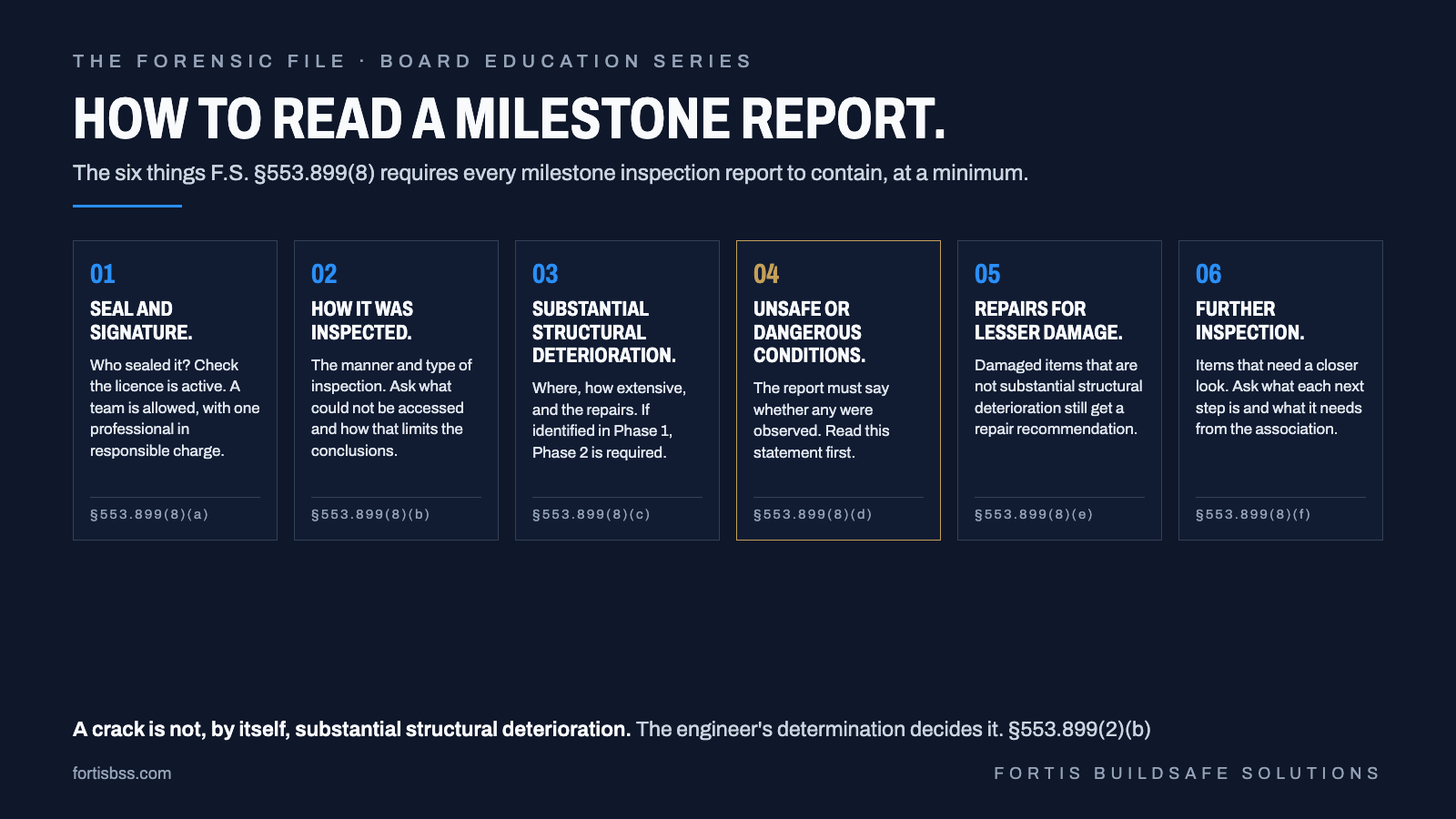
Under §553.899(8), the report must, at a minimum:
- Bear the seal and signature, or the electronic signature, of the licensed engineer or architect who performed the inspection. The statute allows a team of professionals, with an architect or engineer in responsible charge and the work signed and sealed by the appropriate qualified team member (§553.899(2)(a)). Check who sealed the report and that the licence is active on the state's licensing records.
- Indicate the manner and type of inspection forming the basis for the report. Use this section to learn what was examined and how. If areas were inaccessible or outside the scope, ask the engineer to list them and say how they limit the conclusions.
- Identify any substantial structural deterioration, within a reasonable professional probability based on the scope of the inspection, describe its extent, and identify recommended repairs. When substantial structural deterioration is identified during Phase 1, Phase 2 is required (§553.899(7)(b)).
- State whether unsafe or dangerous conditions were observed, as those terms are defined in the Florida Building Code.
- Recommend remedial or preventive repair for items that are damaged but are not substantial structural deterioration. These are repair recommendations in their own right, even though they do not trigger Phase 2. Plan for them.
- Identify and describe any items requiring further inspection. If the report does not explain why an item needs more inspection, or what the next step is, ask.
If you cannot find one of the six, ask the engineer where it is. It may sit under a heading your board would not expect.
What does "substantial structural deterioration" mean in a report?
It is the classification that decides whether Phase 2 is required, and the statute defines it: "substantial structural distress or substantial structural weakness that negatively affects a building's general structural condition and integrity" (§553.899(2)(b)).
The same definition says what it does not include: "surface imperfections such as cracks, distortion, sagging, deflections, misalignment, signs of leakage, or peeling of finishes unless the licensed engineer or architect performing the phase one or phase two inspection determines that such surface imperfections are a sign of substantial structural deterioration" (§553.899(2)(b)).
So a photo of a crack is not, by itself, a finding of substantial structural deterioration. The classification turns on the engineer's determination. If a report shows a crack or another surface condition and does not say how the engineer classified it, do not read silence as a conclusion either way. Ask the engineer to state it in writing.
A report with no substantial structural deterioration is not a general safety clearance. Unsafe or dangerous conditions (item 4), lesser damage (item 5) and further inspection (item 6) are separate findings, and each needs its own answer.
How should a board read condition ratings and severity language?
Section 553.899 uses two terms that trigger next steps: "substantial structural deterioration" and "unsafe or dangerous conditions." It does not set a statewide good, fair or poor scale, so ratings, priority levels and repair timeframes come from the engineer's method or from a local program's requirements.
Three habits help:
- Find the definitions. A rating means what the report, or the program behind it, says it means. Read those definitions before the findings.
- Do not compare ratings across reports. "Fair" in one report and "fair" in another may not be the same measurement.
- Separate condition from urgency. A report may rate how deteriorated an element is and, separately, how soon it should be repaired. Ask which one a given label describes.
What should you look for in the photos?
Photos document visible conditions within the scope of the inspection. They can show a great deal, including cracking, spalled concrete or exposed reinforcing steel, but they cannot by themselves establish the condition of materials that are hidden from view.
Check that each photo is tied to a finding and a location you could find on the property, such as a stack, a floor, a unit or an elevation. A photo you cannot place is hard to act on. For balconies and railings, which often draw many photos, see our guide to what Florida condo boards should watch for on balconies and railings.
What does "recommend further investigation" actually mean?
The statute requires the report to "identify and describe any items requiring further inspection" (§553.899(8)(f)). It does not say what form the next step takes, so ask the engineer what each item involves and what it needs from the association, such as access to units or a contractor to open a finish.
Further inspection and Phase 2 are different things that can overlap. Phase 2 is required when substantial structural deterioration is identified during Phase 1 (§553.899(7)(b)); an item flagged for further inspection does not trigger Phase 2 on its own. If the report is not clear about whether substantial structural deterioration was identified, get the engineer's answer in writing.
When Phase 2 is required, the engineer performing it must submit a Phase 2 progress report, with a timeline for completing Phase 2, to the local enforcement agency within 180 days after submitting the Phase 1 report (§553.899(7)(b)). Each county or city must then adopt an ordinance requiring the association to schedule or commence repairs for substantial structural deterioration within a set timeframe after the local enforcement agency receives the Phase 2 report, and the repairs must be commenced within 365 days after receiving that report. If the owner does not submit proof that repairs have been scheduled or commenced in time, the local enforcement agency must review and determine whether the building is unsafe for human occupancy (§553.899(11)). Note that the 365 days is a deadline to start repairs, not to finish them. Our article on what happens after a Phase 2 milestone inspection report covers that stage in detail.
What questions should your board bring back to the engineer?
Put them in writing so the answers come back in writing:
- Did you observe any unsafe or dangerous conditions, and what do you recommend we do now?
- Which findings, if any, did you identify as substantial structural deterioration, and where are they?
- For surface conditions shown in the photos, how did you classify each one?
- What could you not access, and how does that limit the conclusions?
- For each item flagged for further inspection, what is the next step, and what does it need from the association?
- What do the ratings and priority labels mean, and which ones describe urgency?
- From a structural-condition and safety standpoint, which recommended repairs are most urgent?
- What does the separate summary leave out that the board should know before owners read it?
How to fund the work is a separate decision for the board, its counsel and its financial advisers.
How does Fortis write its reports?
Fortis condition reports describe what was found, where it is and how extensive it is, and recommend the repair. Detailed repair quantities, the square footage and counts a contractor prices, are prepared on a separate quantity sheet when an engagement moves to repair bidding, rather than in the report itself. A board looking in a Fortis report for a square-footage figure to budget from should ask about that bid-stage step instead.
Every Fortis assessment is performed to one documented standard and sealed by a licensed Florida PE who exercised direct responsible charge. If your board has a report in hand and wants help understanding what it says, we are glad to walk through it with you. Read more about our milestone inspection service, or see what happens during a Florida milestone inspection, from the first call to the Phase 1 report.
Related reading: What happens during a Florida milestone inspection · What happens after a Phase 2 report · What happens when a condo "fails" its milestone inspection · Balconies and railings
Sources
- Fla. Stat. §553.899 (2026), Mandatory structural inspections for condominium and cooperative buildings, subsections (2), (7), (8), (9) and (11). https://www.leg.state.fl.us/statutes/index.cfm?App_mode=Display_Statute&URL=0500-0599/0553/Sections/0553.899.html. Accessed November 12, 2026.
This article is general information for condominium and cooperative boards, not legal advice for a specific association. Confirm requirements with your local building official and the association's counsel.
KEEP THE FACTS CURRENT.
Florida's building-safety requirements change by county and by year. The Fortis Brief is a short note from Fortis BuildSafe Solutions, a few times a quarter, on what the rules say now and what a board should do about them.
Milestone Inspections: What Your Board Must Do
A plain-language board guide covering what triggers your Milestone Inspection, which deadline actually applies to your building, the Phase 1 and Phase 2 process, and what the statute requires your board to do next.
Record Appendix.
Related record
Continue Reading

What is the difference between a special assessment and a reserve fund for a Florida condo?
November 9, 2026


What is construction administration, and who does what between an engineer's finding and a finished repair?
November 8, 2026
What does a Florida condo board actually receive when its SIRS is done?
November 8, 2026
Related Services
Reader questions
Have a question about this?
Every inquiry is reviewed by a Fortis engineer.