
In This Record
- 01Which components must the study cover?
For each building three habitable stories or higher, the study must cover, at a minimum, these items "as related to the structural integrity and safety of the building" (§718.112(2)(g)1.):
- 02What must the report actually contain for each item?
At a minimum, the statute requires the study to (§718.112(2)(g)4.a.):
- 03
- 04What does the funding recommendation have to look like?
The study must include a recommended reserve funding schedule based on a baseline funding plan, meaning reserve funding for each budget year is enough to keep the reserve cash balance above zero.
Reviewed by Gabor I. Nagy, PE — Founder
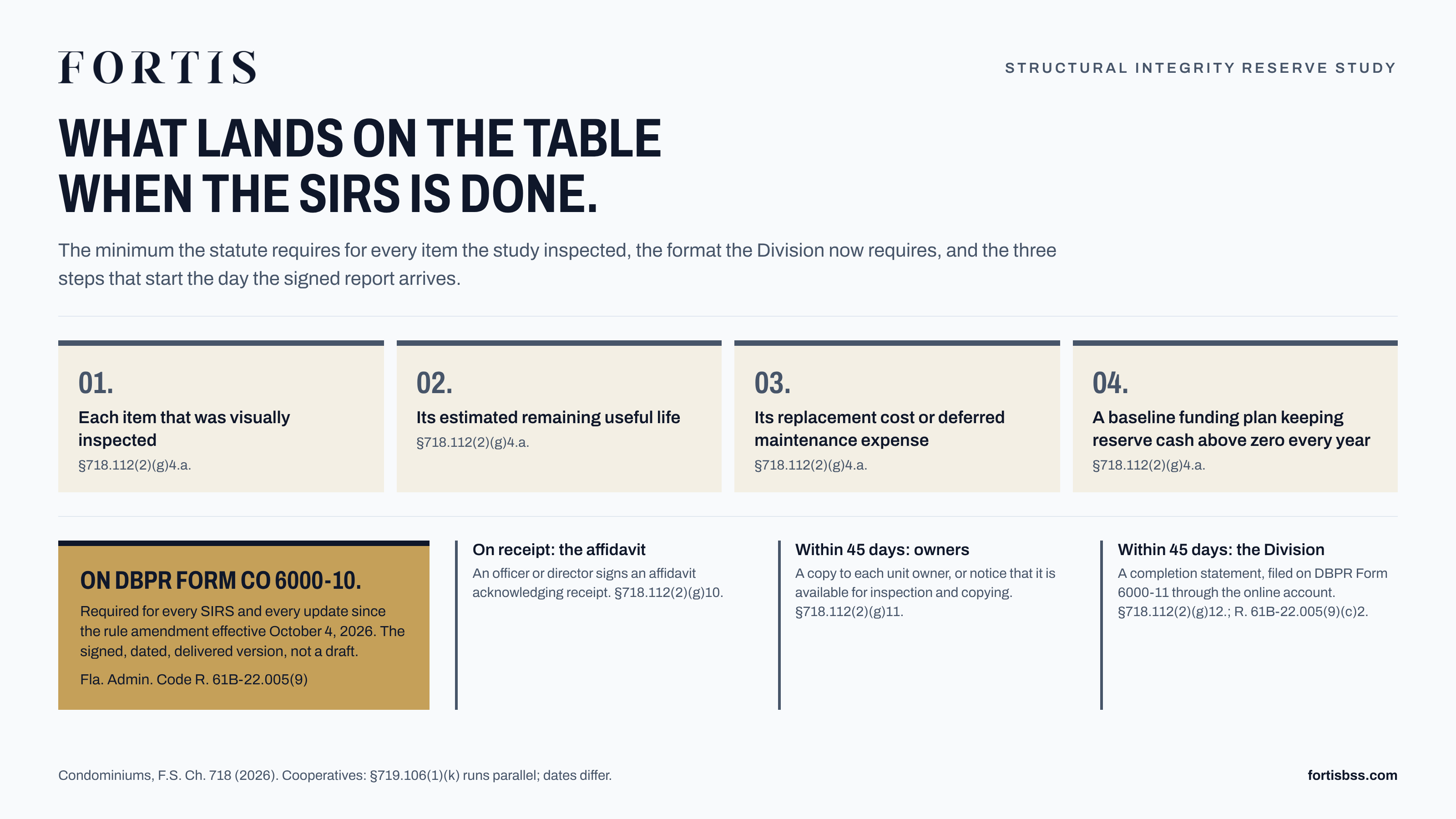
Direct answer: A Florida structural integrity reserve study must list each building item that was visually inspected, give each one an estimated remaining useful life and an estimated replacement cost or deferred maintenance expense, and recommend a reserve funding schedule that keeps the reserve cash balance above zero every budget year (F.S. §718.112(2)(g)4.a.).
Boards commission a structural integrity reserve study (SIRS) because the statute requires one. Fewer boards know what should be on the table when it is finished. Knowing that in advance makes it easier to compare proposals, to read the report when it arrives, and to spot a study that leaves something out.
This article is written for condominium boards under Chapter 718. Cooperative boards follow a parallel rule in F.S. §719.106(1)(k), with differences noted below.
Which components must the study cover?
For each building three habitable stories or higher, the study must cover, at a minimum, these items "as related to the structural integrity and safety of the building" (§718.112(2)(g)1.):
- Roof
- Structure, including load-bearing walls and other primary structural members and primary structural systems
- Fireproofing and fire protection systems
- Plumbing
- Electrical systems
- Waterproofing and exterior painting
- Windows and exterior doors
- Any other item with a deferred maintenance expense or replacement cost above the statutory threshold, where failing to replace or maintain it negatively affects the items above, as determined by the visual inspection
That threshold is the greater of $25,000 or an inflation-adjusted amount the Division of Florida Condominiums, Timeshares, and Mobile Homes posts by February 1 each year (§718.112(2)(f)6.). The Division's posted figure for 2026 is $25,675. It changes every year, so check the current figure when your study is scoped.
What must the report actually contain for each item?
At a minimum, the statute requires the study to (§718.112(2)(g)4.a.):
- Identify each item of the condominium property that was visually inspected
- State its estimated remaining useful life
- State its estimated replacement cost or deferred maintenance expense
- Provide a reserve funding plan or schedule with a recommended annual reserve amount that reaches each item's cost by the end of its remaining useful life
The study is based on a visual inspection of the condominium property (§718.112(2)(g)2.), and it must be performed or verified by a Florida-licensed engineer or architect, or by a reserve specialist or professional reserve analyst certified by the Community Associations Institute or the Association of Professional Reserve Analysts (§718.112(2)(g)3.a.).
Is there a required format?
Yes. Under the Division's reserves rule as amended effective October 4, 2026, every SIRS, including any update or amendment, must be completed on the current DBPR Form CO 6000-10, the Structural Integrity Reserve Study (SIRS) Form, effective August 2026 (Fla. Admin. Code R. 61B-22.005(9)). The same rule adds three points worth knowing:
- Only a full study satisfies the ten-year requirement. A narrower update does not take its place (R. 61B-22.005(9)(a)).
- A draft is not the deliverable. The completed SIRS is the version signed, dated and delivered to the association by the professional who performed it. Preliminary drafts or revisions prepared for internal board review do not count (R. 61B-22.005(9)(c)1.).
- The findings are not the board's to edit. The association must fund reserves in line with the most recent SIRS and may not alter its findings, including remaining useful lives and costs (R. 61B-22.005(9)(d)).
If a proposal does not say the report will be delivered on the current Division form, ask why before you sign.
What does the funding recommendation have to look like?
The study must include a recommended reserve funding schedule based on a baseline funding plan, meaning reserve funding for each budget year is enough to keep the reserve cash balance above zero. It may also recommend other schedules, as long as each one meets the association's maintenance obligation (§718.112(2)(g)4.a.).
Two related points boards often miss:
- The study has to account for how you plan to pay. It must consider the association's funding methods: regular assessments, special assessments, lines of credit or loans. If the study is done before the board approves a special assessment or secures a loan, it must be updated to reflect the method chosen (§718.112(2)(g)4.c.). Modeling a method in the study is not the same as approving it: for a condominium, funding SIRS reserves by special assessment, line of credit or loan requires a majority vote of the total voting interests of the association (§718.112(2)(f)2.c.(I)).
- The budget is tied to the study. Reserves for the SIRS items in the budget must be based on the findings and recommendations of the association's most recent study (§718.112(2)(f)2.a.). If the board wants to adopt a budget whose reserve funding does not align with the study's funding plan, the association must first obtain an updated study (§718.112(2)(g)4.c.).
Can the study say an item needs no reserves?
Yes, in two situations (§718.112(2)(g)4.b.):
- When an item's useful life and replacement cost cannot be estimated, the study may recommend that no reserves are needed, or recommend a deferred maintenance amount instead.
- When an item's estimated remaining useful life is greater than 25 years, the study may recommend that replacement reserves are not needed, though it may still recommend a deferred maintenance amount.
One point keeps this from being a loophole. For those same items, the association is not required to reserve replacement costs, but it must reserve any deferred maintenance expense the study recommends (§718.112(2)(f)2.a.). And an item with no replacement reserve still has to be maintained.
If the study recommends reserves for an item where the statute does not require them, that amount must be separately identified in the report. A board reading the funding schedule should be able to tell required reserves from optional ones at a glance.
What does the statute leave out of the study?
The requirement does not apply to buildings less than three stories in height; to single-family, two-family, three-family or four-family dwellings with three or fewer habitable stories above ground; to any portion or component of a building that has not been submitted to the condominium form of ownership; or to any portion or component maintained by a party other than the association (§718.112(2)(g)5.).
Note the wording: the requirement applies to buildings "three habitable stories or higher," while the exclusion refers to buildings "less than three stories in height." Both are quoted as the statute writes them.
The last exclusion matters in mixed-use and phased buildings. Who maintains a component is set by the declaration and the association's other governing documents, not by the engineer. If a commercial owner or a master association maintains part of the structure, the report should name the excluded components and the document the exclusion relies on.
What has to happen after the board receives it?
The deliverable is not finished when it lands. Three obligations start on receipt:
- An officer or director signs an affidavit acknowledging receipt of the completed study (§718.112(2)(g)10.).
- Within 45 days, owners get it. The association must distribute a copy of the study to each unit owner, or deliver a notice that it is available for inspection and copying on written request, by mail or personal delivery, or by e-mail or fax to owners who previously consented to receive notices electronically (§718.112(2)(g)11.).
- Within 45 days, the Division gets a statement. The association must tell the Division that the study was completed and made available to owners (§718.112(2)(g)12.). Under the amended rule, that notice and the affidavit are filed on DBPR Form 6000-11, Affidavit of Acknowledgement, through the association's online account with the Division (R. 61B-22.005(9)(c)2.).
The rule also requires the association to complete the SIRS Reporting form in that online account for every study, initial or amended (R. 61B-22.005(10)).
Put the receipt date on the board calendar the day the signed report arrives. Both 45-day clocks run from it.
How is a cooperative's study different?
The SIRS paragraph itself runs parallel: the component list, the minimum contents, the funding recommendation, the affidavit and both 45-day obligations appear in substance in §719.106(1)(k). The cooperative budget and reserve rules sit in §719.106(1)(j), and they should be read on their own terms. The dates differ. The condominium statute says "at least every 10 years after the condominium's creation," while the cooperative statute says "at least every 10 years." The first-study deadline for existing associations also differs: December 31, 2025 for condominiums (§718.112(2)(g)7.) and December 31, 2024 for cooperatives (§719.106(1)(k)7.). Both statutes allow an association with a milestone inspection due by December 31, 2026 to complete the study alongside it, and neither allows the first study to be completed after December 31, 2026. Cooperative boards should work from §719.106(1)(k) rather than a condominium timeline.
The Division's reserves rule, Rule 61B-22.005, is written under Chapter 718. Cooperative boards should confirm with the Division which forms apply to them rather than assume the condominium forms do. When does your condo's SIRS clock start? What December 31, 2026 means for a SIRS
What should a board look for when the report arrives?
A short check. Items 1 to 5 come from the statute and the Division's rule. Items 6 and 7 are not legal requirements, but they are what makes a report easy to defend later:
- The report is on the current DBPR Form CO 6000-10 and is the signed, dated, delivered version, not a draft.
- Each item has a remaining useful life and a cost, or, where the statute allows, a stated reason the estimate cannot be determined.
- There is a baseline funding plan that keeps the reserve cash balance above zero every budget year.
- Any item with reserves recommended but not required is separately identified.
- The funding methods the board actually intends to use are reflected.
- Every component on the statutory list is addressed, including any the building does not have.
- Any excluded portion of the building is named, with the reason.
Under the Fortis SIRS component checklist, each component the statute names gets its own line in the report, including the ones a building does not have. A component that does not apply is recorded as not applicable with a written reason, and every remaining useful life and cost figure carries the basis it was derived from. Years later, a documented exclusion shows what was left out and why, so its basis can be checked. A silent omission leaves nothing to check.
The milestone inspection and the SIRS remain two separate requirements under two separate statutes. The fieldwork can overlap: a milestone inspection performed within the past 5 years that meets the SIRS requirements may be used in place of the visual inspection portion of the study (§718.112(2)(g)8.). It does not replace the rest of the study. Milestone inspections vs. SIRS in Florida
If your board is scoping a SIRS and wants to know what the finished report should contain before you sign, we are glad to walk through it. Every Fortis assessment is performed to one documented standard and sealed by a licensed Florida PE who exercised direct responsible charge. Structural Integrity Reserve Study
Sources
- Fla. Stat. §718.112(2)(f)2.a., (2)(f)2.c., (2)(f)6. and (2)(g)1.-12. (2026). https://www.flsenate.gov/Laws/Statutes/2026/718.112. Accessed November 7, 2026.
- Fla. Stat. §719.106(1)(k) (2026). https://www.flsenate.gov/Laws/Statutes/2026/719.106. Accessed November 7, 2026.
- Fla. Admin. Code R. 61B-22.005 (amended October 4, 2026). https://flrules.org/gateway/ruleNo.asp?id=61B-22.005. Accessed November 7, 2026.
- Florida DBPR, Division of Florida Condominiums, Timeshares, and Mobile Homes, "Reserve Threshold." https://www2.myfloridalicense.com/condos-timeshares-mobile-homes/reserve-threshold/. Accessed November 7, 2026.
This article is general information for condominium and cooperative boards, not legal or financial advice for a specific association. Confirm the requirements that apply to your building with the association's counsel.
KEEP THE FACTS CURRENT.
Florida's building-safety requirements change by county and by year. The Fortis Brief is a short note from Fortis BuildSafe Solutions, a few times a quarter, on what the rules say now and what a board should do about them.
Understanding Your SIRS Report: A Board Member’s Guide
Covers what a Structural Integrity Reserve Study is, how the 10-year cycle works under §718.112(2)(g)1, and how the HB 913 reserve funding changes affect your association.
Record Appendix
Related record
Continue Reading


What is construction administration, and who does what between an engineer's finding and a finished repair?
November 8, 2026

If your Florida condo still has not completed its SIRS, what does December 31, 2026 mean?
November 6, 2026
What happens when a Florida condo "fails" its milestone inspection?
November 1, 2026
Related Services
Reader questions
Have a question about this?
Every inquiry is reviewed by a Fortis engineer.