

In This Record
- 01Step 1: The finding. Who owns it?
An inspection report identifies conditions, describes their extent and recommends repairs.
- 02Step 2: Repair design. Who owns it?
A finding is not yet a repair scope.
- 03Step 3: Bidding. Who owns it?
Florida condominium associations must obtain competitive bids for a materials, equipment or services contract when the payment exceeds 5 percent of the association's total annual budget, including reserves, and the association is not required to accept the lowest bid (F.S.
- 04Step 4: Construction administration. Who owns it?
Construction administration is what keeps the finished repair tied to the engineered repair documents.
Reviewed by Gabor I. Nagy, PE — Founder
Direct answer: Construction administration is a defined set of engineering services during a restoration project: reviewing submittals, answering contractor questions, observing the work at agreed intervals, checking payment requests and reporting to the board. Its scope, including how often the engineer is on site, is whatever the written agreement says. The contractor performs the repair and remains responsible for its means, methods and workmanship.
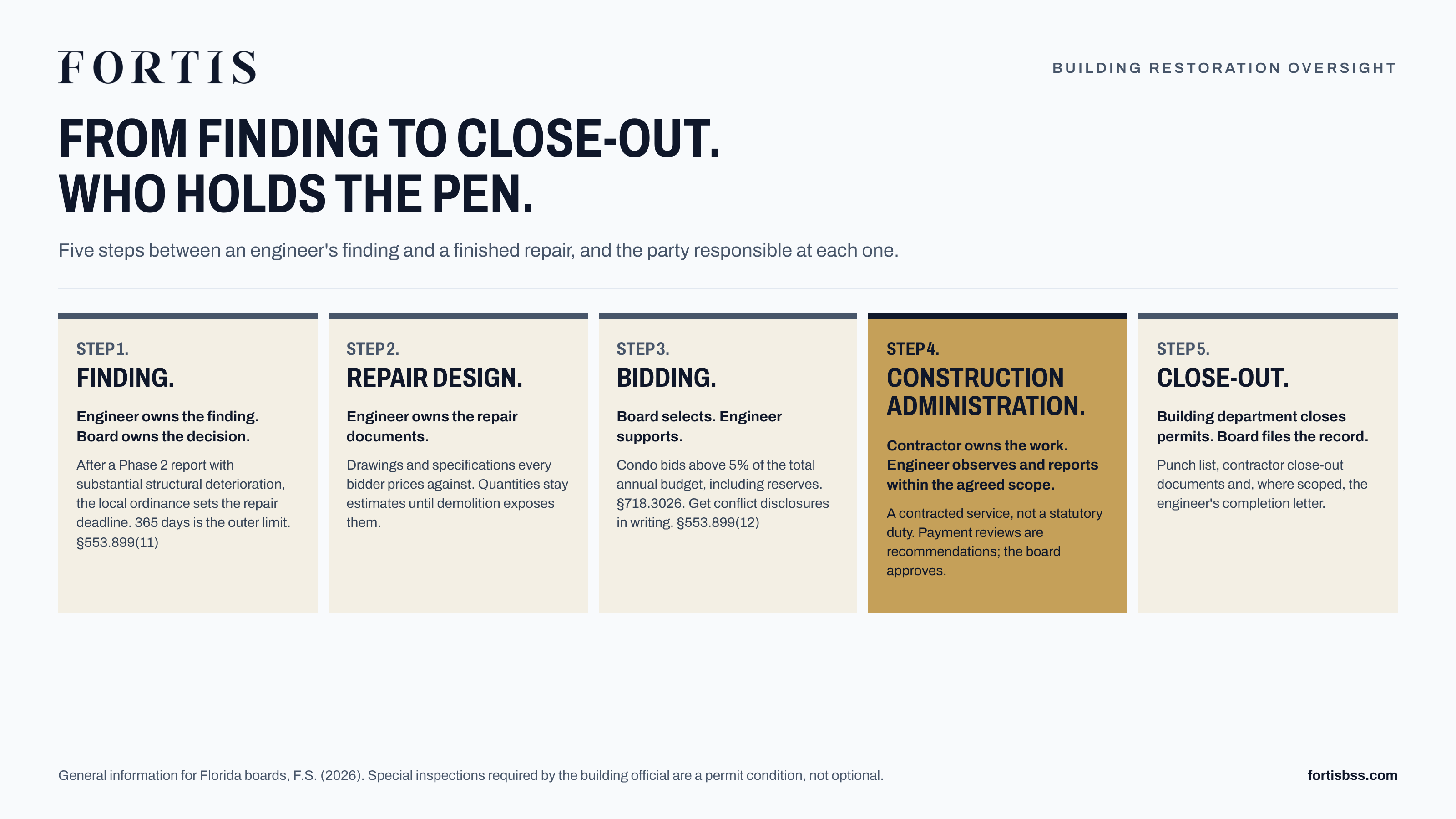
The stretch boards most often misread is the one between "the engineer found something" and "a contractor is on site." It has several distinct steps, and a different party holds the pen at each one. Knowing who holds what keeps a project from stalling, and keeps the board from signing for something it has not seen.
Step 1: The finding. Who owns it?
The engineer owns the finding. The board owns the decision.
An inspection report identifies conditions, describes their extent and recommends repairs. If the report comes out of a milestone inspection and a Phase 2 report identifies substantial structural deterioration, a statutory clock applies: each county or city must adopt an ordinance setting when repairs are scheduled or commenced, and the repairs must be commenced within 365 days after the building department receives the Phase 2 report (F.S. §553.899(11)). The local ordinance sets the deadline that actually applies to your building. The 365 days is the statewide outer limit, not a guaranteed window. What happens after a Phase 2 milestone inspection report in Florida?
If the owner does not submit proof that repairs were scheduled or commenced in time, the building department must review and determine whether the building is unsafe for human occupancy (§553.899(11)). That is a review, not an automatic finding, but it is a review the board controls only by meeting the local deadline.
What the board should ask for here: a clear list of which findings need engineered repair documents, which are maintenance, and which need further investigation before a scope can be written.
Step 2: Repair design. Who owns it?
The engineer owns the repair documents.
A finding is not yet a repair scope. Contractors can give budget estimates early, but on structural restoration an engineer typically turns the findings into repair drawings and specifications before firm bids are taken: what gets repaired, how, to what standard, and in roughly what quantities. Where the permit requires engineered documents, these are what the building department reviews and the contractor bids against.
On concrete restoration, quantities are estimates until the damaged material is removed. Good repair documents say so and set out how the actual quantities will be measured and approved once demolition exposes them.
What the board should ask for here: repair documents complete enough that every bidder is pricing the same scope.
Step 3: Bidding. Who owns it?
The board owns the contractor selection. The engineer supports it.
Florida condominium associations must obtain competitive bids for a materials, equipment or services contract when the payment exceeds 5 percent of the association's total annual budget, including reserves, and the association is not required to accept the lowest bid (F.S. §718.3026(1)). Contracts for engineering and architect services are not subject to that bid requirement (§718.3026(2)(a)). The section does not limit an association's ability to obtain needed products and services in an emergency (§718.3026(2)(b)). Associations with 10 or fewer units may opt out of the section by a two-thirds vote of the unit owners.
Cooperatives follow a parallel rule in F.S. §719.3026, with the threshold stated as 5 percent of the association's budget including reserves, and an opt-out available to associations with fewer than 100 units if two-thirds of the unit owners vote for it.
Disclosure rules also apply when the firm that did the inspection may be involved in the work that follows. A licensed architect or engineer who bids to perform a milestone inspection must disclose in writing any intent to bid on services related to the maintenance, repair or replacement that inspection may recommend. A design professional or contractor bidding on that recommended work may not have a direct or indirect interest in the inspecting firm, or a covered family relationship with someone who does, unless the relationship is disclosed to the association in writing. A contract made without a required disclosure is voidable and terminates when the association files written notice (§553.899(12)). Where the repair recommendations come from a SIRS instead, a separate disclosure rule applies (§718.112(2)(g)3.b. for condominiums, §719.106(1)(k)3.b. for cooperatives). Ask for these disclosures in writing before you engage.
What the board should ask for here: a bid comparison that lines up each contractor's price against the same scope and quantities, with exclusions called out.
Step 4: Construction administration. Who owns it?
The contractor owns the work. The engineer observes, documents and reports within the agreed scope. The board approves payment.
Construction administration is what keeps the finished repair tied to the engineered repair documents. It is a contracted service, not a statutory duty: its scope is whatever the engineering agreement says, so read that agreement before work starts. Where the scope covers it, it typically includes:
- A pre-construction meeting with the repair contractor
- Review of submittals, shop drawings and change orders against the repair documents
- Responses to contractor requests for information (RFIs)
- Site observation, including measurement of repair areas after demolition
- Review of contractor payment applications against completed quantities, with a recommendation to the board
- Progress reporting to the board and manager
How often the engineer is on site should be agreed in writing before work begins, and it should scale with the risk of the work. A balcony slab edge repair and a column repair do not need the same attention. Periodic observation is not continuous supervision, and the engineer's authority to reject work or approve changes is whatever the contracts give it.
Special inspections are a separate matter. Where the code or the building official requires them, they are a permit condition, not an optional part of a construction administration package.
What the board should ask for here: payment applications that the engineer has checked against measured quantities before the board pays them. The engineer's review is a recommendation; the board still approves the payment under its contract with the contractor. That check is one of the most direct protections construction administration gives an association.
Step 5: Close-out. Who owns it?
The engineer documents completion, where scoped. The building department closes the permits. The board files the record.
A restoration project is finished when the paperwork says it is, not when the scaffolding comes down. Close-out typically includes punch-list walkthroughs, the contractor's close-out documents, confirmation from the building department that the project's permits are closed and, where the engineering agreement calls for it, a completion letter from the engineer. What that letter can say depends on how much of the work the engineer observed, which is one more reason to agree the level of oversight up front. For a milestone-driven repair, keep whatever the building department requires to show the repairs were completed.
What the board should ask for here: one close-out package, kept with the association's official records.
Can the board skip construction administration?
Boards can and do contract for less oversight on a small, straightforward repair. What the board gives up is the independent check that the work matches the engineered repair documents and that each payment reflects work actually done. Whatever level is chosen, the permit, the building department's inspections and any special inspections it requires still apply. Matching the level of oversight to the risk of the work, and agreeing it in writing before construction starts, is the approach that holds up.
How does Fortis handle the contractor side?
Fortis does not name a contractor to a board, manager or owner unless a dated verification of that contractor's license and insurance status, less than 90 days old, is on file. A contractor whose license has lapsed or whose insurance has expired since the last job is exactly the kind of problem that is easy to check before a contract is signed and expensive to discover after. A verification is a snapshot, so the board should still confirm both on the day the contract is signed.
If your board has a report in hand and wants to understand the path from findings to a finished, closed-out repair, we are glad to walk through it. Every Fortis assessment is performed to one documented standard and sealed by a licensed Florida PE who exercised direct responsible charge. Building Restoration Oversight
Sources
- Fla. Stat. §553.899(11) and (12) (2026). https://www.flsenate.gov/Laws/Statutes/2026/553.899. Accessed November 7, 2026.
- Fla. Stat. §718.112(2)(g)3.b. and §719.106(1)(k)3.b. (2026). https://www.flsenate.gov/Laws/Statutes/2026/718.112 ; https://www.flsenate.gov/Laws/Statutes/2026/719.106. Accessed November 7, 2026.
- Fla. Stat. §718.3026 (2026). https://www.flsenate.gov/Laws/Statutes/2026/718.3026. Accessed November 7, 2026.
- Fla. Stat. §719.3026 (2026). https://www.flsenate.gov/Laws/Statutes/2026/719.3026. Accessed November 7, 2026.
This article is general information for condominium and cooperative boards, not legal advice for a specific association or a project-specific engineering recommendation. Confirm deadlines with the building department having jurisdiction and the association's counsel.
KEEP THE FACTS CURRENT.
Florida's building-safety requirements change by county and by year. The Fortis Brief is a short note from Fortis BuildSafe Solutions, a few times a quarter, on what the rules say now and what a board should do about them.
The Board President's Guide to Florida's Building Safety Laws
A plain-language walkthrough of milestone inspections, SIRS, county recertification, and your board's personal exposure — what triggers each requirement and what your board must do next.
Record Appendix
Sources
Sources
- https://www.flsenate.gov/Laws/Statutes/2026/553.899
- https://www.flsenate.gov/Laws/Statutes/2026/718.112
- https://www.flsenate.gov/Laws/Statutes/2026/719.106
- https://www.flsenate.gov/Laws/Statutes/2026/718.3026
- https://www.flsenate.gov/Laws/Statutes/2026/719.3026
- Florida Statute §553.899
- Florida Statute §718.112(2)(g)
- Florida Statute §719.106(1)(k)
Related record
Continue Reading

What does a Florida condo board actually receive when its SIRS is done?
November 8, 2026

If your Florida condo still has not completed its SIRS, what does December 31, 2026 mean?
November 6, 2026
What happens when a Florida condo "fails" its milestone inspection?
November 1, 2026
Related Services
Reader questions
Have a question about this?
Every inquiry is reviewed by a Fortis engineer.