
In This Record
- 01What exactly does the statute say about December 31, 2026?
The sentence is short and it is unusual.
- 02Is the date different for a cooperative?
Yes, and this is the detail most easily missed, because the cooperative rule lives in an entirely different chapter.
- 03Which buildings does this reach?
This is worth reading carefully, because the paragraph does not use one single phrase for building height.
- 04What does the statute say happens if a board misses it?
This is where most of what is circulating online is wrong, in both directions.
Reviewed by Gabor I. Nagy, PE — Founder
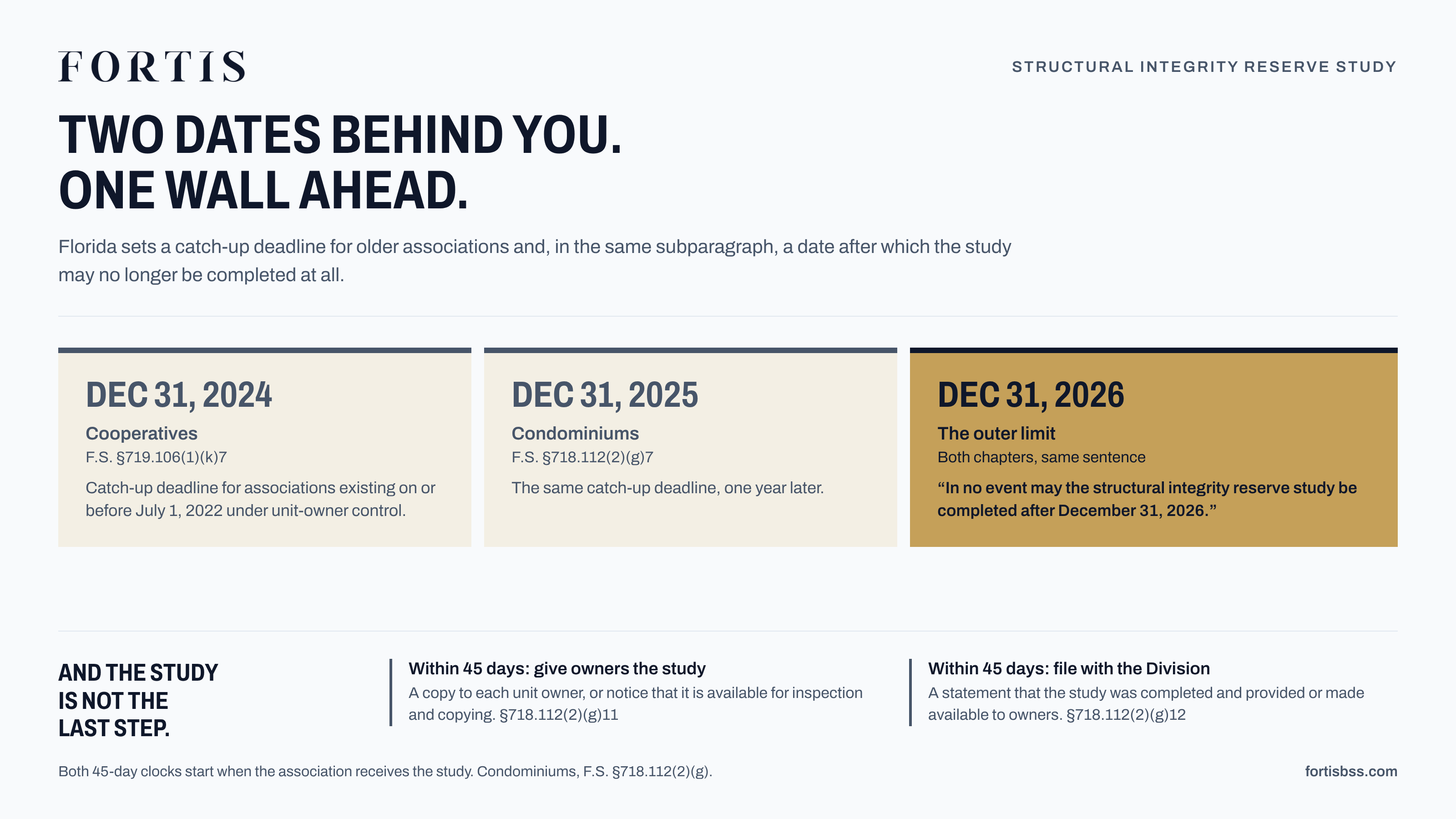
It is a ceiling, not a reminder. F.S. §718.112(2)(g)7 says a structural integrity reserve study may not be completed after December 31, 2026. For condominium associations that existed on or before July 1, 2022 and are controlled by owners rather than the developer, the study was due December 31, 2025. Cooperatives run on an earlier date under a different chapter. The statute sets no fine, and completing the study is not the last step.
What exactly does the statute say about December 31, 2026?
The sentence is short and it is unusual. Most compliance deadlines tell you when something is due. This one tells you when it can no longer be done:
"In no event may the structural integrity reserve study be completed after December 31, 2026."
That wording sits in §718.112(2)(g)7, the same subparagraph that set the December 31, 2025 due date. No extension mechanism is attached to it and no good-cause provision appears alongside it. Compare that with the milestone inspection, where F.S. §553.899(3)(c) does give a local building official authority to grant an extension for good cause. Nothing equivalent appears in this paragraph.
One point of precision, because it changes how urgently this reads for a given board. The "in no event" sentence carries no limiting language of its own. It sits inside a subparagraph addressed to associations that existed on or before July 1, 2022 and that are controlled by unit owners other than the developer, so the natural reading is that it binds that same group. The statute does not say so expressly. If your association was created after July 1, 2022, your obligation runs on the ordinary 10-year cycle described below, and your association's attorney is the right person to confirm how this subparagraph reads for you.
Is the date different for a cooperative?
Yes, and this is the detail most easily missed, because the cooperative rule lives in an entirely different chapter.
F.S. §719.106(1)(k)7 is the cooperative counterpart. It requires cooperative associations that existed on or before July 1, 2022 and are controlled by unit owners other than the developer to have completed a structural integrity reserve study by December 31, 2024, for each building on the cooperative property three stories or higher in height.
The outer limit is identical. The cooperative provision carries the same sentence: in no event may the study be completed after December 31, 2026. The simultaneous-completion provision is the same as well, and tied to the same date.
So a cooperative board reading a condominium article will get the ceiling right and the due date wrong by a full year. If you are a cooperative, read Chapter 719, not Chapter 718.
Which buildings does this reach?
This is worth reading carefully, because the paragraph does not use one single phrase for building height.
The ongoing requirement at §718.112(2)(g)1 reaches each building on the condominium property that is "three habitable stories or higher in height, as determined by the Florida Building Code."
The catch-up deadline at §718.112(2)(g)7, which is the subparagraph this article is about, reaches each building "three stories or higher in height." The word habitable does not appear there.
Separately, §718.112(2)(g)5 states that the paragraph does not apply to buildings less than three stories in height, or to single-family, two-family, three-family or four-family dwellings with three or fewer habitable stories above ground, or to portions of a building not submitted to the condominium form of ownership, or to portions maintained by someone other than the association.
For most buildings these all point the same way. For a building where they might not, for example a three-story structure whose ground level is parking, the difference between a habitable story and a story is the whole question. That is a determination under the Florida Building Code, so confirm it with your building official rather than counting floors from the parking lot.
The association. Under §718.112(2)(g)1, a residential association must have a study completed at least every 10 years after the condominium's creation. That cycle runs from the creation of the condominium, not from the day the building was finished.
What does the statute say happens if a board misses it?
This is where most of what is circulating online is wrong, in both directions. Some of it implies fines. Some of it implies nothing happens.
Subparagraph 7 states no penalty. What the paragraph does say appears at §718.112(2)(g)10: if the officers or directors of an association willfully and knowingly fail to complete a structural integrity reserve study, that failure is a breach of an officer's or a director's fiduciary relationship to the unit owners under F.S. §718.111(1). The same subparagraph separately requires that an officer or a director sign an affidavit acknowledging receipt of the completed study.
"Willfully and knowingly" is a legal standard, not an engineering one. What it means for your board, and what your board should be doing now to record its compliance efforts, is a question for your association's attorney. Fortis BuildSafe Solutions is a forensic engineering firm, and that determination is outside what an engineer can tell you.
What we can tell you is the part that is procedural, and it is the part boards most often do not know.
Is the study finished when the report arrives?
No, and this is the quiet trap in the whole paragraph.
Two further duties follow, each on a 45-day clock running from when the association receives the completed study:
- §718.112(2)(g)11. Within 45 days after receiving the study, the association must distribute a copy to each unit owner, or give notice that the completed study is available for inspection and copying on written request. Delivery may be by mail or personal delivery, or by electronic transmission to owners who previously consented to receive notice electronically.
- §718.112(2)(g)12. Within 45 days after receiving the study, the association must provide the Division a statement indicating that the study was completed and was provided or made available to unit owners, submitted on the form the Division publishes.
A board that commissions a study in December, receives it, files it in a drawer and considers the matter closed has not finished what the statute asks. Put both 45-day dates on the calendar the day the report lands.
The study is also an official record. Under F.S. §718.111(12)(g), the association records a qualifying association must post to a website or application include both §553.899 inspection reports and the structural integrity reserve study. Whatever you complete does not stay internal.
Can we still run the SIRS alongside our milestone inspection?
Yes, and for a board behind on both, this is the most useful provision in the paragraph.
An association required to complete a milestone inspection in accordance with §553.899 on or before December 31, 2026 may complete the structural integrity reserve study simultaneously with that milestone inspection.
Two things about how that is written. First, the door is tied to the milestone deadline, not to the association's creation date or to who controls the board. Second, it closes on the same date as the outer limit. If your milestone is due on or before December 31, 2026 and you have scheduled neither, this is the last window in which the statute lets you run them together.
To be clear about what that does and does not do: it lets one field effort serve two requirements where the scopes genuinely overlap. It does not merge them. The milestone inspection and the structural integrity reserve study remain two separate obligations under two separate statutes.
Can a condo complete its SIRS and milestone inspection together? Milestone inspections vs. SIRS
Does an inspection we already had count toward the study?
Partly, toward one component of it, and the statute is broader here than most boards realize.
Under §718.112(2)(g)8, if the milestone inspection required by §553.899, or an inspection completed for a similar local requirement, was performed within the past five years and meets the requirements of the paragraph, that inspection may be used in place of the visual inspection portion of the structural integrity reserve study.
That phrase "or an inspection completed for a similar local requirement" matters a great deal in South Florida. The county recertification program is how the milestone requirement is administered and satisfied in Broward and Miami-Dade, so the inspection sitting in your files may have reached you under that name rather than as a milestone inspection. It may still be usable here. Whether it qualifies depends on whether it meets the requirements of the paragraph, which is a question to put to whoever performs your study, with the report in hand. Do not assume it qualifies, and do not assume it does not.
Milestone inspection vs. building recertification
Note also what this provision is not. It replaces the visual inspection portion only. The study still requires the component analysis and the funding analysis.
Separately, §718.112(2)(g)9 allows an association that has completed a milestone inspection, or an inspection for a similar local requirement, to delay a required structural integrity reserve study for no more than the two consecutive budget years immediately following that inspection, so the association can focus its resources on the inspection's repair and maintenance recommendations. That is a distinct provision from the catch-up deadline and should not be read as extending the December 31, 2026 limit.
What has to be in the study, and who can perform it?
At a minimum, the study must address the roof; the structure, including load-bearing walls and other primary structural members and primary structural systems; fireproofing and fire protection systems; plumbing; electrical systems; waterproofing and exterior painting; windows and exterior doors; and any other item with a deferred maintenance or replacement cost exceeding $25,000, or the inflation-adjusted amount if greater, where failing to maintain or replace it negatively affects one of the listed items.
On who may do the work, the statute is broader than most boards expect. Under §718.112(2)(g)3.a., the study, including its visual inspection portion, must be performed or verified by an engineer licensed under chapter 471, an architect licensed under chapter 481, or a person certified as a reserve specialist or professional reserve analyst by the Community Associations Institute or the Association of Professional Reserve Analysts. Each of those qualifications is sufficient on its own, so the statute does not by itself require an engineer.
That is the legal minimum. Separately, and as a matter of our own practice rather than a statement of what the law demands: every Fortis structural integrity reserve study is engineer-led and sealed by a licensed Florida PE exercising direct responsible charge.
The boards who call us in November about a December 31 deadline are almost never surprised by the report. They are surprised by the field time.
What should a board do before the end of the year?
- Establish whether you have a study at all, and whether it is the right one. A conventional reserve study is not a structural integrity reserve study. The difference is what the document must contain: the named components above, a visual inspection, and a funding analysis tied to what was observed.
- Check which chapter you are under. Condominium associations read §718.112(2)(g). Cooperatives read §719.106(1)(k), where the catch-up date was a year earlier.
- Find your condominium's creation date, not the building's completion date. That is what starts the 10-year cycle.
- Check whether a milestone inspection is due on or before December 31, 2026. If it is, the simultaneous-completion provision is available to you until that date and not after.
- Pull any inspection from the last five years, including a county or city recertification, and have it assessed against the paragraph's requirements rather than assuming either way.
- Calendar both 45-day duties now, so they are not missed in the week the report arrives.
- Ask your association's attorney how subparagraph 7 reads for your association, particularly if it was created after July 1, 2022.
Structural Integrity Reserve Study milestone deadline calculator
If your board is working out where it stands and would like the question answered against your own documents and dates, Fortis is glad to walk through it with you. Call (954) 756-6876 or email sales@fortisbss.com.
KEEP THE FACTS CURRENT.
Florida's building-safety requirements change by county and by year. The Fortis Brief is a short note from Fortis BuildSafe Solutions, a few times a quarter, on what the rules say now and what a board should do about them.
Understanding Your SIRS Report: A Board Member’s Guide
Covers what a Structural Integrity Reserve Study is, how the 10-year cycle works under §718.112(2)(g)1, and how the HB 913 reserve funding changes affect your association.
Record Appendix
Related record
Continue Reading


What happens when a Florida condo "fails" its milestone inspection?
November 1, 2026
When does your condo's SIRS clock start: when the building was finished, or when the condominium was created?
October 30, 2026
Does HB 913 change anything for a Broward or Miami-Dade building that already does a county recertification?
October 27, 2026
Related Services
Reader questions
Have a question about this?
Every inquiry is reviewed by a Fortis engineer.