
In This Record.
- 01What is a reserve fund, and how does it work?
The annual budget of a Florida condominium must include reserve accounts for capital expenditures and deferred maintenance.
- 02What is a special assessment, and when do boards use one?
Florida law defines a special assessment as any assessment levied against a unit owner other than the assessment required by a budget adopted annually (§718.103).
- 03How do the two connect when a building needs a SIRS?
This is where the questions usually start.
- 04Can a board reduce or skip reserve funding instead?
For a budget adopted on or after December 31, 2024, a unit-owner-controlled association that must obtain a SIRS may not vote to provide no reserves or less reserves than required for the SIRS items.
Direct answer: A reserve fund is money an association sets aside through its annual budget for future repair and replacement of major components. A special assessment is any assessment levied against unit owners other than the one set by the annual budget (F.S. §718.103). For buildings that need a structural integrity reserve study, Florida law ties reserve amounts to that study and limits when they can be reduced.
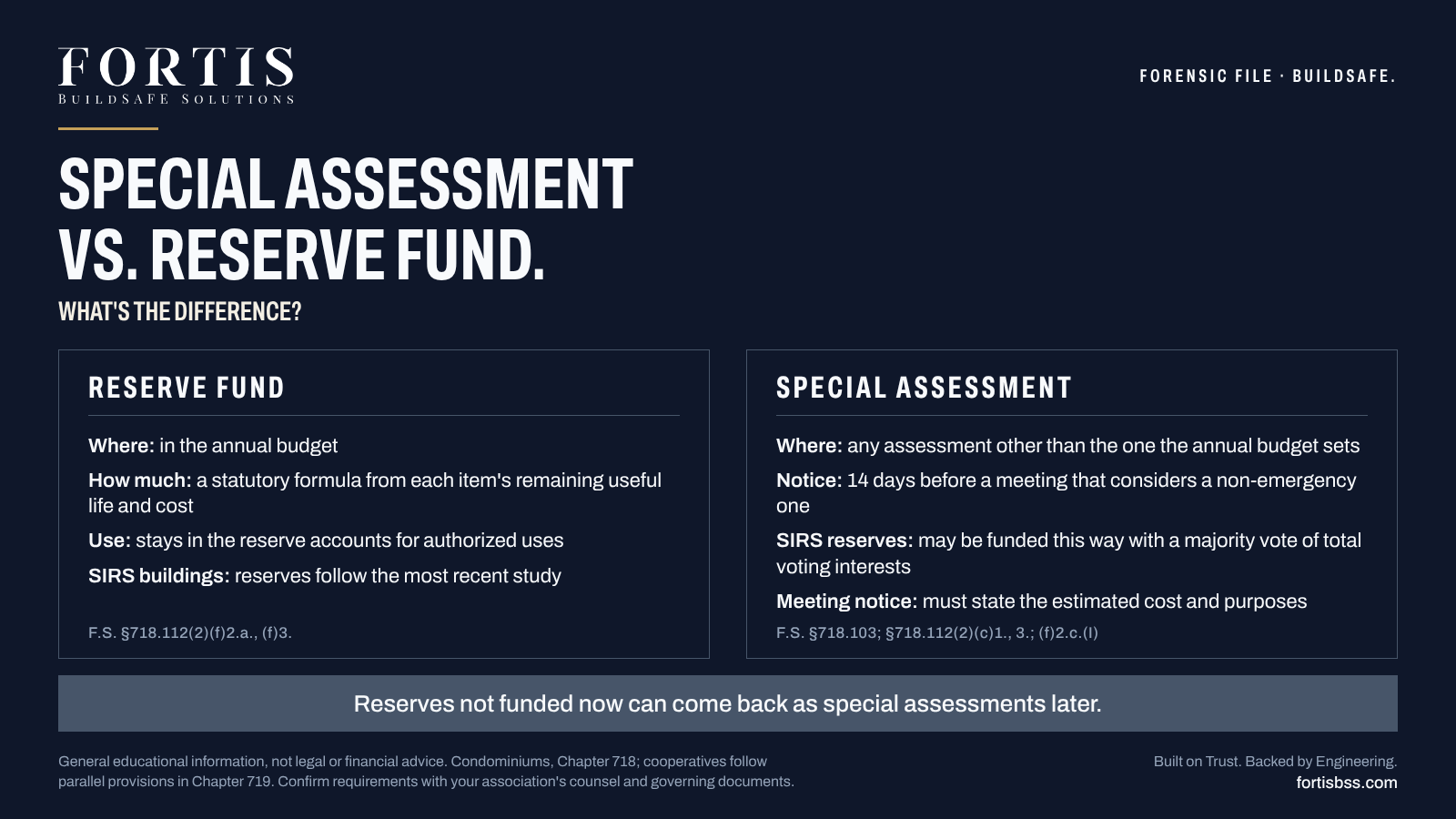
Boards and owners often treat the two as opposites. They are really two routes to the same result: paying for work the building needs. Which route applies, and who has to approve it, depends on what the statute says and what the association's documents add.
What is a reserve fund, and how does it work?
The annual budget of a Florida condominium must include reserve accounts for capital expenditures and deferred maintenance. Those accounts must include roof replacement, building painting and pavement resurfacing regardless of cost, plus any other item whose replacement cost or deferred maintenance expense exceeds the statutory threshold, which is the greater of a fixed statutory minimum and an inflation-adjusted amount. The Division adjusts that minimum for inflation each year and posts the current figure on its website, so check that figure for your budget year (F.S. §718.112(2)(f)2.a. and (f)6.).
The amount reserved is computed by a formula based on each item's estimated remaining useful life and estimated replacement cost or deferred maintenance expense (§718.112(2)(f)2.a.). In plain terms: the board estimates how long each component has left and what it will cost, and the budget sets money aside toward that cost under the statutory formula. The amount reserved can differ from one budget year to the next.
Reserve money has to stay in the reserve accounts. It may be used only for authorized reserve expenditures unless a majority of all the total voting interests approves another use in advance. For a budget adopted on or after December 31, 2024, the members of a unit-owner-controlled association that must obtain a structural integrity reserve study may not vote to use reserve funds, or any interest earned on them, for any purpose other than the replacement or deferred maintenance costs of the components listed in the SIRS statute (§718.112(2)(f)3.). Reserve funding for those components may be pooled only with other components listed in that statute (§718.112(2)(f)4.).
What is a special assessment, and when do boards use one?
Florida law defines a special assessment as any assessment levied against a unit owner other than the assessment required by a budget adopted annually (§718.103). It is a separate assessment, outside the one the annual budget sets. It can pay for an unplanned cost or, as the SIRS section below explains, be one of the ways an association funds required reserves.
The statute sets a notice process around it:
- Written notice of a meeting at which a non-emergency special assessment will be considered must be mailed, delivered or electronically transmitted to the unit owners and posted conspicuously on the condominium property at least 14 days before the meeting, with an affidavit of compliance filed in the official records (§718.112(2)(c)1.).
- The notice of any meeting at which regular or special assessments will be considered must state specifically that assessments will be considered and provide the estimated cost and a description of the purposes (§718.112(2)(c)3.).
- Emergency actions follow a different path, described in the same paragraph (§718.112(2)(c)1.). Whether a particular situation qualifies is a question for the association's attorney.
Fourteen days' notice is a meeting requirement. It does not by itself authorize an assessment; the board's authority and any owner vote come from the statute and the association's governing documents.
Whether a particular special assessment is needed, and how large, is a question for the board, the association's attorney and its financial advisers, subject to the owner approval and governing-document requirements that apply. It is not an engineering determination.
How do the two connect when a building needs a SIRS?
This is where the questions usually start. A structural integrity reserve study (SIRS) covers, at a minimum, eight categories: roof; structure, including load-bearing walls and other primary structural members and systems; fireproofing and fire protection systems; plumbing; electrical systems; waterproofing and exterior painting; windows and exterior doors; and any other item above the dollar threshold whose failure to be replaced or maintained negatively affects the first seven (§718.112(2)(g)1.). It applies to each building three habitable stories or higher in height, as determined by the Florida Building Code, and it is completed at least every 10 years after the condominium's creation (§718.112(2)(g)1.).
The study must identify each item inspected, state its estimated remaining useful life and its estimated replacement cost or deferred maintenance expense, and provide a reserve funding plan or schedule with a recommended annual reserve amount. At a minimum it must include a baseline funding plan in which each budget year's funding is enough to keep the reserve cash balance above zero, and it may recommend other schedules that are sufficient to meet the association's maintenance obligation (§718.112(2)(g)4.a.).
The budget then follows the study: for an association required to obtain a SIRS, reserves must be maintained for the SIRS items the association is responsible for, and the reserve amount must be based on the findings and recommendations of the most recent study (§718.112(2)(f)2.a.).
The statute is explicit that these reserves may be funded by regular assessments, special assessments, lines of credit or loans. A special assessment, a line of credit or a loan used this way requires the approval of a majority vote of the total voting interests of the association (§718.112(2)(f)2.c.(I)). An association that secures one of these must include it, with related details, in the annual financial statement delivered to unit owners and provided to prospective purchasers (§718.112(2)(f)2.c.(II)). That provision adds conditions for a line of credit or loan: it must be sufficient to fund the cumulative amount of any previously waived or unfunded portions of the required reserve funding, and its funds must be immediately available to the board for required repair, maintenance or replacement expenses without further approval by the members.
The funding route also feeds back into the study. A SIRS must take into account the funding methods the association uses. If the study was done before the association approved a special assessment or secured a line of credit or loan, the study must be updated to reflect the method selected and its effect on the reserve funding schedule. And the association must obtain an updated study before adopting any budget in which the reserve funding from regular assessments, special assessments, lines of credit or loans does not align with the funding plan in the most recent version of the study (§718.112(2)(g)4.c.). A board that is weighing a funding route should ask its attorney and the person who performed the study how that requirement applies before the budget is adopted.
Can a board reduce or skip reserve funding instead?
For a budget adopted on or after December 31, 2024, a unit-owner-controlled association that must obtain a SIRS may not vote to provide no reserves or less reserves than required for the SIRS items. The main exception is narrow: a multicondominium association may do so if the Division has approved an alternative funding method (§718.112(2)(f)2.b.). Separately, if an association votes to terminate the condominium under §718.117, the members may vote to waive maintenance of the reserves recommended by the most recent SIRS (§718.112(2)(f)2.a.). For items outside the SIRS list, a majority of the total voting interests may still vote to provide no reserves or less reserves.
The statute also provides narrow, specific pauses:
- If the local building official determines the entire building is uninhabitable because of a natural emergency, the board may pause or reduce reserve contributions until the building is habitable again (§718.112(2)(f)2.d.).
- For a budget adopted on or before December 31, 2028, an association that completed a milestone inspection within the previous two calendar years may, with the approval of a majority of the total voting interests, pause or reduce reserve contributions for no more than two consecutive annual budgets to fund repairs the milestone inspection recommended. An association that pauses must have a SIRS performed before it resumes contributions (§718.112(2)(f)2.e.).
When an owner vote on waiving or reducing reserves is put on a proxy, the statute requires this statement on the face of the proxy ballot in capitalized, bold letters: "WAIVING OF RESERVES, IN WHOLE OR IN PART, OR ALLOWING ALTERNATIVE USES OF EXISTING RESERVES MAY RESULT IN UNIT OWNER LIABILITY FOR PAYMENT OF UNANTICIPATED SPECIAL ASSESSMENTS REGARDING THOSE ITEMS." (§718.112(2)(f)5.) That sentence is the clearest statement in the statute of how the two tools relate: reserves not funded now can come back as special assessments later.
Does this work the same way for a cooperative?
The cooperative statute follows the same structure in Chapter 719. Its budget paragraph requires reserve accounts for capital expenditures and deferred maintenance, reserves for the SIRS items are based on the most recent study, and those reserves may be funded by regular assessments, special assessments, lines of credit or loans, with a special assessment, line of credit or loan requiring a majority vote of the total voting interests (F.S. §719.106(1)(j)2.a. and 3.a.(I)). Chapter 719 also carries the requirement to update the study when the budget's funding does not align with it (§719.106(1)(k)4.c.). The notice rules for meetings that consider special assessments are in §719.106(1)(c). The paragraph numbering differs from Chapter 718, so a cooperative board should read its own chapter and its governing documents rather than assume the condominium citations apply.
What should a board ask its engineer, and what should it ask someone else?
A SIRS can be performed or verified by an engineer licensed under Chapter 471, an architect licensed under Chapter 481, or a certified reserve specialist or professional reserve analyst (§718.112(2)(g)3.a.). Whoever performs it, the study answers engineering and cost-estimating questions. The decisions about how the association pays belong to the board and, where the statute or governing documents require it, the owners.
Questions for the person who performed the study:
- Which items did you inspect, and what remaining useful life and cost did you assign to each?
- What does the baseline funding plan assume, and what other schedules did you evaluate?
- Which findings, if any, are repairs that cannot wait for the next budget cycle?
- What is the basis for each cost estimate, and when was it last updated?
Questions for the association's attorney, accountant or other financial adviser:
- Which funding route fits our governing documents and vote requirements: regular assessments, a special assessment, a line of credit or a loan?
- How does each route affect owners, including prospective purchasers who receive the annual financial statement?
- What notice and vote does each require, and what must go in the official records?
How does Fortis handle the line between engineering and funding?
When Fortis reports on a component, the report states what the engineering shows: the item, its condition, its remaining useful life and its estimated cost. The reserve funding schedule the statute requires is part of a SIRS. Whether to meet a particular cost through reserves, a special assessment, a line of credit or a loan is the association's decision, made by the board and any owners whose approval is required, with its attorney and financial advisers, and we keep that line visible so an engineering finding is not read as a financial recommendation.
If your board has a SIRS in hand and wants to understand how its findings connect to the budget, we are glad to walk through the report. Every Fortis assessment is performed to one documented standard and sealed by a licensed Florida PE who exercised direct responsible charge. Read more about our Structural Integrity Reserve Study (SIRS) service.
Related reading: Milestone inspections vs. SIRS · What a Florida condo board receives when its SIRS is done · HB 913 SIRS deadline
Sources
- Fla. Stat. §718.103 (2026), definitions of "assessment" and "special assessment." https://www.flsenate.gov/Laws/Statutes/2026/718.103. Accessed November 9, 2026.
- Fla. Stat. §718.112(2)(c), (2)(f) and (2)(g) (2026). https://www.flsenate.gov/Laws/Statutes/2026/718.112. Accessed November 9, 2026.
- Fla. Stat. §719.103 and §719.106(1)(c), (1)(j) and (1)(k) (2026). https://www.flsenate.gov/Laws/Statutes/2026/719.103 ; https://www.flsenate.gov/Laws/Statutes/2026/719.106. Accessed November 9, 2026.
This article is general information for condominium and cooperative boards, not legal or financial advice for a specific association. Confirm requirements with the association's counsel and your governing documents.
KEEP THE FACTS CURRENT.
Florida's building-safety requirements change by county and by year. The Fortis Brief is a short note from Fortis BuildSafe Solutions, a few times a quarter, on what the rules say now and what a board should do about them.
Understanding Your SIRS Report: A Board Member’s Guide
Covers what a Structural Integrity Reserve Study is, how the 10-year cycle works under §718.112(2)(g)1, and how the HB 913 reserve funding changes affect your association.
Record Appendix.
Related record
Continue Reading


What is construction administration, and who does what between an engineer's finding and a finished repair?
November 8, 2026

What does a Florida condo board actually receive when its SIRS is done?
November 8, 2026
If your Florida condo still has not completed its SIRS, what does December 31, 2026 mean?
November 6, 2026
Related Services
Reader questions
Have a question about this?
Every inquiry is reviewed by a Fortis engineer.