

Statutes cited
SB 4-D (2022) · HB 913 (2025) · Florida Statute §553.899 · Florida Statute §718.112(2)(g) · Florida Statute §719.106(1)(k)Primary source: Florida Legislature
Statute text checked
In This Record.
- 01June 24, 2021: what happened at Surfside?
In June 2021, Champlain Towers South, a twelve-story condominium in Surfside, suffered a sudden structural failure. It was not caused by a storm or any outside force, and that is what made it a turning point: a building had reached that condition while meeting the requirements in place at the time.
- 022022, SB 4-D: what did the first law require?
The Legislature's first response was Senate Bill 4-D, enacted as chapter 2022-269. It created two separate obligations that boards still confuse with each other. The first is the milestone inspection, a new section of law at Florida Statutes §553.899.
- 032023, SB 154: why did the 25-year coastal rule disappear?
As first written, SB 4-D put any building within three miles of the coast on a 25-year inspection clock automatically, and buildings farther inland on a 30-year clock.
- 042024, HB 1021: what did boards have to start posting?
House Bill 1021, chapter 2024-244, tightened governance and widened who has to keep records online. It lowered the threshold at which a condominium association must maintain its official records on a website or app, from 150 units down to 25 or more units, a change that took effect January 1, 2026.
Reviewed by Gabor I. Nagy, PE — Founder
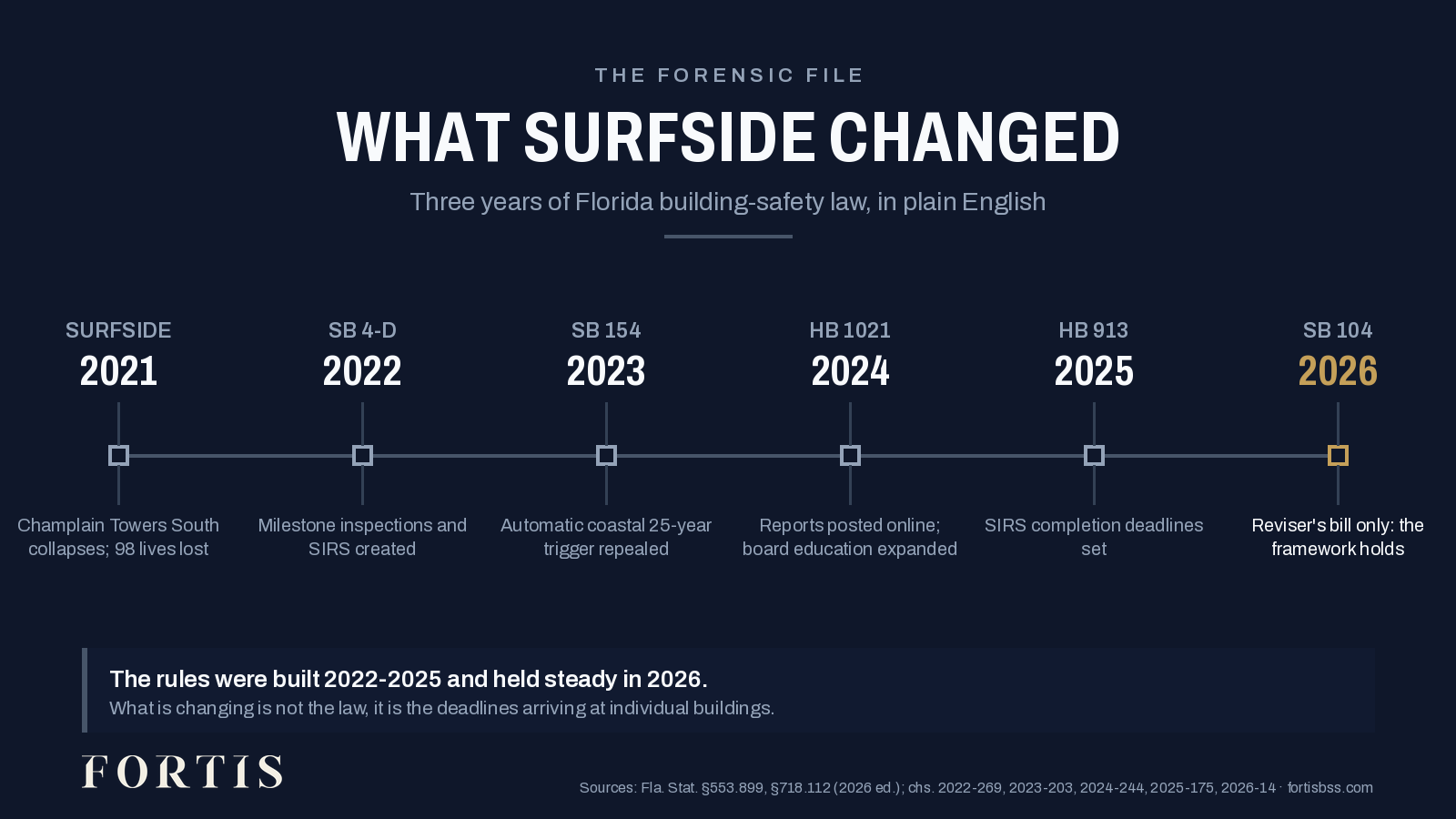
Direct answer: The collapse of Champlain Towers South in Surfside on June 24, 2021, which killed 98 people, rewrote how Florida treats its aging condominiums. Four laws passed from 2022 to 2025 built the framework your board now lives under: milestone inspections, funded structural reserves, public reporting, and board education. The 2026 legislative session left that framework unchanged.
June 24, 2021: what happened at Surfside?
In June 2021, Champlain Towers South, a twelve-story condominium in Surfside, suffered a sudden structural failure. It was not caused by a storm or any outside force, and that is what made it a turning point: a building had reached that condition while meeting the requirements in place at the time.
That is the question the Legislature set out to answer, and the one boards now live with: how does a building get there without anyone being required to look? At the time, Florida had no statewide law requiring an older condominium to be inspected for structural safety on any schedule. Miami-Dade and Broward ran their own county recertification programs, but most of the state had nothing. Surfside is the reason that changed. It is worth being precise about what it did and did not set in motion, because the details are what your board is accountable for.
Not Sure Which Requirement Applies?
Send the building's Certificate of Occupancy date and the date the condominium was created under §718.112(2)(g)1. Fortis will confirm which requirement applies and what the deadline actually is.
- §553.899.
- §718.112(2)(g)
- §719.106(1)(k)
2022, SB 4-D: what did the first law require?
The Legislature's first response was Senate Bill 4-D, enacted as chapter 2022-269. It created two separate obligations that boards still confuse with each other.
The first is the milestone inspection, a new section of law at Florida Statutes §553.899. It requires condominium and cooperative buildings of three or more habitable stories to have a structural inspection performed by a licensed engineer or architect, first at a set age and then every ten years. A milestone inspection is a focused structural life-safety review. It is not a code-compliance inspection and not a reserve study.
The second is the Structural Integrity Reserve Study, or SIRS, added to §718.112(2)(g) for condominiums, with a parallel requirement for cooperatives at §719.106(1)(k). A SIRS requires an association to study specific structural components and fund reserves for them, and it removed the ability to waive reserves for those components. The milestone inspection asks whether the building is safe now. The SIRS asks whether the association has set aside the money to keep it that way. They run on different clocks and different laws, which is the single most common point of confusion we correct for boards. We have written a separate explainer on how the two differ.
SB 4-D also carried a coastal rule that did not survive, which is where the next law comes in.
- §553.899(3)(b)
2023, SB 154: why did the 25-year coastal rule disappear?
As first written, SB 4-D put any building within three miles of the coast on a 25-year inspection clock automatically, and buildings farther inland on a 30-year clock. That bright line proved too blunt. Senate Bill 154, chapter 2023-203, repealed the automatic coastal trigger.
Under the law as it now stands, 30 years is the statewide default. A 25-year trigger applies only where the local enforcement agency, your city or county building department, has affirmatively determined that local conditions, including proximity to salt water, require it under §553.899(3)(b). Distance from the water alone no longer shortens your deadline.
This is not a technicality. It means the honest answer to "is our building on a 25-year or a 30-year clock" is not something you can read off a map. It depends on what your specific local jurisdiction adopted. Broward, for example, applies 25 years countywide; most of the state defaults to 30 unless a city adopted otherwise. A board that assumes 25 because it is near the beach can be wrong in either direction, and we walk through how to tell which clock your building is on.
- §553.899(9)
2024, HB 1021: what did boards have to start posting?
House Bill 1021, chapter 2024-244, tightened governance and widened who has to keep records online. It lowered the threshold at which a condominium association must maintain its official records on a website or app, from 150 units down to 25 or more units, a change that took effect January 1, 2026. Milestone inspection reports were already required to be posted where an association has a website under §553.899(9); HB 1021 brought many smaller condominium associations into that online-records regime. The law also expanded the education that newly elected and appointed condominium directors must complete, adding milestone inspections and SIRS to the curriculum.
The theme of HB 1021 is transparency. After Surfside, the Legislature decided that owners should be able to see the condition of the building they live in and the reserves meant to maintain it, not learn about a deficiency after an assessment lands. For a board, the practical effect is that these reports are no longer buried internal documents. For a covered association, they are official records an owner can pull up.
2025, HB 913: what changed about the SIRS deadline?
House Bill 913, chapter 2025-175, is the law most boards were asking about this year, because it governs the SIRS completion deadlines that are now arriving. It extended the initial condominium deadline and clarified how a recent milestone or similar local inspection interacts with the study.
The dates are not the same for every building, and the difference between a condominium and a cooperative matters. A condominium association that existed on or before July 1, 2022 and is controlled by unit owners rather than the developer was required to complete its first SIRS by December 31, 2025, for each building three stories or higher. A cooperative association under Chapter 719 keeps an earlier baseline, December 31, 2024. A co-op board handed the condominium date is handed a date a full year wrong, which is exactly the kind of error that comes from reading a summary instead of the chapter that governs your building. There is also a coordination window: an association that must complete a milestone inspection by December 31, 2026 may complete its SIRS at the same time, and the statute says the study may not be completed after December 31, 2026. That December 31, 2026 date is tied to the milestone-coordination provision; it is not a blanket extension every association can assume, which is a question worth putting to your association's counsel. Here is what the December 31, 2026 date means for a condominium that has not finished.
HB 913 also confirmed that a qualifying milestone inspection, or an inspection done for a similar local requirement such as a county recertification, can stand in for the visual-inspection portion of the SIRS and can let a board briefly delay the study to focus on the inspection's repairs. It does not erase the study.
- §553.899
- §718.112
2026: did the law change again?
No. This is the part of the timeline worth sitting with, because it is the opposite of what most boards assume.
The milestone-inspection statute, §553.899, was not amended in the 2026 legislative session at all. Its history line ends at the 2025 law. The only 2026 act that touched the condominium bylaws statute, §718.112, was Senate Bill 104, chapter 2026-14, the Legislature's annual reviser's bill. A reviser's bill deletes obsolete language and fixes cross-references and typographical errors. It passed both chambers unanimously, and it changed none of your obligations. The other two 2026 acts that reached community associations addressed homeowners' association architectural review and a rewrite of the nonprofit-corporation law that condominium statutes cross-reference. Neither changed the milestone, SIRS, records, or reserve frameworks.
The practical takeaway is simple and it is good news for planning: the rules your board lives under were built between 2022 and 2025 and held steady in 2026. The deadlines are not moving. What is changing is not the law. It is that the dates the law set years ago are now, finally, arriving at individual buildings.
- §553.899
- §718.112
Where does this leave your board now?
The framework is settled, so the work is no longer about tracking new legislation. It is about knowing which clock your specific building is on and whether anything is overdue.
- Confirm your milestone trigger with your local building department, not a map or a neighbor. It is 30 years unless your jurisdiction adopted 25.
- In Broward and Miami-Dade, the county recertification program is how the milestone requirement is administered and satisfied. A building there completes one current-cycle process with the county rather than a separate state milestone filing. That program covers the milestone, not the SIRS, which remains its own obligation. (Milestone inspection versus building recertification, side by side.)
- Check your SIRS status against the date that governs your building, condominium or cooperative, and against the December 31, 2026 outer limit.
- Treat your inspection reports and SIRS as public records if your association has 25 or more units.
Here is the field observation we would offer, and it is the one line in this piece that is ours rather than the statute's: across the Broward and Miami-Dade buildings we track, the board that feels blindsided in 2026 is almost never reacting to a new law. It is meeting a requirement the Legislature wrote in 2022, arriving at its building for the first time. The law stopped changing. The deadlines did not stop coming.
If you are not certain which trigger date applies to your building, or whether your milestone and SIRS obligations are current, Fortis BuildSafe Solutions, a Florida forensic engineering firm, can check your building's records against the law as it actually reads today and give your board a clear picture. That is a conversation, not a sales pitch, and it is the kind of question worth answering before a deadline rather than after.
Sources
- Fla. Stat. §553.899 (milestone inspections), 2026 edition, The Florida Senate. History: s. 3, ch. 2022-269; s. 2, ch. 2023-203; s. 4, ch. 2024-244; s. 4, ch. 2025-175.
- Fla. Stat. §718.112 (condominium bylaws; SIRS), 2026 edition, The Florida Senate.
- Senate Bill 104 (2026), reviser's bill, chapter 2026-14, The Florida Senate.
- SB 4-D (ch. 2022-269); SB 154 (ch. 2023-203); HB 1021 (ch. 2024-244); HB 913 (ch. 2025-175).
- Champlain Towers South collapse, June 24, 2021: History.com; CBS News Miami.
General information for Florida condominium and cooperative boards. Not legal advice; consult your association's attorney for legal questions about your building.
KEEP THE FACTS CURRENT.
Florida's building-safety requirements change by county and by year. The Fortis Brief is a short note from Fortis BuildSafe Solutions, a few times a quarter, on what the rules say now and what a board should do about them.
The Board President's Guide to Florida's Building Safety Laws
A plain-language walkthrough of milestone inspections, SIRS, county recertification, and your board's personal exposure — what triggers each requirement and what your board must do next.
Record Appendix.
Related record
Continue Reading
What is the difference between a special assessment and a reserve fund for a Florida condo?
November 9, 2026
What does a Florida condo board actually receive when its SIRS is done?
November 8, 2026
If your Florida condo still has not completed its SIRS, what does December 31, 2026 mean?
November 6, 2026
Related Services
Reader questions
Have a question about this?
Every inquiry is reviewed by a Fortis engineer.