

In This Record
- 01Why is a parking structure more exposed than the building above it?
The American Concrete Institute's guide for durable parking structures (ACI 362.1R) lists the reasons.
- 02
- 03What can you observe on a walk through your garage?
The conditions below are what an engineer looks for first.
- 04What does a documented concrete repair involve?
Concrete repair is designed and specified project by project; the sequence below is drawn from ACI RAP Bulletin 7 (spall repair of horizontal surfaces) and ICRI Guideline 310.1R (surface preparation where reinforcing steel has corroded) and describes the typical stages, not a specification.
What does salt air do to a South Florida parking garage?
Published: September 24, 2026 · Last reviewed: September 24, 2026
Reviewed by Gabor I. Nagy, PE — Founder
Direct answer: Salt air deposits chloride on exposed concrete; wetting and drying carry it inward to the reinforcing steel. With moisture and oxygen present, the steel corrodes, and the corrosion products occupy several times the volume of the original steel. That pressure cracks and delaminates the concrete until it spalls. Parking structures are among the most exposed parts of a building.
This post is a guided walk through a parking structure: what the marks on a slab underside can indicate, what a documented concrete repair involves, and how Florida law defines the line between a surface imperfection and a structural finding. It is general information, not an assessment of your building; visual observation alone cannot determine a structure's condition.
Why is a parking structure more exposed than the building above it?
The American Concrete Institute's guide for durable parking structures (ACI 362.1R) lists the reasons. Parking structures have "reduced roofing, cladding, and climate control that result in a more severe direct or indirect exposure to rain, snow, sunlight, temperature variations, and airborne chlorides," they carry "heavy moving loads," and the guide names "structure proximity to sea water" as a design condition. It also states that "maintenance of parking structures is essential to durability and longevity."
ACI's guidance is national and does not describe any particular garage. What it establishes is that a parking structure's exposure is, by design, more severe than a conditioned building's, and that a coastal location is a recognized design and maintenance factor.
What does salt air actually do to reinforced concrete?
Four steps. (The chemistry is covered in more depth in Why does concrete spall in South Florida?; this is the short version.)
-
Chloride is deposited and carried inward. Marine aerosol deposits chloride on exposed surfaces, and wetting and drying cycles move it into the concrete. Deposition varies with wind, shielding, height and distance from the water. One long-term field study of a marine atmosphere zone in coastal Brazil (Meira et al., 2007) measured up to a 70 percent reduction in chloride penetration into concrete over the first hundred meters from the sea, with chloride still measurable at a station 1,100 meters inland. It is a study of the mechanism, not a South Florida measurement; the principle is that distance reduces exposure without eliminating it.
-
Chloride reaches the steel. Concrete's alkalinity forms a passive film on embedded steel. Chloride ions break that film. Corrosion then requires moisture and oxygen, which a parking slab usually has. Engineers use threshold values to judge when chloride content at the bar becomes a concern; the Federal Highway Administration cites a commonly used figure of about 0.71 kg/m³ (1.2 lb/yd³) of concrete while noting that "a single threshold value may not be appropriate across all conditions." How long it takes chloride to reach that level depends on the depth and quality of concrete cover and on how wet the slab stays. There is no fixed year.
-
The steel corrodes and expands. In FHWA's words, "the corrosion products resulting from the corrosion of steel reinforcing bars occupy a volume equal to three to six times that of the original steel. This increase in volume induces stresses in the concrete that result in cracks, delaminations, and spalls."
-
The concrete cracks, delaminates, and spalls. A crack may open along the line of a bar. The concrete over the bar may separate from it while still in place (a delamination, which sounds hollow when tapped). Eventually the cover concrete falls away and the bar is exposed. How much cross-section the bar has lost by that point varies and can only be established by measurement.
What can you observe on a walk through your garage?
The conditions below are what an engineer looks for first. Each is an indicator, not a diagnosis: a photograph or a walk-through can show that a condition exists, not what is causing it or how far it extends. That takes testing and an engineer's evaluation.
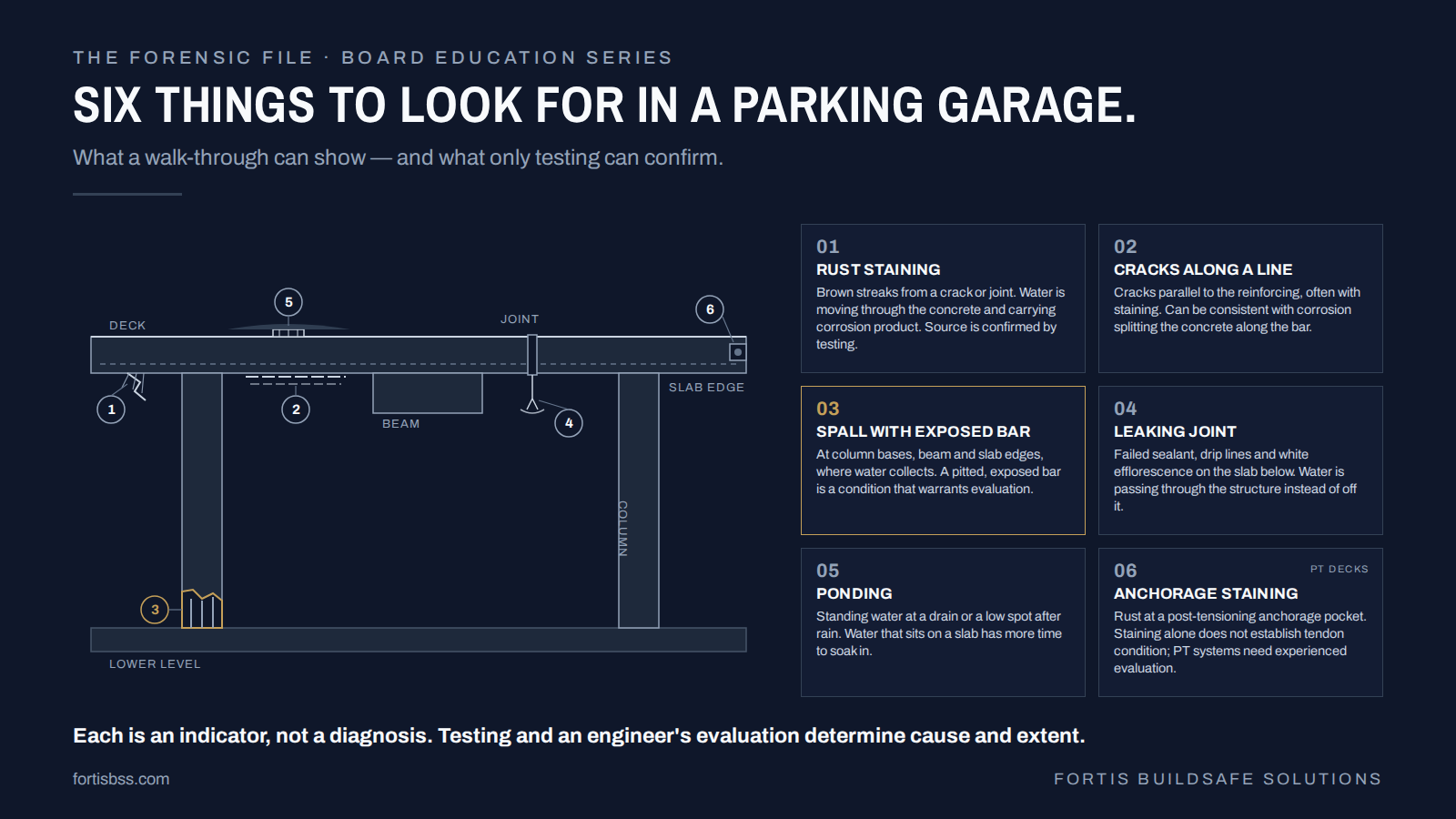
Rust staining. Brown streaks from a crack or joint indicate that water is moving through the concrete and carrying corrosion product with it. Staining can also originate from embedded items, fixtures or prior repairs, which is why an engineer tests before concluding.
Cracks that follow a straight line. Cracks parallel to the reinforcing, particularly with staining, can be consistent with corrosion-induced splitting along the bar. Other cracking, including shrinkage cracking, has other causes and its own significance; crack width, pattern, location and whether it is moving all matter, and none of that is decided from a photograph.
Spalls at column bases, beam edges and slab edges. These are locations where water tends to collect and where concrete cover can be thin. A spall with exposed, pitted bar is a condition that warrants evaluation.
Leaking joints and efflorescence. White mineral deposits and drip lines beneath a joint indicate water is passing through the structure. In a coastal garage that water can carry chloride to the slab below; whether it does is a question for testing.
Ponding. Standing water after rain, a drain that no longer drains, or a low spot at a ramp break. Water that sits on a slab has more time to soak in.
Anchorage staining on post-tensioned decks. Rust at a post-tensioning anchorage pocket is a condition of its own. Staining alone does not establish tendon condition, and post-tensioned systems are evaluated by engineers experienced with them.
What does a documented concrete repair involve?
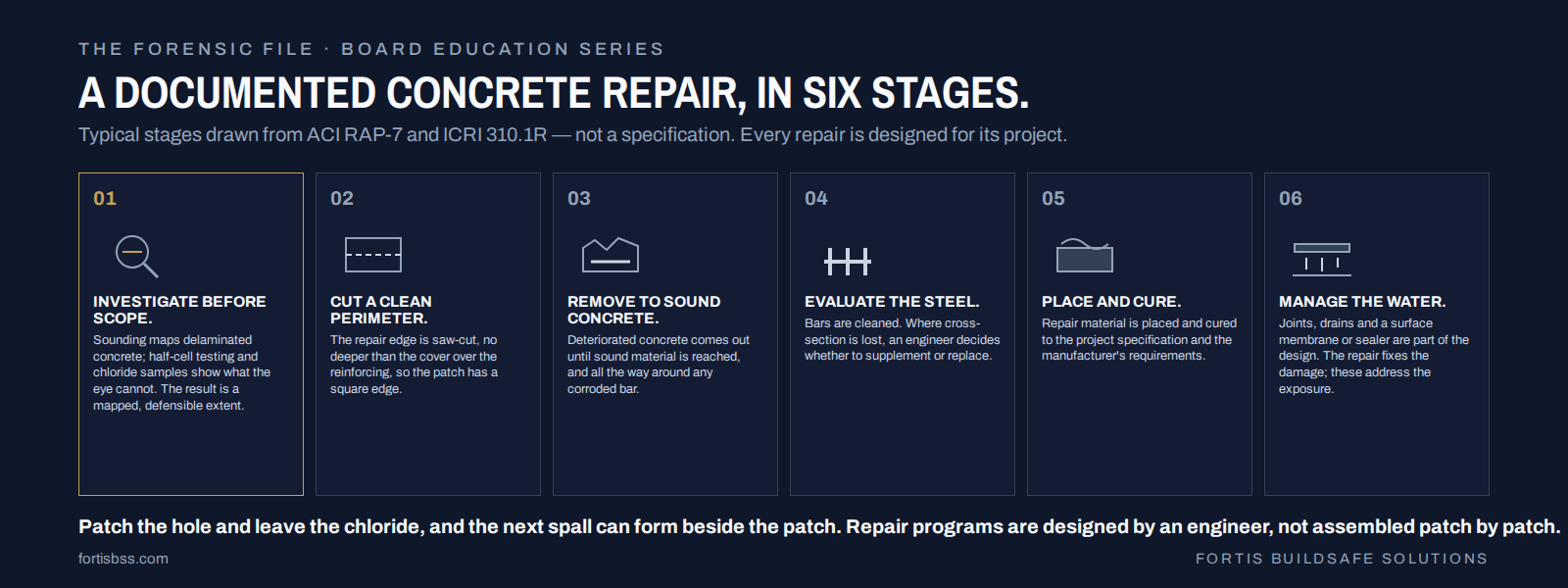
Concrete repair is designed and specified project by project; the sequence below is drawn from ACI RAP Bulletin 7 (spall repair of horizontal surfaces) and ICRI Guideline 310.1R (surface preparation where reinforcing steel has corroded) and describes the typical stages, not a specification.
- Investigation before scope. Delaminated concrete is mapped by sounding (RAP-7 references ASTM D4580, a practice written for bridge decks and applied to other horizontal concrete). Where corrosion is suspected but not visible, half-cell potential testing (ASTM C876) indicates the likelihood of corrosion activity, which the engineer interprets alongside chloride sampling and cover measurements. No survey finds every concealed defect; the purpose is a mapped, defensible extent.
- Perimeter cut. RAP-7: "Sawcut the perimeter of the repair. To avoid damaging reinforcement, the sawcut should not be deeper than the cover over the reinforcement."
- Removal to sound concrete and around corroded bars. RAP-7: "Removals around the bar should allow the hand to pass under the bar. Clearance around the bar should be approximately 3/4 in. (20 mm)."
- Steel evaluation. RAP-7 states that if corroded bars are found with loss of cross section, an engineer should be consulted. Whether bars are supplemented or replaced is an engineering decision for that project.
- Cleaning, placement and curing of the repair material according to the project specification and the material manufacturer's requirements.
- Water management. Joint replacement, drainage correction, and surface protection such as a traffic-bearing membrane or sealer are considered as part of the repair design, because the repair addresses the damage and these measures address the exposure.
Why do some garage repairs fail within a few years?
One recognized cause is that chloride remains in the concrete around the repair. A patch places new, chloride-free, high-alkalinity concrete next to concrete that is still contaminated, and, as a Concrete Repair Bulletin article by Ball and Whitmore (2003) describes it, that difference in corrosion potential "is the driving force for new corrosion sites to form in the surrounding chloride-contaminated concrete." Engineers call this ring-anode, halo, or incipient-anode corrosion; the sign is "new concrete spalls adjacent to the previously completed patches." The same article observes that under those conditions "it is not uncommon to find additional repairs required in 2 to 5 years."
It is not the only cause. Preparation, material selection, curing, bond failures and poor water management also cause repairs to fail, which is why a repair program is designed by an engineer rather than assembled patch by patch. Where contaminated concrete remains in place, the design may include galvanic anodes at repair perimeters (to mitigate corrosion of the reinforcing adjacent to the patch), a surface membrane to limit further chloride ingress, or, where deterioration is extensive, replacement of a larger area of slab. Which applies depends on the extent of contamination, the element's structural capacity, the repair history and the cost of alternatives.
How does Florida law define the line between a surface imperfection and a structural finding?
Florida's milestone inspection statute defines "substantial structural deterioration" (F.S. §553.899(2)(b)) as "substantial structural distress or substantial structural weakness that negatively affects a building's general structural condition and integrity," and states that the term "does not include surface imperfections such as cracks, distortion, sagging, deflections, misalignment, signs of leakage, or peeling of finishes unless the licensed engineer or architect performing the phase one or phase two inspection determines that such surface imperfections are a sign of substantial structural deterioration."
Two things follow. A crack or a stain is not, by itself, a statutory finding. And the determination is made by the licensed engineer or architect performing the inspection, on the basis of the inspection and, if a phase two is required, testing (§553.899(7)(a)–(b)).
Where the statutory inspection fits. For a building of three or more habitable stories that is subject in whole or part to condominium or cooperative ownership, §553.899(3)(a) requires a milestone inspection "by December 31 of the year in which the building reaches 30 years of age, based on the date the certificate of occupancy for the building was issued, and every 10 years thereafter." Under §553.899(3)(b), the local enforcement agency may determine that local circumstances, "including environmental conditions such as proximity to salt water," require the inspection at 25 years instead. Phase one is a visual examination of "habitable and nonhabitable areas of a building, including the major structural components" (§553.899(7)(a)); a parking structure that is part of the building is within that scope. The statute also sets notice, reporting and repair-commencement timelines that are beyond this post; they are covered in What happens after a Phase 2 milestone inspection report in Florida?.
Broward and Miami-Dade. In both counties, the county recertification program is how the milestone requirement is administered and satisfied. Broward's Board of Rules and Appeals states that for buildings that must perform a milestone inspection under §553.899, the Building Safety Inspection "shall serve as compliance for both milestone inspection requirements," and that "parking garages and guardrails are not exempt from this program." Miami-Dade's Building Recertification structural report form includes a section for "underground or lower-level parking garages." See Milestone inspection vs. building recertification in Florida.
Between statutory cycles. Exposed reinforcing, loose or fallen concrete, a joint that leaks at every rain, or a prior repair failing at its edges warrant an engineer's evaluation when observed, not at the next cycle; any area where concrete may fall is handled under the property's safety procedures first. A repair program scoped from a documented condition survey is priced on the mapped extent of deterioration; how much investigation a given structure needs is itself an engineering judgment.
If your board is looking at conditions like the ones above, Fortis BuildSafe Solutions is a forensic engineering firm that performs building condition assessments and restoration oversight for South Florida associations. Every Fortis assessment is evidence-based, performed to one documented standard, and sealed by a licensed Florida PE who exercised direct responsible charge; the report records what was observed, what was tested, and what the assessing engineer recommends. Contact Fortis.
This post is general information for boards and managers, not engineering advice about a specific building. Whether a condition constitutes substantial structural deterioration under §553.899 is determined by the licensed engineer or architect performing the inspection. Statutes and local requirements change; confirm current requirements with your local enforcement agency.
Sources
- Florida Statutes §553.899 (2026 edition; history through ch. 2025-175), Mandatory structural inspections for condominium and cooperative buildings — http://www.leg.state.fl.us/statutes/index.cfm?App_mode=Display_Statute&URL=0500-0599/0553/Sections/0553.899.html (accessed September 24, 2026).
- ACI 362.1R-12, Guide for the Design and Construction of Durable Concrete Parking Structures, American Concrete Institute, 2012 (reapproved 2024 as ACI PRC-362.1-12(24)) — https://www.concrete.org/portals/0/files/pdf/previews/362.1r-12web.pdf (accessed September 24, 2026).
- Smith, J.L. and Virmani, Y.P., Materials and Methods for Corrosion Control of Reinforced and Prestressed Concrete Structures in New Construction, FHWA-RD-00-081, Federal Highway Administration, August 2000 — https://highways.dot.gov/media/7506 (accessed September 24, 2026).
- Meira, G.R., Andrade, C., Alonso, C., Borba Jr., J.C., Padilha Jr., M., "Durability of concrete structures in marine atmosphere zones – The use of chloride deposition rate on the wet candle as an environmental indicator," Cement and Concrete Composites 29 (2007) 667–676 — https://oa.upm.es/8751/2/INVE_MEM_2010_86478.pdf (accessed September 24, 2026).
- Ball, J.C. and Whitmore, D.W., "Corrosion Mitigation Systems for Concrete Structures," Concrete Repair Bulletin, International Concrete Repair Institute, July/August 2003 — https://www.icri.org/wp-content/uploads/2024/04/CRBJulyAug03_Ball.pdf (accessed September 24, 2026).
- ACI RAP Bulletin 7, Spall Repair of Horizontal Concrete Surfaces, American Concrete Institute, 2005 — https://www.icri.org/wp-content/uploads/2025/02/aci-rap-7.pdf (accessed September 24, 2026).
- ICRI Guideline No. 310.1R-2008, Guide for Surface Preparation for the Repair of Deteriorated Concrete Resulting from Reinforcing Steel Corrosion, International Concrete Repair Institute — https://store.icri.org/item/3101r2008-english-guideline-surface-preparation-repair-deteriorated-concrete-resulting-reinforcing-steel-corrosion-342511 (accessed September 24, 2026).
- ASTM C876-22b, Standard Test Method for Corrosion Potentials of Uncoated Reinforcing Steel in Concrete — https://store.astm.org/c0876-22b.html (accessed September 24, 2026).
- ASTM D4580, Standard Practice for Measuring Delaminations in Concrete Bridge Decks by Sounding, as referenced in ACI RAP Bulletin 7 (above).
- ACI CODE-562-21, Assessment, Repair, and Rehabilitation of Existing Concrete Structures — Code Requirements and Commentary, American Concrete Institute, 2021 — https://www.concrete.org/store/productdetail.aspx?ItemID=56221&Language=English&Units=US_Units (accessed September 24, 2026).
- Broward County Board of Rules and Appeals, Building Safety Inspection Program brochure, September 2024 — https://www.broward.org/codeappeals/documents/2024%20Bora%20BSIP%20Brochure.pdf (accessed September 24, 2026); program page https://www.broward.org/CodeAppeals/pages/safetyinspectionprogram.aspx.
- Miami-Dade County, Building Recertification Structural Report form, Rev. 01/25R2.0, Section 14, "Underground or Lower-Level Parking Garages" — https://www.miamidade.gov/building/library/min-inspection-structural-recert-2025.pdf (accessed September 24, 2026); program page https://www.miamidade.gov/global/economy/building/recertification.page.
KEEP THE FACTS CURRENT.
Florida's building-safety requirements change by county and by year. The Fortis Brief is a short note from Fortis BuildSafe Solutions, a few times a quarter, on what the rules say now and what a board should do about them.
The Board President's Guide to Florida's Building Safety Laws
A plain-language walkthrough of milestone inspections, SIRS, county recertification, and your board's personal exposure — what triggers each requirement and what your board must do next.
Record Appendix
Sources
Sources
- http://www.leg.state.fl.us/statutes/index.cfm?App_mode=Display_Statute&URL=0500-0599/0553/Sections/0553.899.html
- https://highways.dot.gov/media/7506
- https://www.miamidade.gov/building/library/min-inspection-structural-recert-2025.pdf
- https://www.miamidade.gov/global/economy/building/recertification.page
- Florida Statute §553.899
Related record
Continue Reading

Why does Florida inspect older condominiums at all? A short history of the rules your board lives under
October 17, 2026
How much does a milestone inspection cost in Florida, and what drives the price?
October 16, 2026
Broward or Miami-Dade: which recertification clock is your building on?
October 10, 2026
Related Services
Reader questions
Have a question about this?
Every inquiry is reviewed by a Fortis engineer.