

Statutes cited
Florida Statute §553.899 · SB 4-D (2022)Primary source: Florida Legislature
Statute text checked
In This Record.
- 01Which buildings does this cover?
Highland Beach calls them association buildings. The town's code defines one as a building that is not a threshold building, is "owned, in whole or in part, by a condominium association or cooperative association, is three stories or more in height and contains at least four dwelling units."
- 02Why does Highland Beach start at 25 years when the state says 30?
Because the statute lets a town make that call, and Highland Beach made it. F.S. §553.899(3)(a) sets the statewide default: a milestone inspection by December 31 of the year the building reaches 30 years of age, measured from the certificate of occupancy date, and every 10 years after that.
- 03What does the town require that a milestone inspection does not?
An electrical engineer. The town's phase one requires "an inspection by a professional electrical engineer certifying and attesting that such building is electrically safe." Where the building is not electrically safe, that engineer must identify any major or critical deficiencies in the electrical system, together with the repairs or alterations needed and a recommended timeframe for them.
- 04Does it work the other way around?
No, and this is worth stating plainly, because it is the one that most often leaves a board unfinished. Satisfaction runs one way. Completing the Town of Highland Beach recertification satisfies the milestone requirement, because the town program is a superset: it asks for everything §553.899 asks for, and then asks for the electrical certification on top.
- §553.899
- §110.9
Reviewed by Gabor I. Nagy, PE — Founder
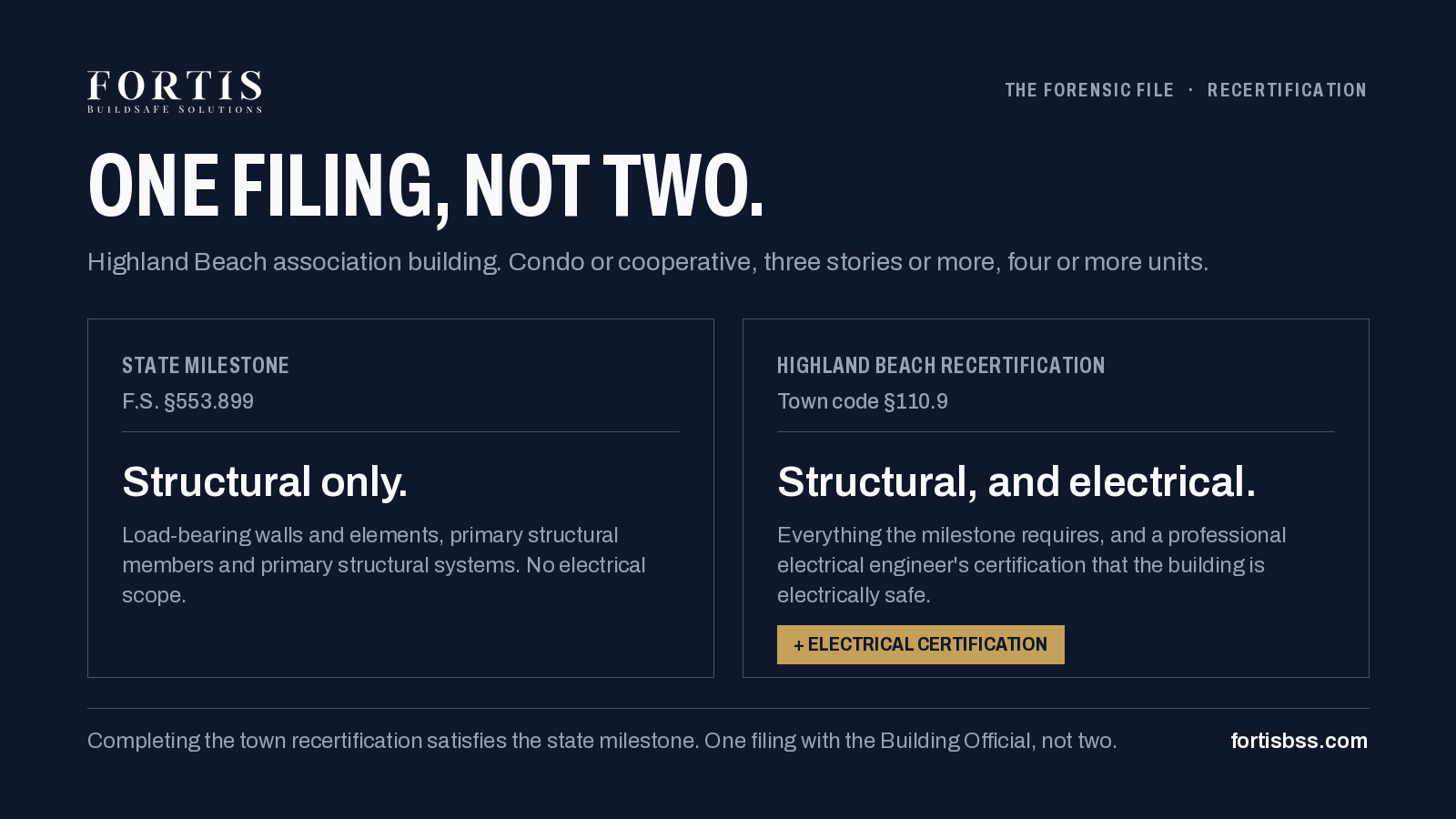
Direct answer: No. For a condominium or cooperative three stories or more with at least four dwelling units, the Town of Highland Beach's recertification program is how the milestone requirement is administered and satisfied, for the buildings it covers. One filing with the town's Building Official, not two. The town's scope is wider than the state's.
- §553.899(3)(a)
Which buildings does this cover?
Highland Beach calls them association buildings. The town's code defines one as a building that is not a threshold building, is "owned, in whole or in part, by a condominium association or cooperative association, is three stories or more in height and contains at least four dwelling units."
Those are, in substance, the condominium and cooperative buildings the state milestone reaches under F.S. §553.899(3)(a), which applies to buildings three or more habitable stories tall. Two differences are worth noting: the town adds its own floor of at least four dwelling units, and it says "stories" where the statute says "habitable stories." A board sitting near either line should confirm its exact status, because a building can meet the state trigger without meeting the town's association-building definition.
The town program also covers threshold buildings and non-residential buildings. Those have no milestone requirement to satisfy in the first place, so nothing on this page applies to them. A one-story restaurant can appear on the town's recertification list. It is a town obligation and only a town obligation.
Confirm Your Recertification Trigger
Send the building's Certificate of Occupancy date and jurisdiction. A Fortis PE will confirm the trigger age that applies and what the county expects in the report.
- §553.899(3)(a)
- §553.899(3)(b)
Why does Highland Beach start at 25 years when the state says 30?
Because the statute lets a town make that call, and Highland Beach made it.
F.S. §553.899(3)(a) sets the statewide default: a milestone inspection by December 31 of the year the building reaches 30 years of age, measured from the certificate of occupancy date, and every 10 years after that.
§553.899(3)(b) then allows a local enforcement agency to determine that "local circumstances, including environmental conditions" such as "proximity to salt water" justify the earlier trigger of 25 years.
Highland Beach's code recites that test almost word for word. Its stated reason for requiring recertification of association buildings at 25 years is "Due to local circumstances and the proximity to salt water."
This is the part boards most often get backwards. The 25-year clock is not a coastal rule that applies automatically because the building is near the ocean. SB 4-D created an automatic coastal 25-year trigger in 2022 and SB 154 repealed it. What remains is local adoption, town by town and city by city. Highland Beach adopted it. The next municipality up the coast may not have.
For the wider picture on why the 25-or-30 answer depends on your city hall rather than your coastline, see is your milestone due at 25 years or 30.
- §553.899
What does the town require that a milestone inspection does not?
An electrical engineer.
The town's phase one requires "an inspection by a professional electrical engineer certifying and attesting that such building is electrically safe." Where the building is not electrically safe, that engineer must identify any major or critical deficiencies in the electrical system, together with the repairs or alterations needed and a recommended timeframe for them.
F.S. §553.899 contains no electrical scope at all. It is a structural statute: load-bearing elements, primary structural members and primary structural systems.
So the two programs are not the same size, and that matters when a board is reading proposals. A structural-only scope does not complete a Highland Beach recertification. A board that commissions a bare milestone inspection, files it, and considers the matter closed has not finished what the town asked for.
- §553.899
- §553.899(7)(b)
- §553.899(9)
Does it work the other way around?
No, and this is worth stating plainly, because it is the one that most often leaves a board unfinished.
Satisfaction runs one way. Completing the Town of Highland Beach recertification satisfies the milestone requirement, because the town program is a superset: it asks for everything §553.899 asks for, and then asks for the electrical certification on top.
Performing a bare §553.899 milestone inspection does not satisfy Highland Beach. The electrical half is simply missing, and the town has not created a second, parallel milestone filing for an association building to use instead.
One Building Official. One deadline schedule. One filing.
One filing does not mean one task. The report still has to be produced to the statute's standard, and §553.899 keeps its other requirements whichever way the building satisfies the milestone. If phase one identifies substantial structural deterioration, a phase two inspection must follow under §553.899(7)(b). And once the report is in, §553.899(9) gives the association 45 days to distribute the inspector-prepared summary to every unit owner and to post it conspicuously on the property; an association that is required to have a website must also publish the full report and summary there.
- §553.899(3)(a)
- §553.899
Is your building on a seven-year cycle after it turns 40?
Almost certainly not, and you may have read otherwise.
The town's code sets two repeat intervals: 10 years, and 7 years once a building passes 40 years of age. Both of those sentences name threshold buildings. Neither names association buildings.
Association buildings get the 25-year initial trigger with no repeat interval stated in the town's code at all. Their cycle is therefore the statutory one: every 10 years under F.S. §553.899(3)(a).
Several guides circulating in the Palm Beach market read that sentence loosely and tell condominium boards they move to a seven-year cycle at 40. For a condominium or cooperative, that is wrong. It is a drafting gap in a code section that is only fully coherent for association buildings when you read it as the town's way of administering the state milestone requirement.
If a management company or a prior engineer has you budgeting for a seven-year cycle, that is worth a second look before it reaches your reserve study.
In our own clause-by-clause comparison of the town's code with §553.899, the only substantive divergence is the electrical certification. It is the one Highland Beach requirement with no equivalent in the state milestone statute, and so the one most easily missed by a scope written to the statute alone.
- §553.899(3)(b)
Why does none of this appear in the town's code as a sentence?
Because it is not written there, in either direction.
The string "553.899" does not appear anywhere in the Town of Highland Beach's administrative code. There is no sentence saying town recertification substitutes for the state milestone, and no sentence saying it does not. Miami-Dade County has such a sentence. Highland Beach does not.
What the town's code does instead is implement the statute clause by clause. It defines and requires a phase one and a phase two milestone inspection, using the statute's own two-phase vocabulary, which only entered Florida law in 2022. It carries the statute's definition of substantial structural deterioration. It recites the §553.899(3)(b) salt-water test to justify 25 years. It copies the good-cause extension. It names the same population of buildings.
The town is the local enforcement agency. A Highland Beach association board that files a signed and sealed phase one report with the Highland Beach Building Official has performed the inspection the statute describes and filed it with the body the statute requires it be filed with.
That reading is a professional judgment Fortis BuildSafe Solutions has recorded and will stand behind, not a quotation from the code. If a board's counsel asks, that is exactly how it should be described.
- §110.9
- §553.899
- §8-11(f)
What should a Highland Beach board do next?
- Find your certificate of occupancy date. Everything starts there, not from the purchase date or the year of the last repair project.
- Check whether you are an association building under the town's definition: condominium or cooperative, three stories or more, at least four dwelling units.
- Scope structural and electrical together. A proposal that covers only one leaves you unfinished.
- Ignore the seven-year figure unless you are a threshold building.
- Ask for the filing, not just the report. The deliverable that ends the obligation is the sealed report in the Building Official's hands.
If your board is working out where it stands in Highland Beach and would like the question answered against your own certificate of occupancy date, Fortis is glad to walk through it with you. You can start with our Palm Beach County service page or the milestone deadline calculator, or call (954) 756-6876 or email sales@fortisbss.com.
Sources
- Town of Highland Beach, Administrative Code Chapter 1 for the 8th Edition (2023) Florida Building Code, §110.9 "Recertification of buildings and components." https://highlandbeach.us/DocumentCenter/View/130/Highland-Beach-Amendment-to-the-8th-Ed-of-Florida-Building-Code-PDF (accessed November 19, 2026).
- Florida Statutes §553.899 (2026), Mandatory structural inspections for condominium and cooperative buildings, subsections (2), (3)(a), (3)(b), (7)(b) and (9). https://www.flsenate.gov/Laws/Statutes/2026/553.899 (accessed November 19, 2026).
- Miami-Dade County Code §8-11(f), for the contrast with a jurisdiction whose code does state the substitution. https://www.miamidade.gov/building/library/amended-miami-dade-ordinance.pdf (accessed October 31, 2026).
This article is general information for condominium and cooperative boards, not legal advice for a specific association. Confirm requirements with your local building official and the association's counsel.
KEEP THE FACTS CURRENT.
Florida's building-safety requirements change by county and by year. The Fortis Brief is a short note from Fortis BuildSafe Solutions, a few times a quarter, on what the rules say now and what a board should do about them.
Building Recertification in Broward & Miami-Dade: What Boards Must Do
Covers county-specific recertification timelines, what the engineer's report must include, and how to avoid city-imposed fines.
Record Appendix.
Related record
Continue Reading
Which Florida Building Code edition applies to your condo's repair project?
November 17, 2026
How do you read your Florida condo's structural engineering report?
November 12, 2026
What is the difference between a special assessment and a reserve fund for a Florida condo?
November 9, 2026
Related Services
Reader questions
Have a question about this?
Every inquiry is reviewed by a Fortis engineer.