

Statutes cited
Florida Statute §553.899Primary source: Florida Legislature
Statute text checked
In This Record.
- 01What does Florida law say about which code edition applies to a permit?
Section 553.73(7)(d) answers it. The edition of the code "which is in effect on the date of application for any permit" governs the permitted work "for the life of the permit and any extension granted to the permit."
- 02When does the 9th Edition (2026) take effect?
The Florida Building Commission's own documents list December 31, 2026. Its milestones document says the Commission initiated development of the 9th Edition (2026) in February 2024 "with an effective date of December 31, 2026," and its product approval presentation lists the same effective date.
- 03Does the new code change the repair deadlines in §553.899?
No. The two run on separate clocks. Section 553.899(11) requires counties and municipalities to adopt an ordinance setting when repairs for substantial structural deterioration must be scheduled or commenced after a Phase 2 report, and it caps that time: repairs "must be commenced within 365 days after receiving such report."
- 04Which boards will feel the changeover most?
Here is how we read the statute, and it is an inference from the text rather than a statement in it. Two different dates are in play.
- §553.73(7)(d)
Reviewed by Gabor I. Nagy, PE — Founder
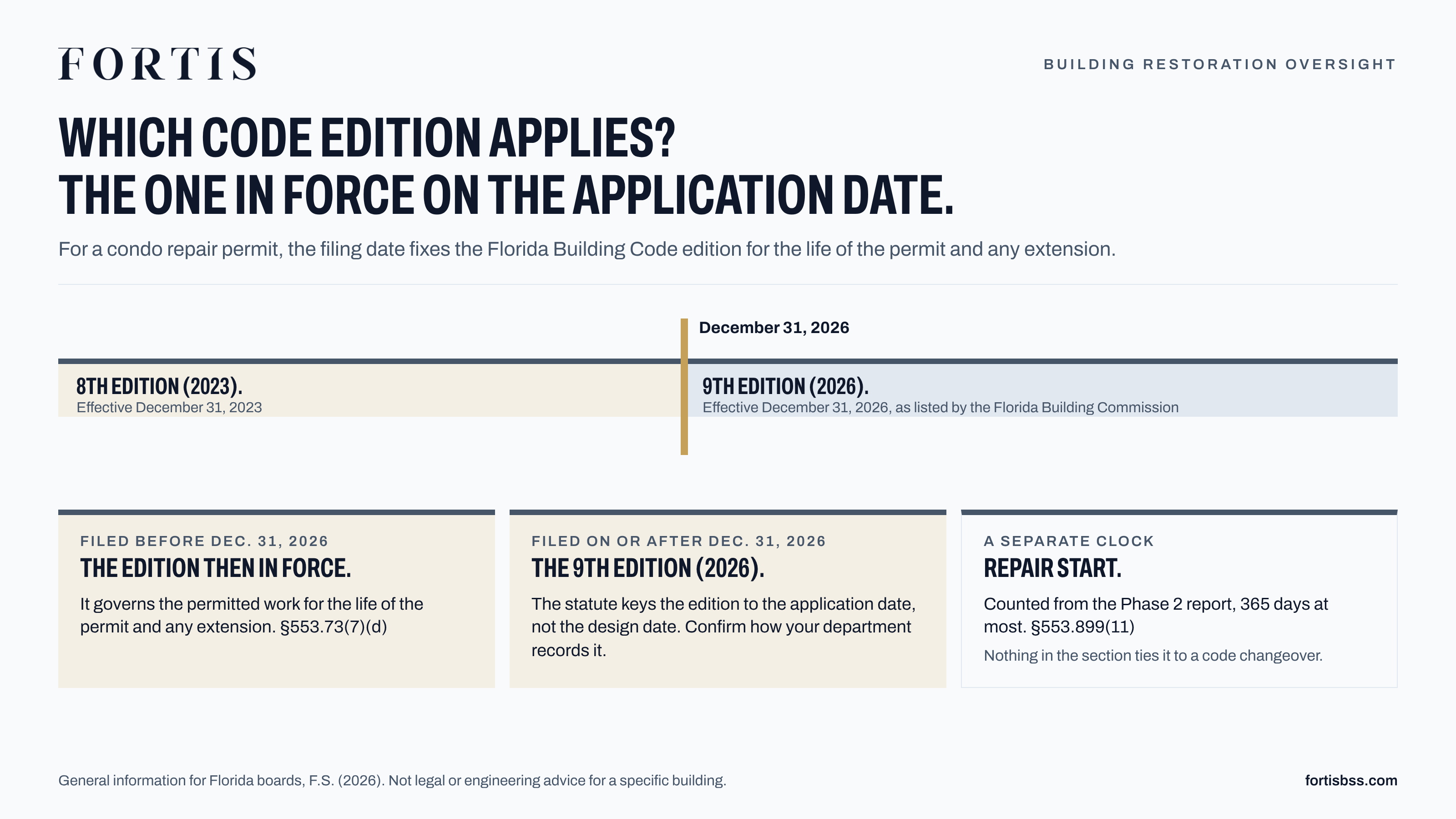
Direct answer: Under §553.73(7)(d), the Florida Building Code edition in effect on the date a permit application is filed governs the work for the life of the permit and any extension. The Commission lists the 9th Edition (2026) as effective December 31, 2026, so the application date, not the design date, decides which edition applies.
Boards that are designing or bidding milestone or SIRS-driven repairs this winter keep hearing that "the new code is coming." That is true, and it is also easy to over-read. The law says something specific about which edition applies, and it says nothing about hurrying. This article walks through what the statute actually provides, what it leaves to your building department, and what a board can ask its engineer before the changeover.
What does Florida law say about which code edition applies to a permit?
Section 553.73(7)(d) answers it. The edition of the code "which is in effect on the date of application for any permit" governs the permitted work "for the life of the permit and any extension granted to the permit."
In plain terms, the edition is fixed at the moment of application. An application dated December 30, 2026 stays under the code in force that day, even if the work runs well into 2027. An application dated on or after the new edition's December 31 effective date falls under the new one. The statute keys the edition to the date of application. How a department records that date, including its submission cutoffs and what it needs to accept a filing, is set by its own procedures, so confirm the recorded date with the department in writing.
Not Sure Which Requirement Applies?
Send the building's Certificate of Occupancy date and the date the condominium was created under §718.112(2)(g)1. Fortis will confirm which requirement applies and what the deadline actually is.
- §553.73(7)(e)
When does the 9th Edition (2026) take effect?
The Florida Building Commission's own documents list December 31, 2026. Its milestones document says the Commission initiated development of the 9th Edition (2026) in February 2024 "with an effective date of December 31, 2026," and its product approval presentation lists the same effective date. For comparison, the Commission's site gives December 31, 2023 as the effective date of the 8th Edition (2023).
The three-year rhythm comes from the statute. Section 553.73(7)(a) directs the Commission to adopt an updated code every 3 years, and §553.73(7)(e) provides that an updating rule takes effect no sooner than 6 months after the updated code is published.
- §553.899
- §553.73(1)(a)
Does the new code change the repair deadlines in §553.899?
No. The two run on separate clocks. Section 553.899(11) requires counties and municipalities to adopt an ordinance setting when repairs for substantial structural deterioration must be scheduled or commenced after a Phase 2 report, and it caps that time: repairs "must be commenced within 365 days after receiving such report." The ordinance timeframe runs from the point "the local enforcement agency receives a phase two inspection report," and the 365-day clause is the outside limit. Your local ordinance can set a shorter period, so 365 days is a ceiling, not a planning period, and your local enforcement agency and association counsel can confirm which period and which date apply to your building. Section 553.899(11) contains no extension tied to a code changeover. The section covers buildings of three habitable stories or more, as determined by the Florida Building Code, that are condominiums under chapter 718 or cooperatives under chapter 719, subject to the statute's other qualifications.
One related point is worth knowing. A milestone inspection is not a code-compliance review. Section 553.899(2)(a) says its purpose "is not to determine if the condition of an existing building is in compliance with the Florida Building Code or the firesafety code." That does not exempt later repair permits from the code: §553.73(1)(a) places "repair" within the code's scope. The code edition matters when repairs are designed and permitted, not when the building is inspected.
- §553.899(11)
- §553.73(7)(d)
- §553.899(8)(d)
Which boards will feel the changeover most?
Here is how we read the statute, and it is an inference from the text rather than a statement in it. Two different dates are in play. The repair-start deadline in §553.899(11) is counted from the Phase 2 report, and the code edition is fixed by the permit application date under §553.73(7)(d). For a board whose report arrived around the turn of the year, the application date can fall on either side of December 31 while the repair-start deadline sits well into 2027. That makes the board's own schedule for design, bidding and funding the thing to plan around. It is not a reason to wait: if a report identifies unsafe or dangerous conditions, which §553.899(8)(d) requires it to state, the engineer's recommendations come first and the code edition second.
Should a board rush to file before December 31?
Not on the date alone. Three points belong in that decision.
The recorded application date matters. The statute fixes the edition at the date of application. It does not spell out what a complete or accepted application is, and building departments' procedures differ from one jurisdiction to the next. Ask the department how it records the application date and what its review process looks like, and get the recorded date in writing.
A permit set has to be ready. Drawings are prepared to a specific edition and coordinated across disciplines. Whether an earlier filing on the current edition saves anything, or only adds revisions later, depends on the project. That is a question for the engineer of record, not a rule of thumb.
We are not comparing the editions here. This article makes no claim about what the 9th Edition changes for existing-building repairs. Whether it affects your scope is something to confirm with the engineer who designed it.
- §553.73(5)
- §553.73(4)(k)
What happens to local amendments when a new edition arrives?
Section 553.73(4)(e) provides that an amendment to the code adopted by a local government under that subsection "is effective only until the adoption of the new edition" of the code by the Commission every third year. At that point the Commission reviews each such amendment and either adopts it as part of the code or rescinds it. If it is rescinded, the local government may readopt it under the statute. That is the general rule, and the statute carves out exceptions, for example for certain flood-resistance amendments (§553.73(5)) and water-conservation amendments (§553.73(4)(k)). So a requirement your county or city added locally to the current edition may be carried forward, changed or readopted. Ask your building department which local amendments apply to your work and how it will handle the transition.
What should a board ask its engineer before the changeover?
- Which code edition is the repair design based on, and which edition will govern if the application is dated on or after December 31, 2026?
- What is the realistic date the permit set will be complete, and how does it compare with December 31?
- How does our building department record the application date, and what does it need to accept an application?
- Which local amendments apply to this project now, and does the department expect them to continue?
- If the design must be updated to a newer edition, what changes, and what does that do to schedule and budget?
- What scope of work does the applicable edition require for this particular repair, and what does it not?
- What keeps our application active once filed, and what would cause us to lose its place?
- What repair-start period does our local ordinance set for our Phase 2 report, and how does this timeline fit within it?
For more on the steps between a finding and a finished repair, see what construction administration covers and what happens after a Phase 2 report.
- §553.73(7)(d)
Frequently asked questions
If my condo's repair permit is filed in 2026, which code applies? The edition in effect on the application date, for the life of the permit and any extension, under §553.73(7)(d). The Commission lists the 9th Edition (2026) as effective December 31, 2026, so an application dated before that day falls under the edition then in force. Confirm with your building department how it records the application date.
Does the 9th Edition extend the deadline to start repairs? No. Section 553.899(11) requires repairs to be commenced within 365 days after the Phase 2 report is received, and it contains nothing tied to a code changeover. Your local ordinance sets the specific timeframe, which can be shorter than 365 days.
Who records the application date? The statute fixes the edition at the date of application. Your local building department records it under its own procedures, so confirm its process and the recorded date with the department before you plan a filing.
This article is educational and general in nature. It is not legal advice, and it is not engineering advice for any specific building. Code requirements and local procedures vary, and only a licensed professional working from your building's records can evaluate a particular project. Dates and rules are as stated in the sources below on the access date shown.
Fortis BuildSafe Solutions is a forensic engineering firm serving condominium associations, cooperatives and property owners across Broward, Miami-Dade and Palm Beach counties. If your board is weighing repair timing against the code changeover and wants to understand what the building needs before deciding, we can help you establish where it actually stands. Talk with Fortis about your building. Our Building Restoration Oversight work covers the period between a Phase 2 finding and a closed-out permit.
- §553.73
- §553.899
Sources
- Florida Statutes §553.73 (2026 edition), Florida Building Code, subsections (1)(a), (4)(e), (4)(k), (5), (7)(a), (7)(d), (7)(e) at https://www.flsenate.gov/Laws/Statutes/2026/553.73 (read at leg.state.fl.us, accessed November 16, 2026; section history ends with ch. 2026-55).
- Florida Statutes §553.899 (2026 edition), Mandatory structural inspections for condominium and cooperative buildings, subsections (2)(a), (3)(a), (8)(d), (11) at https://www.flsenate.gov/Laws/Statutes/2026/553.899 (accessed November 16, 2026; section history ends with ch. 2025-175).
- Florida Building Commission, Key Commission Milestones, July 1996 to Present (updated April 14, 2026), Overview p. 5 at https://www.floridabuilding.org/fbc/commission/FBC_0626/Commission/FBC-Updated-Commission-Milestones_14-April-2026.pdf (accessed November 16, 2026).
- Florida Building Commission, State Product Approval and the Florida Building Code 9th Edition (2026) at https://www.floridabuilding.org/fbc/Committees/product_approval/2026_Changes/2026_PA_Presentation_Chat.pdf (accessed November 16, 2026).
- Florida Building Commission, Florida Building Code page, effective date of the 8th Edition (2023) at https://www.floridabuilding.org/c/default.aspx (accessed November 16, 2026).
KEEP THE FACTS CURRENT.
Florida's building-safety requirements change by county and by year. The Fortis Brief is a short note from Fortis BuildSafe Solutions, a few times a quarter, on what the rules say now and what a board should do about them.
The Board President's Guide to Florida's Building Safety Laws
A plain-language walkthrough of milestone inspections, SIRS, county recertification, and your board's personal exposure — what triggers each requirement and what your board must do next.
Record Appendix.
Sources
Sources.
- https://www.flsenate.gov/Laws/Statutes/2026/553.73
- https://www.flsenate.gov/Laws/Statutes/2026/553.899
- https://www.floridabuilding.org/fbc/commission/FBC_0626/Commission/FBC-Updated-Commission-Milestones_14-April-2026.pdf
- https://www.floridabuilding.org/fbc/Committees/product_approval/2026_Changes/2026_PA_Presentation_Chat.pdf
- https://www.floridabuilding.org/c/default.aspx
Related record
Continue Reading
If your Highland Beach condo does the town recertification, does it still need a milestone inspection?
November 19, 2026
How do you read your Florida condo's structural engineering report?
November 12, 2026
What is the difference between a special assessment and a reserve fund for a Florida condo?
November 9, 2026
Related Services
Reader questions
Have a question about this?
Every inquiry is reviewed by a Fortis engineer.