
In This Record
- 01When does turnover happen?
Under F.S.
- 02What must the turnover inspection report cover?
Two paragraphs of §718.301(4) set out the report.
- 03What does the turnover inspection report not tell you?
Read the statute's words closely.
- 04What else does the developer hand over that an engineer will want?
Two items on the §718.301(4) list matter most to an engineer reviewing a newly turned-over building:
What should a Florida condo board get from the developer's turnover inspection report?
Published: October 4, 2026 · Last reviewed: October 4, 2026
Reviewed by Gabor I. Nagy, PE — Founder
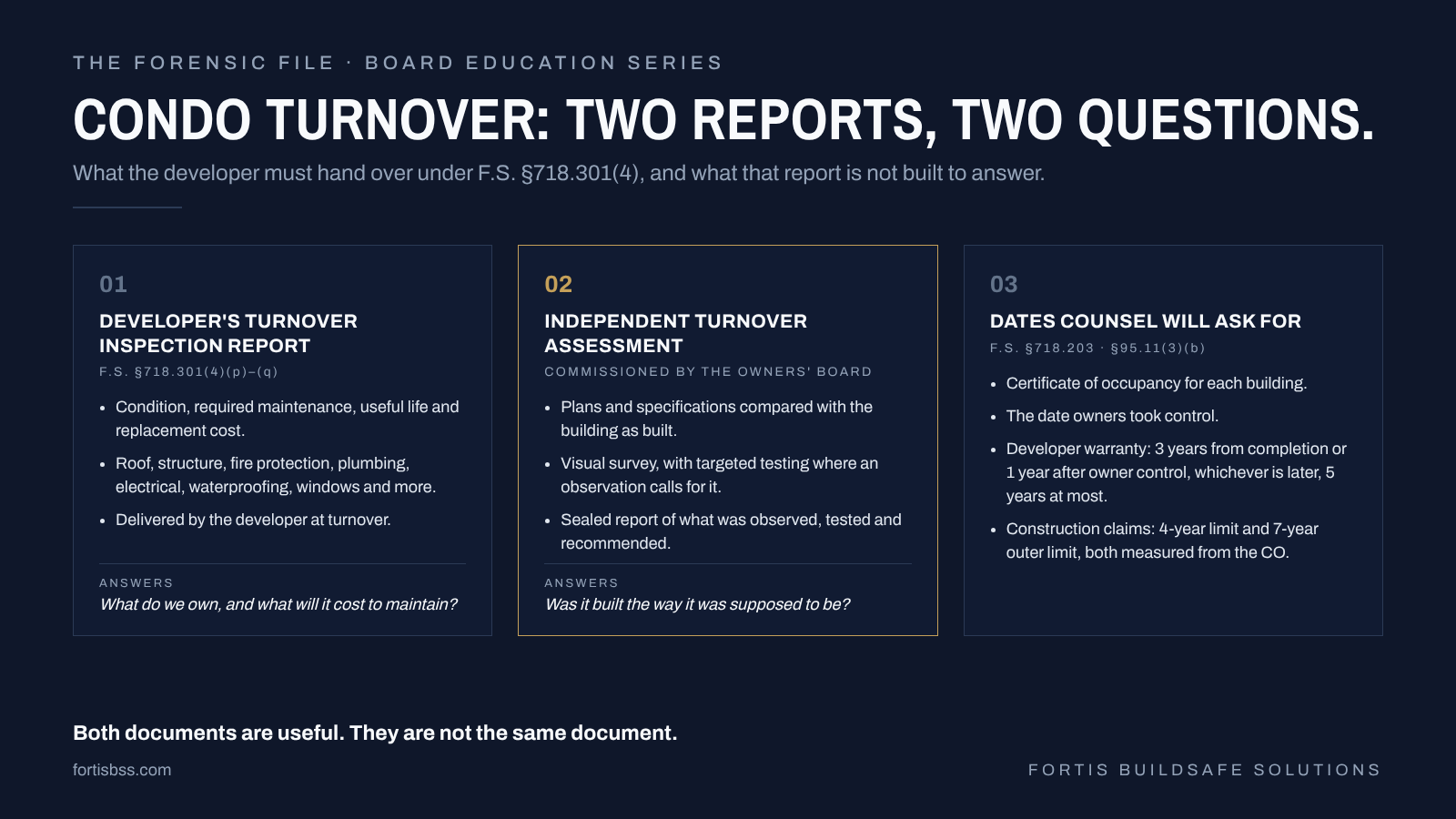
Direct answer: When owners take control of a Florida condominium association, the developer must deliver a turnover inspection report covering the condition, required maintenance, useful life and replacement cost of the roof, structure, fire protection, plumbing, electrical, waterproofing and other major systems. It is a maintenance and reserve document, not a forensic investigation of whether the building was built to its plans.
Turnover is the first time the owners, not the developer, are responsible for the building. The board inherits whatever condition it is in, along with a stack of documents and some legal dates that are already running. This post explains what the law requires the developer to hand over, what the turnover inspection report does and does not tell you, and where an independent engineering look fits.
It is general information about Florida condominiums, not legal advice. The timing questions below belong with association counsel.
When does turnover happen?
Under F.S. §718.301(1), owners other than the developer are entitled to elect a majority of the board at the first of several events, including:
- three years after 50 percent of the units have been conveyed to purchasers;
- three months after 90 percent of the units have been conveyed;
- when all units are completed, some have been conveyed, and none of the others are being offered for sale by the developer in the ordinary course of business;
- when some units have been conveyed and none of the others are being constructed or offered for sale by the developer in the ordinary course of business;
- when the developer files a petition seeking protection in bankruptcy;
- when a receiver for the developer is appointed and not discharged within 30 days, unless the court determines within that time that transfer of control would be detrimental to the association or its members;
- seven years after the recording of the surveyor's certificate, or of the first unit deed not accompanied by a recorded assignment of developer rights, whichever occurs first.
At that point, §718.301(4) says the developer "shall relinquish control of the association, and the unit owners shall accept control," and must deliver a long list of records and property at the same time. The one exception is the audited financial records (paragraph (c)), which may follow within 90 days.
What must the turnover inspection report cover?
Two paragraphs of §718.301(4) set out the report. Both apply "notwithstanding when the certificate of occupancy was issued or the height of the building," and both must be "included in the official records."
Paragraph (p) requires a report "consisting of a structural integrity reserve study" that attests to "required maintenance, condition, useful life, and replacement costs" of:
- roof;
- structure, including load-bearing walls and primary structural members and systems;
- fireproofing and fire protection systems;
- plumbing;
- electrical systems;
- waterproofing and exterior painting;
- windows and exterior doors.
Paragraph (q) requires the same attestation for:
- elevators;
- heating and cooling systems;
- swimming pool or spa and equipment;
- seawalls;
- pavement and parking areas;
- drainage systems;
- irrigation systems.
The terms used for the structure are cross-referenced to the definitions in §627.706. Paragraph (q) carries the same attestation but is not itself described as a structural integrity reserve study.
The report must be under the seal of a Florida-licensed architect or engineer, or come from a person certified as a reserve specialist or professional reserve analyst by the Community Associations Institute or the Association of Professional Reserve Analysts.
Separately, §718.112(2)(g) states that before the developer turns over control, it "must have a turnover inspection report in compliance with s. 718.301(4)(p) and (q) for each building on the condominium property that is three stories or higher in height." Read side by side, the two provisions are not perfectly aligned on which buildings need a report: paragraphs (p) and (q) apply regardless of height, while §718.112(2)(g) refers to buildings of three stories or more. How that applies to a particular property is a question for association counsel. The developer must also deliver "a copy of the association's most recent structural integrity reserve study" (§718.301(4)(s)). See Milestone Inspections vs. SIRS in Florida.
What does the turnover inspection report not tell you?
Read the statute's words closely. The report attests to maintenance, condition, useful life and replacement cost. That is the information a board needs to budget and fund reserves.
The statute does not require the report to compare the building to its approved plans, to give an opinion on code compliance, or to carry out a forensic investigation of construction defects. A preparer documenting "condition" may well record defects they observe, but finding them is not what the report is built to do. It is also commissioned by the developer, before the owners are in control. None of that makes it unreliable. It means it answers a different question from the one many incoming boards are actually asking, which is: was this building built the way it was supposed to be?
That second question is the purpose of an independent turnover assessment, commissioned by the owner-controlled board.
What else does the developer hand over that an engineer will want?
Two items on the §718.301(4) list matter most to an engineer reviewing a newly turned-over building:
- Plans and specifications. Paragraph (f) requires "a copy of the plans and specifications utilized in the construction or remodeling" of the improvements and their mechanical components. It must come with a certificate in affidavit form, from the developer, the developer's agent, or a Florida-licensed architect or engineer, that they represent "to the best of his or her knowledge and belief, the actual plans and specifications utilized." The requirement does not apply where the property was declared a condominium more than three years after construction or remodeling was completed.
- The most recent structural integrity reserve study (paragraph (s)).
Without the plans, an engineer can describe what a building is doing but cannot easily say whether it matches what was designed. If the plans have not arrived, that is the first thing to raise with association counsel.
Which legal dates should a new board know about?
Several legal dates bear on a newly turned-over building. Most of them do not run from turnover at all; they run from the certificate of occupancy. These are legal matters, and how they apply to a specific building is a question for association counsel. Boards should know they exist:
- Statutory warranties. Under §718.203(1)(e), the developer's implied warranty on the roof and structural components of a building, and on its mechanical, electrical and plumbing elements, runs for three years from completion of construction or one year after owners other than the developer obtain control of the association, whichever occurs last, "but in no event more than 5 years." Under §718.203(2)(a), contractors, subcontractors and suppliers warrant the roof and structural components, and the mechanical and plumbing elements serving the building (except mechanical elements serving only one unit), for three years from completion of construction. For these warranties, §718.203(3) treats completion as the issuance of a certificate of occupancy, temporary or otherwise, for the entire building (or, where no certificate of occupancy is issued, substantial completion).
- Claim deadlines. Actions founded on the design, planning or construction of an improvement to real property fall under §95.11(3)(b), a four-year limitation period. Time runs from the earliest of the temporary certificate of occupancy, certificate of occupancy or certificate of completion (or abandonment of construction), with a latent-defect discovery rule, and the statute states that "in any event, the action must be commenced within 7 years" of that date. Neither period runs from turnover.
- Pre-suit notice. Separately, Chapter 558 makes written notice a condition of filing a construction defect action: for an association representing more than 20 parcels, at least 120 days before filing (§558.004(1)(a)).
Because the certificate of occupancy usually comes before turnover, some of that time may already have passed when owners take control. That is the practical reason to document the building's condition early.
What does an independent turnover assessment typically look at?
Scope is set building by building, by the engineer, with the board and its counsel. A typical independent assessment of a newly turned-over condominium includes:
- Document review. Plans and specifications, permit and inspection records, the developer's turnover inspection report and SIRS, and warranty documents.
- A visual survey of the building as built, compared against the plans: building envelope, roofing, balconies and railings, parking structure, waterproofing, windows and doors, and visible structural, mechanical, electrical and plumbing elements.
- Targeted testing where an observation calls for it, for example where water intrusion or a concealed condition is suspected. Testing is chosen to answer a specific question, not by default.
- A documented report, sealed by a Florida PE, that records what was observed, what was tested, and what the engineer recommends.
Does this apply to homeowners' associations?
Not in the same way. Florida's homeowners' association transition statute, §720.307(4), lists the records the developer must deliver at turnover (deeds, governing documents, financial records, contracts, insurance policies, warranties and more), but it does not include a turnover inspection report or a reserve study. An HOA board that wants an engineering baseline of its common areas would commission one itself.
What should a new condominium board do in its first months?
- Confirm the turnover inspection report and SIRS were delivered and are in the official records.
- Confirm the plans and specifications were delivered, with the required certification.
- Write down the dates: the certificate of occupancy (temporary and final) for each building, and the date owners took control. Counsel will want both.
- Engage association counsel on warranty and claim timing.
- Decide whether to commission an independent assessment, and if so, scope it with your engineer and counsel together.
The bottom line
The developer's turnover inspection report tells a new board what it owns and what it will cost to maintain. An independent assessment answers whether it was built the way it was supposed to be. Both are useful, and they are not the same document.
If your association is approaching turnover, or recently completed it, Fortis BuildSafe Solutions is a forensic engineering firm that provides turnover services for South Florida associations. Your assessment will be performed and sealed by a Fortis PE working to the Fortis Standard. Contact Fortis.
This post is general information about Florida law as of the date above. It is not legal advice. Whether and how these provisions apply to a specific association is a question for association counsel.
Sources
- Florida Statutes §718.301, Transfer of association control; claims of defect by association (2026 Florida Statutes; history through s. 13, ch. 2025-175). http://www.leg.state.fl.us/statutes/index.cfm?App_mode=Display_Statute&URL=0700-0799/0718/Sections/0718.301.html (accessed October 4, 2026)
- Florida Statutes §718.112(2)(g), Structural integrity reserve study (2026 Florida Statutes; history through s. 43, ch. 2026-14). http://www.leg.state.fl.us/statutes/index.cfm?App_mode=Display_Statute&URL=0700-0799/0718/Sections/0718.112.html (accessed October 4, 2026)
- Florida Statutes §718.203, Warranties (2026 Florida Statutes; history through s. 12, ch. 2025-175). http://www.leg.state.fl.us/statutes/index.cfm?App_mode=Display_Statute&URL=0700-0799/0718/Sections/0718.203.html (accessed October 4, 2026)
- Florida Statutes §95.11, Limitations other than for the recovery of real property (2026 Florida Statutes; history through s. 41, ch. 2025-153). http://www.leg.state.fl.us/statutes/index.cfm?App_mode=Display_Statute&URL=0000-0099/0095/Sections/0095.11.html (accessed October 4, 2026)
- Florida Statutes §558.004, Notice and opportunity to repair (2026 Florida Statutes; history through s. 8, ch. 2019-75). http://www.leg.state.fl.us/statutes/index.cfm?App_mode=Display_Statute&URL=0500-0599/0558/Sections/0558.004.html (accessed October 4, 2026)
- Florida Statutes §720.307, Transition of association control in a community (2026 Florida Statutes; history through s. 23, ch. 2021-99). http://www.leg.state.fl.us/statutes/index.cfm?App_mode=Display_Statute&URL=0700-0799/0720/Sections/0720.307.html (accessed October 4, 2026)
- Florida Statutes §627.706, Sinkhole insurance; catastrophic ground cover collapse; definitions (2026 Florida Statutes; history through s. 29, ch. 2014-123), cited for the definitions of "primary structural member" and "primary structural system." http://www.leg.state.fl.us/statutes/index.cfm?App_mode=Display_Statute&URL=0600-0699/0627/Sections/0627.706.html (accessed October 4, 2026)
KEEP THE FACTS CURRENT.
Florida's building-safety requirements change by county and by year. The Fortis Brief is a short note from Fortis BuildSafe Solutions, a few times a quarter, on what the rules say now and what a board should do about them.
The Board President's Guide to Florida's Building Safety Laws
A plain-language walkthrough of milestone inspections, SIRS, county recertification, and your board's personal exposure — what triggers each requirement and what your board must do next.
Record Appendix
Sources
Sources
- http://www.leg.state.fl.us/statutes/index.cfm?App_mode=Display_Statute&URL=0700-0799/0718/Sections/0718.301.html
- http://www.leg.state.fl.us/statutes/index.cfm?App_mode=Display_Statute&URL=0700-0799/0718/Sections/0718.112.html
- http://www.leg.state.fl.us/statutes/index.cfm?App_mode=Display_Statute&URL=0700-0799/0718/Sections/0718.203.html
- http://www.leg.state.fl.us/statutes/index.cfm?App_mode=Display_Statute&URL=0000-0099/0095/Sections/0095.11.html
- http://www.leg.state.fl.us/statutes/index.cfm?App_mode=Display_Statute&URL=0500-0599/0558/Sections/0558.004.html
- http://www.leg.state.fl.us/statutes/index.cfm?App_mode=Display_Statute&URL=0700-0799/0720/Sections/0720.307.html
- http://www.leg.state.fl.us/statutes/index.cfm?App_mode=Display_Statute&URL=0600-0699/0627/Sections/0627.706.html
- Florida Statute §718.301(4)(p)–(q)
- Florida Statute §718.112(2)(g)
Related record
Continue Reading
Why does Florida inspect older condominiums at all? A short history of the rules your board lives under
October 17, 2026


How much does a milestone inspection cost in Florida, and what drives the price?
October 16, 2026
Broward or Miami-Dade: which recertification clock is your building on?
October 10, 2026
Related Services
Reader questions
Have a question about this?
Every inquiry is reviewed by a Fortis engineer.