
In This Record
- 01Does Florida law require an inspection after a hurricane?
Not under the milestone statute.
- 02What powers does a condo board have after a declared emergency?
Section 718.1265, Florida Statutes, gives a condominium board a set of emergency powers.
- 03Which changes after a storm are worth an engineer's attention?
A board does not need to diagnose anything.
- 04What should a board record before repairs begin?
A record made before repairs is useful later to the engineer, the insurer and the owners.
When does a Florida condo need a structural assessment after a hurricane?
Published: September 24, 2026 · Last reviewed: September 24, 2026
Reviewed by Gabor I. Nagy, PE — Founder
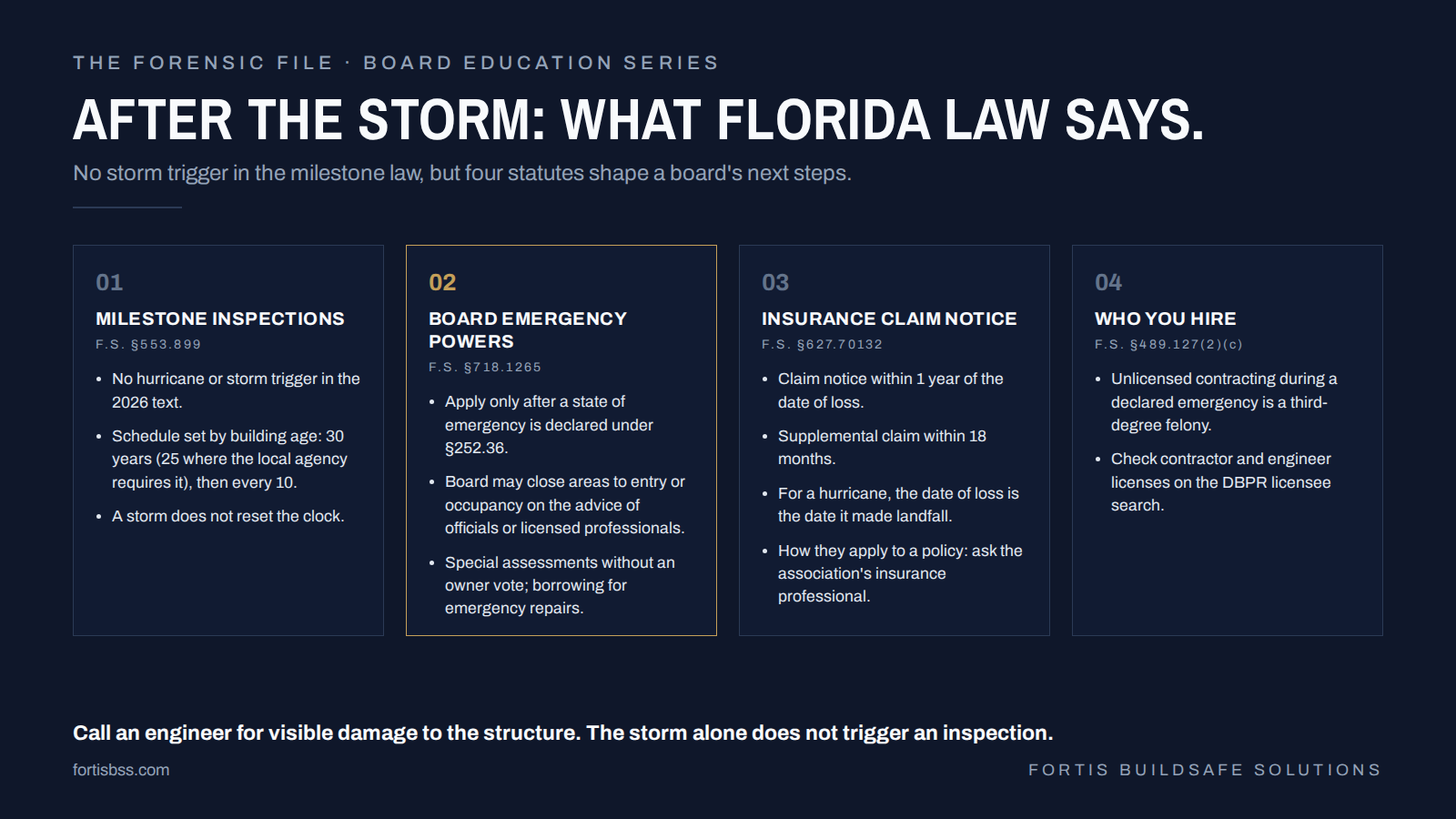
Direct answer: Florida's milestone inspection law does not require a structural assessment after a hurricane, and a storm does not reset the milestone schedule. A board has good reason to call a licensed engineer when a storm visibly damages the facade, balconies, roof or parapets, or when the board must decide whether part of the property is safe to occupy.
This post covers what Florida's milestone statute does and does not require after a storm, the emergency powers a condominium board gains when a state of emergency is declared, which changes are worth an engineer's attention, and what to record before repairs begin. It is general information, not an assessment of any building and not legal or insurance advice.
Does Florida law require an inspection after a hurricane?
Not under the milestone statute. Section 553.899, Florida Statutes, applies to residential condominium and cooperative buildings three habitable stories or more in height. It sets its schedule by building age: an initial milestone inspection by December 31 of the year the building reaches 30 years of age, based on the date its certificate of occupancy was issued, then every 10 years. Under §553.899(3)(b), the local enforcement agency may require the initial inspection at 25 years where it determines that local circumstances, including proximity to salt water, call for it. The 2026 text of the statute contains no language that makes a hurricane, windstorm or declared emergency a trigger for a milestone inspection, and none that shortens the 10-year cycle.
What a storm can do is bring a building to the attention of a local building official. Miami-Dade County, for example, states that unsafe conditions "may result from poor maintenance, natural disasters, fire, deterioration or unpermitted work," and that structures may be flagged "by County inspectors, municipal building officials, or through complaints from the public." That is separate from the milestone schedule, and it depends on the conditions at the building.
In Broward and Miami-Dade, the county recertification program is how the milestone requirement is administered and satisfied. (See Milestone inspection vs. building recertification.)
What powers does a condo board have after a declared emergency?
Section 718.1265, Florida Statutes, gives a condominium board a set of emergency powers. They apply only in response to damage caused by, or anticipated from, an emergency "for which a state of emergency is declared pursuant to s. 252.36 in the locale in which the condominium is located," and only to the extent the declaration, articles and bylaws do not specifically prohibit them. The powers most relevant to a building's condition are these:
- Deciding who can enter or occupy part of the property. Under §718.1265(1)(g) and (1)(i), the board may, "based upon advice of emergency management officials or public health officials, or upon the advice of licensed professionals retained by or otherwise available to the board," determine that a portion of the property is unavailable for entry or occupancy, and determine whether the property or any portion of it "can be safely inhabited, accessed, or occupied." The statute adds that this determination "is not conclusive as to any determination of habitability pursuant to the declaration."
- Mitigating further damage. Under §718.1265(1)(j), the board may contract for debris removal and take steps to prevent the spread of fungus, including mold or mildew, such as removing wet drywall, insulation, carpet and cabinetry, even where a unit owner would otherwise be responsible for those items.
- Contracting on owners' behalf. Under §718.1265(1)(k), the board may contract for items or services owners are individually responsible for, such as drying units or boarding broken windows, when necessary to prevent further damage. Owners reimburse the actual cost, and the association may use its lien authority to collect.
- Funding emergency repairs. Under §718.1265(1)(l), the board may levy special assessments without a vote of the owners. Under §718.1265(1)(m), when operating funds are insufficient, it may borrow money and pledge association assets as collateral to fund emergency repairs.
Two limits apply. Subsection (2) confines these powers to the time "reasonably necessary" to protect health, safety and welfare, mitigate further damage and make emergency repairs. Subsection (3) says that during a state of emergency declared by the Governor, an association may not prohibit owners and their tenants, guests, agents or invitees from accessing a unit for a sale, lease or other transfer, or for the habitability of the unit or the health and safety of the person, unless a governmental order or determination, or a public health directive from the Centers for Disease Control and Prevention, prohibits that access. That access remains subject to reasonable restrictions adopted by the association.
This is where an engineer's advice fits. The statute lets a board act on the advice of licensed professionals; an engineer's written assessment of the affected area is a record of the professional advice the board relied on.
Which changes after a storm are worth an engineer's attention?
A board does not need to diagnose anything. Its job is to notice change and report it. The list below is Fortis BuildSafe Solutions' own post-storm priority list, not a regulatory checklist:
- Facade and cladding: pieces missing, loosened, bulging or displaced; new cracks.
- Balconies: railings that are loose, bent or pulled away; new cracking at slab edges.
- Roof structure and parapets: damage visible from the ground or from roof access; displaced parapet sections or rooftop equipment.
- Seawalls, where the association is responsible for one: visible new damage. (See Does your South Florida condo's seawall need an inspection?)
- New water entry: water coming through walls, slabs or the roof where it did not before the storm.
- Areas under repair: any area where restoration work was underway when the storm arrived.
What these observations mean for a particular building is a judgment for the engineer. Photograph them; do not try to interpret them.
What should a board record before repairs begin?
A record made before repairs is useful later to the engineer, the insurer and the owners. It should not delay urgent steps to prevent further damage. Where it is safe to do so:
- Photograph conditions first. Follow the instructions of emergency management and building officials. Where a balcony, walkway or other area shows cracking, displacement or other damage that looks unsafe, keep people out of it until it has been assessed.
- Record dates. Note when each photo was taken and when each condition was first observed.
- Keep the paperwork. File the invoices and contracts for emergency work, such as drying, boarding and debris removal, in the association's records.
Florida law also sets notice deadlines for property insurance claims. Under §627.70132(2), Florida Statutes, a claim is barred unless notice was given to the insurer "within 1 year after the date of loss," and a supplemental claim unless notice was given "within 18 months after the date of loss." Under §627.70132(3), for claims resulting from hurricanes, "the date of loss is the date that the hurricane made landfall." For loss assessment coverage under §627.714, §627.70132(4) says notice "may not occur later than 3 years after the date of loss" and must be provided by the later of one year after the date of loss or 90 days after the association's board votes to levy an assessment resulting from a covered loss. How these provisions apply to a particular policy or claim is a question for the association's licensed insurance professional and legal counsel.
How does a board check the people it hires after a storm?
Under §489.127(2)(c), Florida Statutes, an unlicensed person who violates the contractor licensing prohibitions in §489.127(1) during a state of emergency declared by executive order of the Governor commits a third-degree felony. Before signing, confirm that each contractor's license, and the engineer's, is current on the Department of Business and Professional Regulation's public licensee search. A current license does not by itself confirm insurance, scope or suitability; ask for those separately.
It also helps to keep two roles distinct. An engineer assesses and documents condition and, if engaged to do so, prepares the repair documents. A licensed contractor performs the repair. Fortis does not perform physical repairs. (See Building Restoration Engineering & Oversight.)
Does storm damage change a building's milestone inspection?
A storm does not change the statutory milestone schedule. It can change the condition the next inspection finds, and it can bring its own repair and permit work. The next milestone inspection, or county recertification in Broward and Miami-Dade, evaluates the building as it stands at that time. Storm damage repaired under permit, with the engineering documentation kept on file, gives the inspecting engineer a dated record of what happened and what was done. Without that record, a later inspection has less to go on when separating storm-related damage from long-term deterioration. (See Milestone inspections.)
How does Fortis approach a post-storm assessment?
Fortis's written post-storm protocol starts outside. Before entering the building, the field team walks the exterior and checks overhead for loose facade elements, damaged parapets and hanging equipment. Findings are photographed in pairs, one wide for context and one close for detail, and the team narrates as it goes. An observation that may affect life safety is phoned to the reviewing PE from the site, the same day; the technical assessment of that condition is the PE's call.
Where to go from here
If a storm has left your board with questions about a specific condition, Fortis can schedule a Fortis PE and Inspector to look at it. Your assessment will be performed and sealed by a Fortis PE working to the Fortis Standard. Contact Fortis.
Sources
- Florida Statutes §553.899, Milestone inspections (2026 edition) — http://www.leg.state.fl.us/statutes/index.cfm?App_mode=Display_Statute&URL=0500-0599/0553/Sections/0553.899.html (accessed September 24, 2026).
- Florida Statutes §718.1265, Association emergency powers (2026 edition) — http://www.leg.state.fl.us/statutes/index.cfm?App_mode=Display_Statute&URL=0700-0799/0718/Sections/0718.1265.html (accessed September 24, 2026).
- Florida Statutes §627.70132, Notice of property insurance claim (2026 edition) — http://www.leg.state.fl.us/statutes/index.cfm?App_mode=Display_Statute&URL=0600-0699/0627/Sections/0627.70132.html (accessed September 24, 2026).
- Florida Statutes §489.127, Prohibitions; penalties (2026 edition) — http://www.leg.state.fl.us/statutes/index.cfm?App_mode=Display_Statute&URL=0400-0499/0489/Sections/0489.127.html (accessed September 24, 2026).
- Miami-Dade County, Unsafe Structures — https://www.miamidade.gov/global/economy/neighborhood-compliance/unsafe-structures.page (accessed September 24, 2026).
- Florida Department of Business and Professional Regulation, licensee search — https://www.myfloridalicense.com/wl11.asp (accessed September 24, 2026).
KEEP THE FACTS CURRENT.
Florida's building-safety requirements change by county and by year. The Fortis Brief is a short note from Fortis BuildSafe Solutions, a few times a quarter, on what the rules say now and what a board should do about them.
The Board President's Guide to Florida's Building Safety Laws
A plain-language walkthrough of milestone inspections, SIRS, county recertification, and your board's personal exposure — what triggers each requirement and what your board must do next.
Record Appendix
Sources
Sources
- http://www.leg.state.fl.us/statutes/index.cfm?App_mode=Display_Statute&URL=0500-0599/0553/Sections/0553.899.html
- http://www.leg.state.fl.us/statutes/index.cfm?App_mode=Display_Statute&URL=0700-0799/0718/Sections/0718.1265.html
- http://www.leg.state.fl.us/statutes/index.cfm?App_mode=Display_Statute&URL=0600-0699/0627/Sections/0627.70132.html
- http://www.leg.state.fl.us/statutes/index.cfm?App_mode=Display_Statute&URL=0400-0499/0489/Sections/0489.127.html
- https://www.miamidade.gov/global/economy/neighborhood-compliance/unsafe-structures.page
- Florida Statute §553.899
Related record
Continue Reading
Why does Florida inspect older condominiums at all? A short history of the rules your board lives under
October 17, 2026


How much does a milestone inspection cost in Florida, and what drives the price?
October 16, 2026
Broward or Miami-Dade: which recertification clock is your building on?
October 10, 2026
Related Services
Reader questions
Have a question about this?
Every inquiry is reviewed by a Fortis engineer.